Surname
Buchanan surname
Buchanan is a territorial surname, taken from the lands and parish of Buchanan in Stirlingshire on the east shore of Loch Lomond.
- Places
- Stirlingshire, Loch Lomond, Parish of Buchanan
- Linked clan
- Clan Buchanan
- Linked tartan
- Buchanan
- Evidence claims
- 28
- Sources
- 25
- Entry status
- Partial
Origin of the name
Buchanan is a territorial surname, taken from the lands and parish of Buchanan in Stirlingshire on the east shore of Loch Lomond.
The Clan Buchanan Society calls it territorial, and one of its history pages says it was "taken from the land and adopted by Gilbert 'Buchanan' around 1231". Before that, the family's recorded name was a patronymic, MacAuselan or MacAslan, "son of Anselan". The place name itself is not settled. Two Gaelic forms are proposed, Mac a Chanonaich, "son of the canon", and Buth Chanain, "house of the canon", and the society's history reads the second as an early link with the Celtic church. A surname history page offers a different reading, a diminutive of a cattle-growing district, and a commercial name-statistics site gives "dweller at the house of the canon". Those are web summaries, and none of them was checked here against a place-name authority, so the meaning of the first element remains open. The earliest records are land charters, and they do not all agree in detail. The surname history page quotes a charter by Malcolm, Earl of Lennox, of about 1224 that a Dominus Absolone de Buckkan witnessed. The society says Maldouen, third Earl of Lennox, granted the island of Clairinch in 1225 to Absalon, also called Anselan, son of Macbethad, for a pound of wax a year, and that Alexander II confirmed Clairinch and other Buchanan lands to Gilbert on 6 September 1231, with fishing rights in Loch Lomond. Gilbert is the first bearer the society treats as taking Buchanan as a surname, and it records Sir Maurice de Buchanan receiving the lands of Buchanan with powers of judgement in 1282. Spellings in the following centuries vary widely: Buchquhannan 1526, Boquhannan 1536, Balquhannan 1566 and Buchunnuch 1662 are among those quoted, and the society lists Balgquhannen and Baquhannan as early forms, with Buckanon, Buchannon and Bocanan as later ones. The older family story is a different matter. William Buchanan of Auchmar, whose history of the surname appeared in the 1720s, said the founder was Anselan O'Kyan, of Irish royal race, who came to Scotland about 1016 and was rewarded by Malcolm II for help against the Danes. Wikipedia's clan article calls this little more than an origin myth because it is inconsistent with other accounts. The society now says the same, citing Y-DNA: its origins page states that Buchanans and their MacAuslan relatives share no ancestry with the O'Kanes of Ulster more recently than a Bronze Age ancestor, and that their closest male-line cousins are the chiefly line of the MacGregors. That is a society reading of its own project, with no published paper cited, and the same page says further testing is needed to place the line. The name therefore cannot be traced to an Irish origin on current evidence, and it cannot be given a confirmed alternative either. Because the name comes from a place, anyone living on or near those lands could take it, and anyone in later centuries could inherit it through a male line with no connection to the chiefs. The Standing Council of Scottish Chiefs treats everyone with the chief's surname as presumptively a clan member, but that is a presumption the chief may decline. The society's own Y-DNA project reports a participant in haplogroup I1a whose matches point to Scandinavian descent, which shows the surname already covers more than one male line. A Buchanan in Ulster or America has a surname that points at Stirlingshire and no further until a paper trail says otherwise.
Places associated with the name
- Stirlingshire
- Loch Lomond
- Parish of Buchanan
Clan
A surname and a clan can share a name without every bearer of the name belonging to the clan. This is the link the sources support.
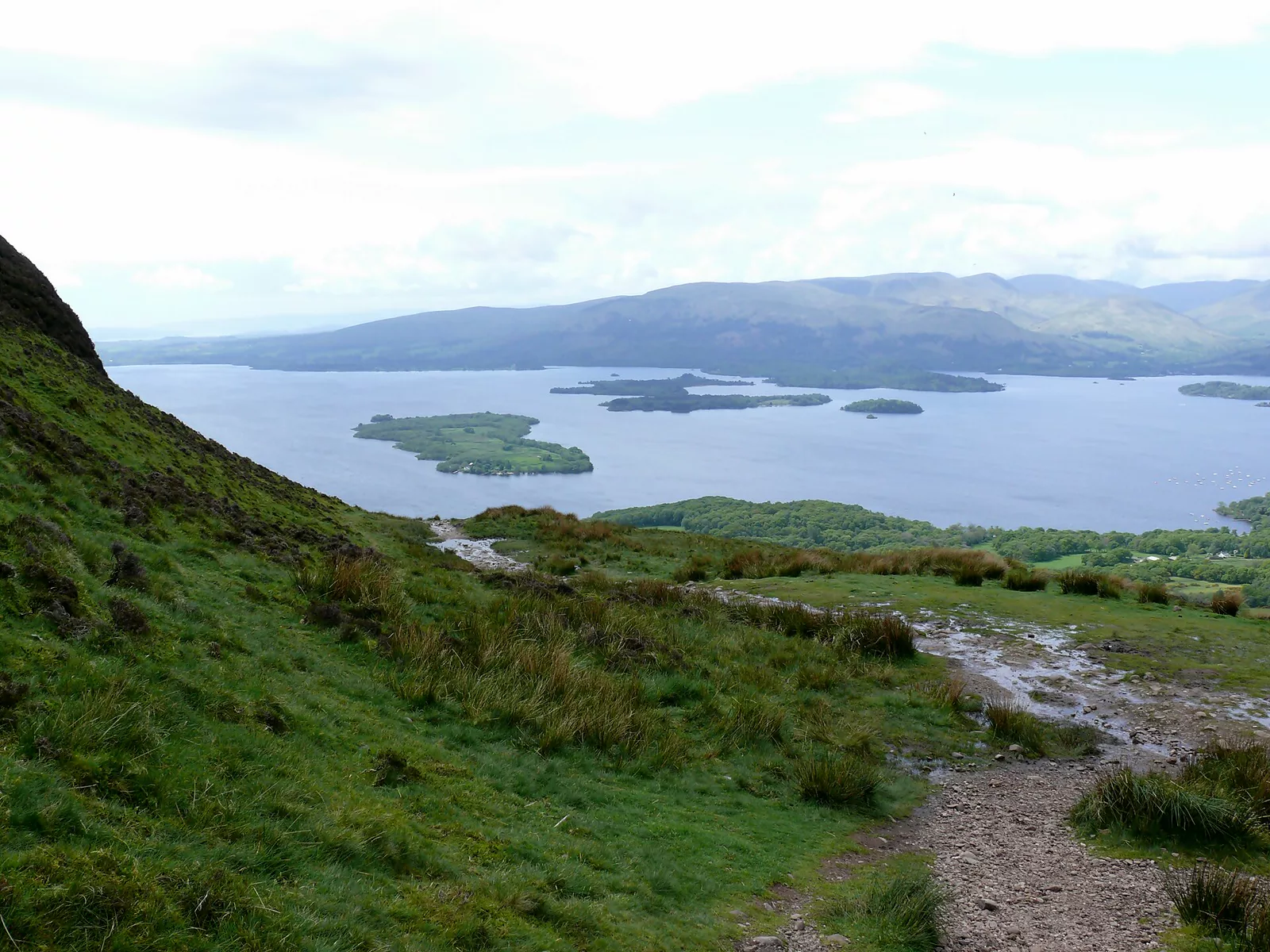
Loch Lomond from Conic Hill near Balmaha on the east shore, the loch where the Buchanans' documented holding of Clairinch lies. The photo does not show Clairinch or the clan.Photo: Ad Meskens, CC BY-SA 3.0 (source) Linked clan · Stirlingshire, Loch Lomond, Parish of Buchanan
Clan Buchanan
Probable Supported by a credible source, not independently confirmed.
The clan takes its name from the same lands, so the link is of the surname to the place and to the family that held it. The clan society's sept table lists more than 50 other surnames, including the MacAslan group, but that list is the chief's choice and not a register of descent. The chiefly line itself is narrower than the surname: the society says the direct line ended in 1682 on the death of Sir John Buchanan without a male heir, and that the Lord Lyon confirmed John Michael Baillie-Hamilton Buchanan in August 2018 as senior representative of the Buchanan of Leny cadet branch, after a petition lodged in December 2016. It says the court treated Auchmar and Spittal as extinct in law and in fact, and excluded the Carbeth, Gartincaber and Drummakill lines because fifteenth-century documents linking them to the chiefs were shown to be forgeries. I read that summary on the society's page and could not extract the text of the court's decision, so the reasoning is the society's account. Of the lines the society names, only the surname Buchanan carries a presumption of membership; the MacAslan group is accepted at the chief's discretion. The confidence is probable and not verified because nothing in a surname alone shows descent from any of the chiefly branches.

Tartan
Tartans linked to the name, each with the strength of the link. The link is to the name's history, not to any individual's family.
Clan tartan
Buchanan
Probable Supported by a credible source, not independently confirmed.
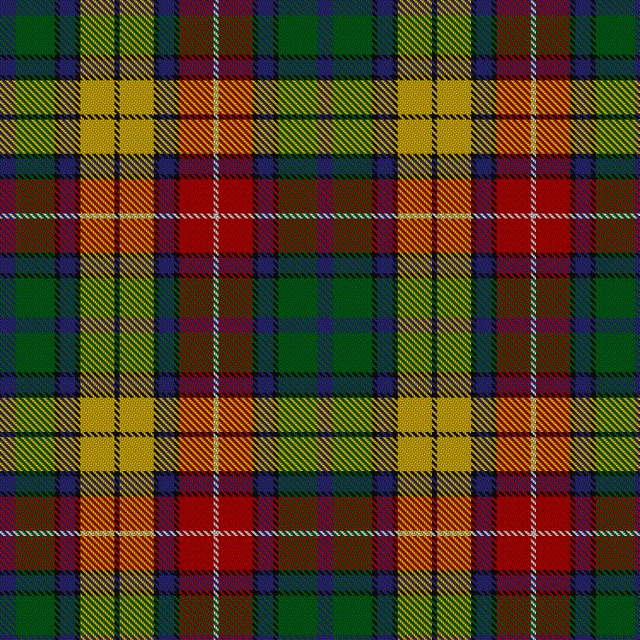
The Scottish Register of Tartans treats Buchanan - 1850 as the clan tartan, from Wilsons of Bannockburn, and records that the chief authorised it in 2022. A separate Buchanan - 1842 entry comes from the Vestiarium Scoticum, and the chief recognised that sett in 2022 as well. Both tartans date from the nineteenth century, long after the 1225 and 1231 charters, so the surname-to-tartan link rests on the clan society's and the chief's recognition, not on any medieval Buchanan pattern. Neither the register nor the society sets a rule that wearing it requires the surname, and the surname does not by itself show a family belongs to the clan.
Image: Scottish Register of Tartans, rendered from the registered threadcount. Crown copyright, National Records of Scotland.
From the evidence
Where the sources disagree
Sentences from the evidence below in which the record says its sources do not agree. Each is quoted as written; follow the claim number for the context.
The two versions on that page differ on the early record, so the page is useful for what each tradition claims, not for which is right.
It adds that scholars disagree whether L1065 represents Dalriada, the Britons of Strathclyde or a Pictish lineage, and that more testing is needed.
The Donegal and Tyrone accounts conflict, and none of these sources documents a line back to the Stirlingshire lairds.
Evidence
28 claims, numbered in the order the record lists them. Consecutive claims that cite the same source are set together under that source. Each claim carries its own evidence level.
- APrimary or official2 claims
- BInstitutional1 claim
- CSpecialist secondary16 claims
- DCommercial9 claims
Claims 1 to 4
- DCommercial
- DCommercial
Wikipedia's article on the clan gives two Gaelic sources suggested for the place name, Mac a Chanonaich, "son of the canon", and Buth Chanain, "house of the canon", and says the surname form MacAuselan, son of Anselan, was borne by early chiefs.
Evidence level D. Sources: [12]
- CSpecialist secondary
The Clan Buchanan Society describes Buchanan as a territorial name and says the MacAslan group of surnames, including Cousland, is synonymous with it. It says the early chiefs' claimed descent from Anselan O Kyan, an Irish prince, has been disproved by YDNA, so the origin may be unknown.
Evidence level C. Sources: [6]
- CSpecialist secondary
The society says Maldouen, Earl of Lennox, granted the island of Clairinch in 1225 to Absalon, also called Anselan, which is the first documented Buchanan possession it names.
Evidence level C. Sources: [13]
Claims 5 to 8
- BInstitutional
The Standing Council of Scottish Chiefs says everyone who shares the chief's surname is deemed a clan member, but that this is a presumption and the chief may refuse a claim.
Evidence level B. Sources: [3]
- CSpecialist secondary
The Clan Buchanan Society's history page says the name derives from Mac a Chanonaich, "son of the canon", or Buth Chanain, "house or seat of the canon", and says Maldonus, third Mormaer of Lennox, granted "the island of Clairinch to Anselan of Buchanan" in 1225. On the same page the grantee is Absalon, son of Macbethad, so the one man appears as Anselan, Absalon and Absalom.
Evidence level C. Sources: [14]
- DCommercial
A surname history page quotes a charter in which Dominus Absolone de Buckkan witnessed a grant by Malcolm, Earl of Lennox, to Sir Robert Herthford, precentor of Glasgow, dated "a.1224". If the quotation is accurate, an Absalon of Buchanan appears one year before the Clairinch grant, but the page names no archive reference and the original was not consulted.
Evidence level D. Sources: [10]
- CSpecialist secondary
The Clairinch page records Alexander II's confirmation on 6 September 1231, with fishing rights in Loch Lomond, and later charters in 1564 to Sir George Buchanan and under James VI to Sir John Buchanan. It says William George Buchanan bought the island back in 1934 and left it to the Buchanan Society in 1939 as a nature sanctuary.
Evidence level C. Sources: [13]
ScotlandsPeople gives these ranges: Old Parish Registers from 1553, statutory registers from 1 January 1855, census returns 1841 to 1921, valuation rolls from 1855 at mid-points between censuses to 1905 and every five years from 1915 to 1940, and wills and testaments 1513 to 1925.
Claims 9 to 12
- CSpecialist secondary
The society's history says Gilbert de Buchanan received confirmation of Clairinch and other Buchanan lands in 1231, and that Sir Maurice de Buchanan received the lands of Buchanan in 1282 with the right to hold courts of life and limb. A separate page on the MacAslan sept says the seventh laird, Gilbert, was the first to take the surname Buchanan, which is the point at which a patronymic became a territorial name.
- DCommercial
A genealogy page puts Gillebrid, the first of the line styled "de Buchanan", at about 1240 as seneschal to the Earl of Lennox, and says Allan, a younger son of Maurice, married the Leny heiress. It also says John Buchanan of Leny fell at Flodden in 1513. The page quotes no primary record for these statements, and its 1240 date is nine years after the 1231 charter naming Gilbert.
Evidence level D. Sources: [15]
- CSpecialist secondary
The society's MacAslan page lists variants of the old patronymic: Cousland, MacAuselan, McAuselan, Macauslane, McAslane, Macaslan, McAuslan, MacCasland, MacAslin, McAslin, MacAusland, McAusland and M'Auselan. A further 1923 entry on Anglicised Irish surnames gives McCaslan, McAuslin and McCasland as forms found in Ulster counties. Each of these is a separate surname today, and a record under one spelling does not show the family also used Buchanan.
- CSpecialist secondary
The society's names page gives early written forms of the place name as Balgquhannen, Balquhannan and Baquhannan, and later spellings as Buckanon, Buchannon, Bocanan and Buchanan. The surname history page dates some of them, Buchquhannan 1526, Boquhannan 1536, Balquhannan 1566 and Buchunnuch 1662. When a record is indexed under a spelling you did not expect, treat the form as scribal until the family or place is confirmed.
Claims 13 to 14
All cite The MacAslan sept [6]
- CSpecialist secondary
The society's MacAslan page says a Malcolm was the first MacAuselan, steward to Maldouen, third Earl of Lennox, "during the reign of David II (1124-1153)". Those dates belong to David I, and Maldouen's grant is dated 1225, so the page is internally inconsistent. This claim is not used for any date in the entry.
Evidence level C. Sources: [6]
- CSpecialist secondary
The society's pages count the lairds differently. The MacAslan and history pages place Gilbert or Anselan as the seventh laird, the chiefs page calls Sir John, who died in 1682, the nineteenth chief, the Clairinch page calls a Sir John the twentieth laird, and an Electric Scotland account of the society's version calls him the twenty-second. The ordinals were not used here, because they follow different counting rules.
Claims 15 to 18
- DCommercial
Wikipedia's clan article says clan tradition has Anselan O Kyan, of the Irish O Cathain, arriving in Argyll about 1016 and receiving Buchanan lands from Malcolm II for service against the Danes. It says these accounts are inconsistent with other records and are officially considered little more than an origin myth, and that Anselan received a charter for Clairinch during the Earl of Lennox's rule (1217 to 1250) and was later recorded as Absalom de Buchanan.
Evidence level D. Sources: [12]
- DCommercial
Electric Scotland reproduces the older family history, in which Anselan O'Kyan, "of royal race", came over about 1016. It also gives a society-approved version that dates the Absalon charter to around 1224 and names the cadet branches Leny, Auchmar, Spittal and Arnprior. The two versions on that page differ on the early record, so the page is useful for what each tradition claims, not for which is right.
Evidence level D. Sources: [17]
- CSpecialist secondary
The society's origins page says the Buchanan chiefly line is haplogroup R1b and that the core Buchanans share the SNP L1065, which it calls the Scots Modal line and which it says clusters with chiefly lines of the MacGregors, MacPhersons, MacLarens, MacRaes and Campbells. It says Buchanans and the closely related MacAuslands share no ancestry with the O'Kanes of Ulster more recently than a Bronze Age ancestor, and that their nearest cousins by male line are the documented chiefly lineage of the MacGregors. It adds that scholars disagree whether L1065 represents Dalriada, the Britons of Strathclyde or a Pictish lineage, and that more testing is needed. The history page dates a MacGregor common ancestor to about the year 400.
- CSpecialist secondary
The society's Y-DNA project page says most participants are haplogroup R1b, the group to which it says almost all Celtic people belong, and that one participant is I1a with matches strongly indicating Scandinavian descent. It welcomes variant spellings and affiliated names. The page gives no participant counts or genealogical paper trail, so it cannot be used to say what share of people named Buchanan are of any one male line.
Evidence level C. Sources: [19]
The Standing Council of Scottish Chiefs says everyone who shares the chief's surname is deemed a clan member, but that this is a presumption and the chief may refuse a claim.
Claims 19 to 22
- DCommercial
William Buchanan of Auchmar's history of the family and surname is dated 1723 by Wikipedia and one genealogy page, and 1728 with a 1775 reprint by a transcribed 1857 newspaper article, so the first printing date is uncertain from these sources. Wikipedia says he claimed the chiefship as head of the most recently separated cadet line and that his line ended when James Buchanan died without heirs in 1816. His book is the source of the Irish-prince story and a primary text on the family, though written by an interested party.
- CSpecialist secondary
The society's page on other claimants says four people were cited as chief without winning formal recognition: Major George Buchanan in 1679, William Buchanan of Auchmar in 1723, Francis Buchanan of Arnprior in 1746 and Dr Francis Buchanan-Hamilton in 1828. It says Walter Scott and other nineteenth-century writers named the Arnprior man as chief, though Auchmar himself did not, and that Buchanan-Hamilton removed his Buchanan surname from his amended claim.
Evidence level C. Sources: [21]
- CSpecialist secondary
The society says the direct chiefly line ended in 1682 when Sir John Buchanan died leaving no male heir, and that the court of the Lord Lyon recognised John Michael Baillie-Hamilton Buchanan in August 2018, after a petition filed in December 2016, as senior representative of Buchanan of Leny. The Lord Lyon's published Note and Decision on the chiefship of Name and Arms of Buchanan is dated 28 September 2018. The estate sale is placed in 1680, 1681 or 1682 on different society pages, and the loss of the lands is attributed to the extravagance of Sir John Buchanan.
- DCommercial
The 1881 UK census count for the surname is 7,755 people, ranking 550, and a modern figure is 11,136, ranking 576, according to a name-statistics site that says it draws on census and ONS, NRS and NISRA records. Its top 1881 counties are Lanarkshire with 2,391, Renfrewshire with 630 and Stirlingshire with 535, so the largest 1881 concentration was in the Glasgow area and not in the parish the name comes from. The site does not explain the pattern and its method is not shown.
Evidence level D. Sources: [22]
Claim 23
- DCommercial
A 1923 reference entry on Anglicised surnames in Ireland derives Buchanan from the Stirlingshire district, repeats the O'Kane derivation of the older clan name, and claims descent of President James Buchanan from the line of Gilbrid Mac Auslan. The derivation is the one the society now rejects, and the entry sets out no documentary chain for the president.
- CSpecialist secondary
James Buchanan wrote that his father was "a native of the County of Donegal", who sailed from Londonderry on the brig Providence for Philadelphia on 4 July 1783. Wikipedia places the father's birth at Ramelton, County Donegal in 1761, as the son of John Buchanan and Jane Russell. An 1857 newspaper article transcribed on a Tyrone genealogy site instead puts the president's grandfather at Tattyreagh, parish of Drumragh, County Tyrone. The Donegal and Tyrone accounts conflict, and none of these sources documents a line back to the Stirlingshire lairds.
- CSpecialist secondary
The Ulster-Scots Agency and Wikipedia describe President Buchanan's family as Ulster-Scots, or Scotch-Irish, with his father an Ulster-Scot from near Ramelton. That label places the family in Ulster by his father's birth in 1761 and says nothing about which Scottish line or place they came from.
Claims 26 to 27
All cite Family history guide [25]
- APrimary or official
ScotlandsPeople gives these ranges: Old Parish Registers from 1553, statutory registers from 1 January 1855, census returns 1841 to 1921, valuation rolls from 1855 at mid-points between censuses to 1905 and every five years from 1915 to 1940, and wills and testaments 1513 to 1925. A Scottish Buchanan line is usually followed back from the 1921 and 1911 censuses to 1841, then into the statutory births, marriages and deaths from 1855, and then the Old Parish Registers, where baptisms of Buchanan children may appear under the spellings listed above.
Evidence level A. Sources: [25]
- APrimary or official
Valuation rolls list the owners, tenants and occupiers of property, so a Buchanan tenant in the old parish of Buchanan can be looked for by name and farm between 1855 and 1940, and wills and testaments extend the search back to 1513. The sources checked here give date ranges only and do not say how many rolls survive for any one parish.
Evidence level A. Sources: [25]
Claim 28
- CSpecialist secondary
Surname alone does not establish clan membership, a chiefly connection, a tartan right or Irish or Scandinavian ancestry. The society's own sept table is the chief's choice, and its Y-DNA project includes more than one male line. For descent from a particular laird or cadet branch, the 2018 Lord Lyon finding as the society reports it turned on a documented pedigree, and it excluded lines whose linking documents were shown to be forgeries.
What this page does not say
Sources
- Our chief
- Names of the Clan Buchanan
- Who is a member of a Clan?
- The Family Tree of Clan Buchanan
- Chiefship of Name and Arms of Buchanan (Note and Decision)
- The MacAslan sept
- What are septs? (Clan Buchanan Society)
- Scottish Register of Tartans: Buchanan - 1850
- Scottish Register of Tartans: Buchanan - 1842
- Buchanan surname
- Clan articles (Mackenzie, Buchanan, Donald, Wallace, Campbell, Fraser of Lovat, Stewart, Gordon, Douglas)
- Clan Buchanan
- The Island of Clairinch
- History of The Clan Buchanan, part 1
- Highland Clans: Buchanan
- Some Anglicised Surnames in Ireland: Buchanan
- Clan Buchanan
- Origins of the Buchanans according to DNA
- Buchanan Y-DNA Project
- Buchanan: Cos. Tyrone, Donegal, Londonderry and Fermanagh
- Other people with some measure of recognition as chief
- Buchanan surname popularity
- Ulster and the White House
- James Buchanan Sr.
- Family history guide