Surname
Campbell surname
Also spelled Cambel, Cambell, Caimbeul
Campbell is the English spelling of the Gaelic Caimbeul.
- Places
- Argyll, Lochawe, Ayrshire, Perthshire, Northern Ireland
- Linked clan
- Clan Campbell
- Linked tartan
- Campbell
- Evidence claims
- 23
- Sources
- 24
- Entry status
- Partial
Origin of the name
Campbell is the English spelling of the Gaelic Caimbeul.
The usual reading is a nickname built from cam, crooked, and beul, mouth, so "twisted mouth" or "wry mouth". W. D. H. Sellar, in a 1973 paper in Scottish Studies, calls it "almost certainly" a nickname of that kind, and adds that the p does not appear until the later fifteenth century. The conference slides of Patrick Hanks and Matthew Hammond summarise G. F. Black's Surnames of Scotland (1946) as giving "wry or crooked mouth" and cite S. Boardman for the first appearance of the spelling Campbell in the 1450s. The earlier written forms are Cambel and similar. The Norman derivation from "de Campo Bello" is the older popular story and has no early support: Sellar says the Norman claim is "barely worth refuting" because the p was not added to the surname until the fifteenth century. Because the name began as a nickname given to one man in one family, and was later taken up by that family's followers, tenants and unrelated people, bearing it does not show descent from the chiefs. The sections below give the earliest records, the three origin stories and how scholars weigh them, why the cadet branches are separate lines, and what each kind of evidence can and cannot prove.
Places associated with the name
- Argyll
- Lochawe
- Ayrshire
- Perthshire
- Northern Ireland
Clan
A surname and a clan can share a name without every bearer of the name belonging to the clan. This is the link the sources support.
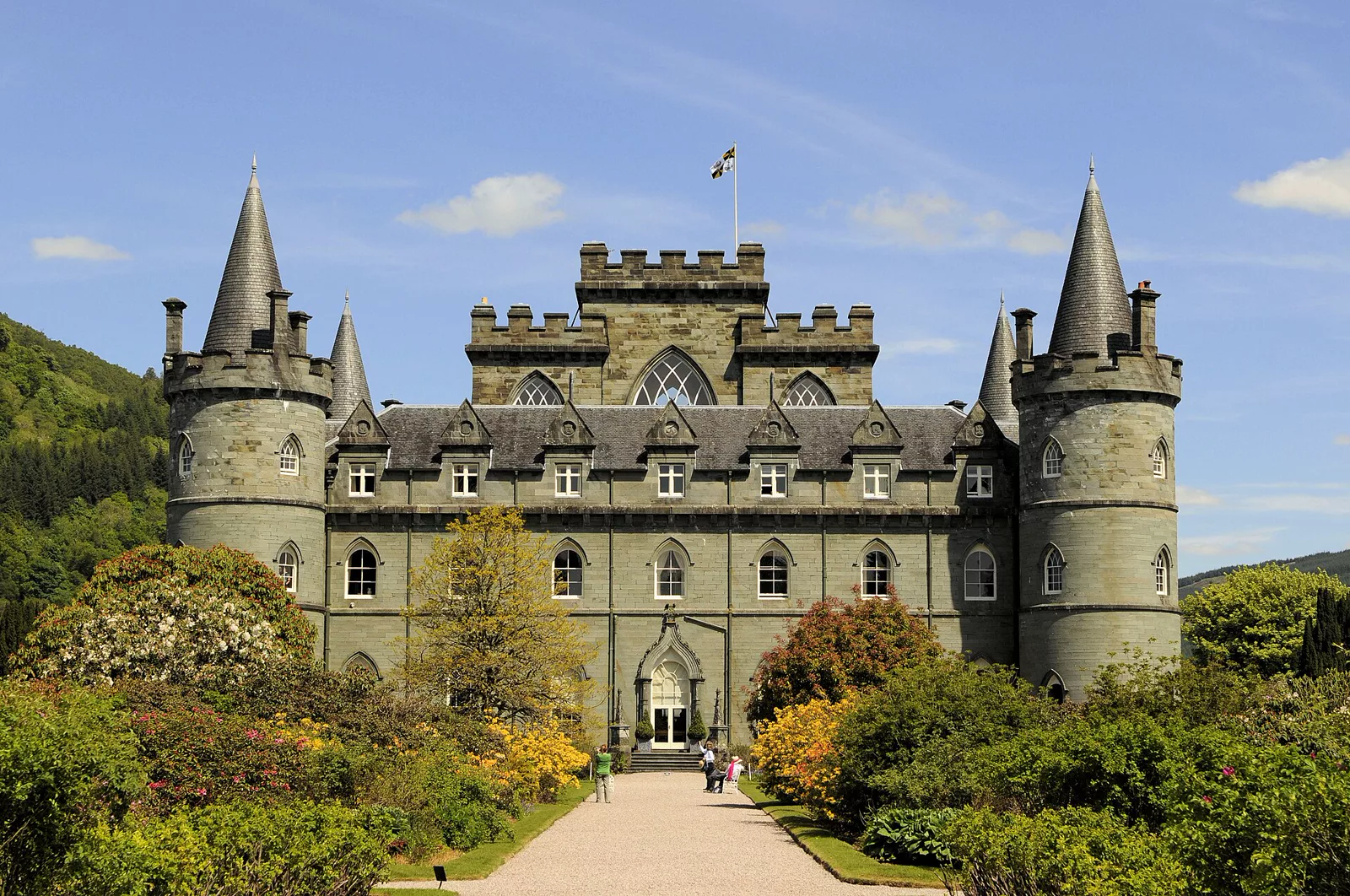
Inveraray Castle on Loch Fyne, the principal seat of the Duke of Argyll, chief of Clan Campbell. The photo shows the castle, not the clan.Photo: Son of Groucho from Scotland, CC BY 2.0 (source) Linked clan · Argyll
Clan Campbell
Probable Supported by a credible source, not independently confirmed.
The surname is the clan's name, and the earliest documented bearers, Gillespie in 1263 and 1266, then Colin and Neill, are the Lochawe family whose chiefs became the Earls and Dukes of Argyll. Sellar says the descent of the Argyll family from those three men is "undoubted", but the link applies to that family and its recognised cadets, not to every person named Campbell. The clan society's own septs author says there can be no suggestion that all those of the sept names are automatically Campbells, and the same applies in reverse: a Campbell with no documented link to the chiefs is a Campbell by name only. Where the chiefs' line meets Breadalbane, Cawdor and Loudoun is a matter for the pedigrees, and Y-DNA testing so far suggests the Glenorchy and Argyll lines may not match.

Tartan
Tartans linked to the name, each with the strength of the link. The link is to the name's history, not to any individual's family.
Clan tartan
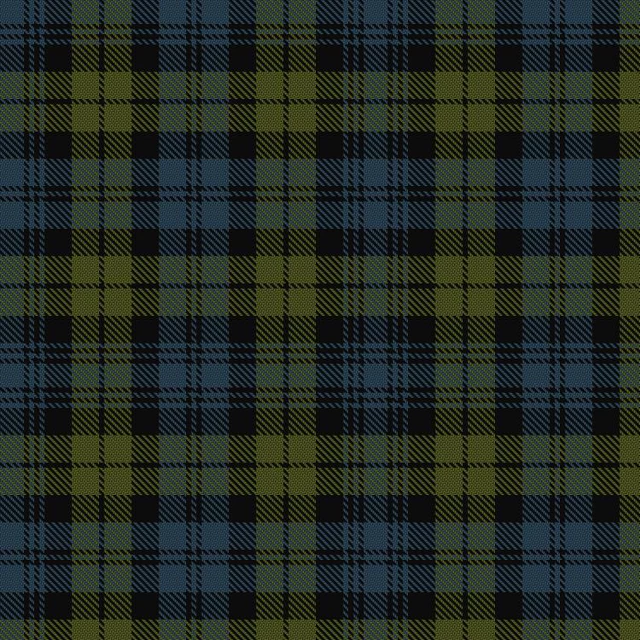
Campbell
Probable Supported by a credible source, not independently confirmed.
The Scottish Register of Tartans lists the Campbell clan tartan with a date of 1 January 1739, and the clan society says the Duke of Argyll approves it. It is the Black Watch sett in lighter shades and became the Campbell tartan in the early 1800s, so the surname-tartan link is through the clan, not through the name. Belongs to the Breadalbane or Glenorchy branch. The register records it as a military tartan reproduced from the Breadalbane Fencibles, 1793 to 1802. A person named Campbell with no Glenorchy link has no particular claim to it, and the Strathclyde Y-DNA work reports the Glenorchy and Argyll lines as unrelated, so even the branch's relation to the chiefs is unsettled. Belongs to the Cawdor branch, a sixteenth-century cadet of the Argyll line. The register dates it to 1798. The surname alone does not point to Cawdor. Belongs to the Loudoun branch of Ayrshire. The register entry is dated 30 November 1988 and follows the 1906 Johnston books, and Sellar traces the branch to a Donald and not to the Lochawe chiefs. Use it only for a documented Loudoun connection.
Image: Scottish Register of Tartans, rendered from the registered threadcount. Crown copyright, National Records of Scotland.
From the evidence
Where the sources disagree
Sentences from the evidence below in which the record says its sources do not agree. Each is quoted as written; follow the claim number for the context.
Evidence
23 claims, numbered in the order the record lists them. Consecutive claims that cite the same source are set together under that source. Each claim carries its own evidence level.
- APrimary or official3 claims
- BInstitutional13 claims
- CSpecialist secondary5 claims
- DCommercial2 claims
Claims 1 to 2
- BInstitutional
Sellar writes that the name "Cambel", with the intrusive p not appearing until the latter half of the fifteenth century, "almost certainly originated as a nickname meaning simply, in Gaelic, 'twisted mouth'". He adds that, according to the Irish genealogist MacFirbis, the first Caimbel was Dugald, grandfather of Colin Mor. The Clan Campbell Society (North America) page reproducing the paper says the same. This is a scholar's judgement from the record evidence and the genealogies, not a documented naming event.
- CSpecialist secondary
The Hanks and Hammond conference slides, which examine Black's Surnames of Scotland, give Black's derivation as Gaelic caimbeul, "wry or crooked mouth", and cite S. Boardman for the anglicised spelling Campbell first appearing in the 1450s. Forebears gives "Gaelic Caimbeul, wry (or crooked) mouth" with the remark that the epithet was probably applied to an early chief, and calls the Norman-French "de Campobello" story unfounded because early records show no "de" and consistent Gaelic spellings. The Oxford and American family-name dictionaries were not opened for this page, so agreement among the major dictionaries is not checked beyond Black.
Claims 3 to 10
All cite The Earliest Campbells: Norman, Briton, or Gael? [1]
- BInstitutional
Sellar traces the "de Campo Bello" derivation to eighteenth and nineteenth century peerage writing: Wood's 1813 edition of Douglas's Peerage describes Eva's husband as "Gillcspick Campbell, a gentleman of Anglo-Norman lineage", and John Pinkerton's Norman view was repeated in Anderson's Scottish Nation (1866). Against it, W. F. Skene in The Highlanders of Scotland (1837) repudiated the story, saying there was no early authority for it. The older tradition in Ane Accompt of the Genealogie of the Campbells folds the Norman idea in by turning Campus Bellus into Beauchamp and sending a son of the line to France, which Sellar treats as a later addition.
Evidence level B. Sources: [1]
- BInstitutional
Sellar accepts that the family's earlier and original name was O'Duibne. Evidence he gives: a 1369 charter of David II to Gillespie (Archibald) Campbell that names Duncan M'Duine as his progenitor in the barony of Lochow; John Carswell calling the Earl of Argyll Ua nDuibhne in 1567; and the Craignish history of about 1720, which says the Campbells are still called Clan O'Guine. He is inclined to think Duibne, the eponym, was a historical person. The legendary Fenian Diarmaid O'Duibne, companion of Finn and lover of Grainne, does not appear in the three oldest surviving Campbell pedigrees (MS 1467, the lost Kilbride manuscript of about 1550, and the pedigree given by MacFirbis). Sellar regards the Diarmaid and Norman material as later additions in the account of the seventeenth-century seanchaidhean Neill MacEwan and Alexander Colville.
Evidence level B. Sources: [1]
- BInstitutional
Sellar offers, tentatively, that the father of Duibne in the early pedigrees (read variously as Feradoig, Feradoigh and a nearly illegible form read by Skene as Eirenaid or Eirenaia) may have started as the name Jeremiah, which Gaelic speakers match with Diarmaid, in the way Norman matches Tormod. He labels this a suggestion, and it is not settled. What is settled in his account is narrower: the early genealogies agree on about eight generations before Colin Mor, give no hint of Norman descent, and contain no Diarmaid.
Evidence level B. Sources: [1]
- BInstitutional
Sellar concludes that the original Campbell tradition of ancestry was neither Gaelic nor Norman but British, and suggests the family's origins lie in the old kingdom of Strathclyde, in the district of Lennox, citing Alexander Macbain's remark that the Campbells may have lived on the borderland of Strathclyde Briton and Gael. He says the descent from King Arthur found in the pedigrees is "incredible", so the claim is about a British-flavoured tradition, not about Arthur. Skene and the eighth Duke of Argyll, quoted by Andrew McKerral, favoured a Gaelic origin at Lochawe. The question remains open among historians, and this page records that disagreement instead of choosing a side.
Evidence level B. Sources: [1]
- BInstitutional
Sellar names Gillespie Campbell, recorded in 1263 in connection with the lands of Menstrie and Sauchie in Clackmannanshire and in 1266 as witness to a charter at Stirling by Alexander III (Exchequer Rolls; Lindores Liber), as the earliest Campbell with contemporary record. His son Colin, otherwise Nicholas, witnesses a charter about 1281 and in 1291 was one of the auditors of Bruce the Competitor. Colin's son Neill, in Latin Nigellus, witnesses a grant to Cambuskenneth Abbey in 1282, became a close supporter of Robert Bruce and died about 1315. Sellar takes Colin to be the original Cailein Mor behind the style MacCailein Mor. Other Campbells (Donald, Dugald, Duncan, Arthur, Thomas) appear on record with increasing frequency from about 1290.
- BInstitutional
Sellar notes that Colin appears in the Ragman Roll in 1296 as "Nicol Cambel", because the Latin Nicholas normally stands for Colin and not Neill, a confusion he says runs through peerage writers from Crawfurd onward. He also records the clerical Master Neill Campbell in the Roll that year as "Mestre Neel Cambel... del counte de Are", meaning the county of Ayr, and as envoy of the Earl of Carrick in 1293. The Roll was compiled by English clerks, so its spellings show how the name sounded to them and not how bearers wrote it.
Evidence level B. Sources: [1]
- BInstitutional
Sellar argues that the Christian names Colin and Neill came into the family from the Celtic Earls of Carrick through a marriage about the middle of the thirteenth century, so that Colin Mor and Robert Bruce's mother were first cousins and Campbell support for Bruce has a kinship explanation. He calls the persistent tradition that Lochawe came through the marriage of two ancestors of Colin Mor to heiresses, one of them the daughter of Paul an Sparain, "entirely credible, even if not susceptible of proof", while the heiress's O'Duibne male line is a later gloss. These are Sellar's reasoned conclusions from partial records and should be read as probable, not proved.
Evidence level B. Sources: [1]
- BInstitutional
Sellar says the Campbells of Strachur, whose chief is styled MacArthur, descend from Arthur Campbell, whom he treats as a cousin and not a brother of Colin Mor, with a father Duncan Dow who may be the Duncan Duf of Kintyre in 1293. He says the later Campbells of Loudoun descend from a Donald, probably a brother of Sir Neill as the Scots Peerage proposes, though he calls the evidence tenuous and doubts the older story of descent from an Ewen. His best evidence for the brotherhood is a 1309 seal reading Douenaldi et Nigelli Cambel Fratrum, and he suggests the Carrick connection may also explain the early Campbell acquisition of the lands of Loudoun in Ayrshire. The Clan Campbell Society cadet-branch page lists Argyll as the main chiefly line, with Breadalbane, Cawdor and Loudoun as the peerage houses and Lochnell as heir to the Argyll line should it fail, and says almost 300 cadet families have been recorded.
The National Archives holds the Report of the Commission given by his Majesty for inquiring into the slaughter of the men of Glencoe, reference SP 8/15/83, dated 20 June 1695, which names nine commissioners and covers the warrants and directions authorising the killings.
Claims 11 to 14
- CSpecialist secondary
The clan society septs author says the Cawdor branch began when Muriel, heiress of Cawdor, married John Campbell, a younger son of the 2nd Earl of Argyll, and dismisses any link with Macbeth's thane. Wikipedia likewise gives the line as Sir John Campbell, died 1546, third son of Archibald, 2nd Earl of Argyll, and a later Earl Cawdor created 5 October 1827 in the UK peerage. Cawdor is therefore a sixteenth-century cadet of the Argyll line whose name comes from an estate acquired by marriage, so a Cawdor Campbell and a Lochawe Campbell are different branches even though both descend from Argyll.
- BInstitutional
Wikipedia gives Sir Colin Campbell, 1st of Glenorchy, died 1475, as founder, granted Glenorchy by his father Duncan, with Sir John Campbell created Earl of Breadalbane and Holland on 13 August 1681. The University of Strathclyde's Campbell genetic genealogy project reports a finding that two leading branches, the Campbells of Glenorchy (the cohort starting from Sir Duncan Campbell, 2nd Lord of Glenorchy, died 1513) and the Campbells of Argyll (from Sir Duncan Campbell, 1st Lord Campbell, died 1453), "have been found to be unrelated to each other" on Y-DNA, from testing of several people with four distinct Glenorchy lineages. The project says the study is ongoing, so the paper pedigree and the DNA result currently disagree and neither is settled.
- CSpecialist secondary
The septs author says Sir Duncan Campbell received a charter of the lands of Loudoun in Ayrshire from Robert I in 1318 after marrying the heiress Susanna Crawford, and warns that early writers sometimes confused Loudoun with Lothian, which has no Campbell link. Wikipedia gives the earldom of Loudoun as created in 1633 for John Campbell, 2nd Lord Campbell of Loudoun, who held through his wife Margaret, granddaughter and heiress of the 1st Lord, Hugh, died 1622. Loudoun is a name taken from an estate in Ayrshire, and the branch is the one Sellar traces to Donald, not to the Lochawe chiefs.
- DCommercial
The killing of MacDonalds of Glencoe on 13 February 1692, reported as about 38 people in Wikipedia's Clan Campbell article and about 30 in its Glencoe article, is the main source of a popular idea that Campbells as a body were guilty. Wikipedia's Massacre of Glencoe article says the 120 soldiers of the Earl of Argyll's Regiment of Foot were led by Captain Robert Campbell of Glenlyon, who acted on a written order from Major Duncanson, that Lord Stair arranged the operation by letter, and that Lieutenant-Colonel James Hamilton blocked the northern exits. It also says the 1695 commission found that Stair and Hamilton had a case to answer but left the decision to William, nobody was punished, and Stair returned to government in 1700. Its Clan Campbell article adds that a roll call a few months earlier listed six Campbells besides Glenlyon, so most of the soldiers were not Campbells.
Claim 15
- APrimary or official
The National Archives holds the Report of the Commission given by his Majesty for inquiring into the slaughter of the men of Glencoe, reference SP 8/15/83, dated 20 June 1695, which names nine commissioners and covers the warrants and directions authorising the killings. A 2019 chapter by Arnaud Fiasson says the commission named Glenlyon, Thomas Drummond, John Lindsay, John Lundie and Robert Barber as actors in the slaughter and put much of the blame on the Master of Stair's excess in his letters. The commission's named actors included men who were not Campbells, and its report places responsibility with the government and its officers, so the name Campbell alone is a poor proxy for blame. Only the catalogue record was read, not the report.
Claims 16 to 17
All cite Campbell surname meaning and distribution [11]
- DCommercial
Forebears, using what it labels 2014 data, counts 38,926 Campbells in Scotland (rank 4), 10,944 in Northern Ireland (rank 1), 492,748 in the United States (rank 41), 71,068 in Canada (rank 12), 50,389 in Australia (rank 26) and 41,322 in Jamaica (rank 4), about 828,742 worldwide. Wikipedia's surname article, citing Forebears frequency comparisons, gives different ranks for most of the same places: 3rd in Northern Ireland, 7th in Scotland and 18th in Australia, though it also has Jamaica at 4th. The two level D sources disagree on rank, so treat the counts as rough, and note that neither source is an official census. Lochawe in Argyll is the traditional seat of the chiefs' family, and Wikipedia says emigration from the eighteenth century spread the name to the United States, Canada, Australia and Ulster.
- CSpecialist secondary
Records show Cambel in the Ragman Roll of 1296 (as Sellar quotes it), the Gaelic form Caimbeul, and Cambell; the form Campbell is dated by Boardman to the 1450s according to Hanks and Hammond. Forebears and Wikipedia both treat Campbell as the standard form. Which of these a given ancestor used often depended on who wrote the record, so an unfamiliar spelling in a parish or estate book is not evidence of a different family.
The Scottish Register of Tartans lists Campbell with a tartan date of 1 January 1739 and a note that the pattern comes from the 43rd Regiment, later the Black Watch, and became the clan tartan in the early 1800s.
Claims 18 to 21
- CSpecialist secondary
The Clan Campbell Society's list names Arthur, MacArthur and MacCarter, Bannatyne, Burns, Burnett, Cadell and Calder, Denoon, Gibson, Harris, Isaac, MacIver, Orr, Ure, MacKellar, Lorne, Loudon, MacTavish and Thomson among others, but its own author calls the Burns inclusion "very thin evidence", says the Hastings link rests on an 1804 marriage and is "remarkable tenuous", and finds the Harris and Burnett entries puzzling. The same author separates descent from association: MacArthurs come from more than one stem, MacIvers had "little or no likelihood of a common origin", Sons of Thomas are not all Argyll MacTavishes, and Lorne is a title also held by MacDougalls and Stewarts so "there is no means of knowing from what blood its users descend". Sellar by contrast says he believes the MacEwan and Colville account of the MacTavish Campbells, MacIver Campbells and Campbells of Craignish is substantially correct, while the septs author disputes the Ane Accompt story of MacTavish origins. A sept list is a statement by one organisation, and does not make every bearer a Campbell.
- APrimary or official
The Scottish Register of Tartans lists Campbell with a tartan date of 1 January 1739 and a note that the pattern comes from the 43rd Regiment, later the Black Watch, and became the clan tartan in the early 1800s. The register also lists Campbell of Breadalbane from the Breadalbane Fencibles (1793), Campbell of Cawdor (1798), and Campbell of Loudoun (registered 1988, following the Johnston books of 1906). The surname does not decide which of these a person may wear; the Clan Campbell Society treats four as official Campbell tartans, and the branch tartans follow the branch.
- BInstitutional
Four misconceptions are sourced. First, that Campbell means "de Campo Bello": rejected by Skene, Sellar and Forebears. Second, that the family descends from Diarmaid O'Duibhne in a direct line: absent from the three oldest pedigrees. Third, that every Campbell belongs to the chief's family: the name began as a nickname, the family took in followers and tenants, and the Strathclyde Y-DNA work reports two named branches that do not match. Fourth, that a Campbell was responsible for Glencoe as a clan: the order chain ran through Duncanson, Hamilton and Stair, and the soldiers were mostly not Campbells.
- APrimary or official
Statutory registers in Scotland begin in 1855 and old parish registers run from 1553 to 1854, according to National Records of Scotland, which says tracing a line back to 1855 is usually fairly straightforward and going beyond is more difficult; ScotlandsPeople is the official site for these. For Argyll Campbells, the clan society points to the Rev. Henry Paton's transcripts of Campbell entries in the Sheriff Court Books of Inveraray, the Argyll Archives at Cherry Park, Inveraray, and the Breadalbane papers in National Records of Scotland, which cover Perthshire and Glenorchy and Kilchurn. National Records of Scotland's estate guide says rentals sometimes name tenants and leases (tacks) may give more detail. The clan society adds that armorial bearings are personal to one grantee and that chiefly descent needs documented proof of unbroken male-line descent, so a surname is no evidence of either.
- BInstitutional
Y-DNA follows the male line only. The Strathclyde project reports 2024 Big Y-700 tests for four documented male-line descendants of Colin Campbell of Loch Awe, with 32, 19, 11 and 3 test-takers carrying particular markers, and says conclusions on the early history of the Glenorchy line will take time. The Campbell DNA Project page of the clan society says a test can link you with other Campbells who share an ancestor "whether from the Scottish Highlands, Ireland, or beyond", but that page gives no figures on how many Campbells match the chiefly line. A match shows a shared ancestor, not necessarily the Lochawe family.
- BInstitutional
It does not prove a Norman or Fenian ancestor, descent from the Lochawe chiefs, membership of the clan in the legal sense, a right to the chief's arms, or a particular tartan. A Highland origin does not follow from the name alone: Forebears and Wikipedia both put it among the most common surnames in Northern Ireland, and the clan society's DNA page speaks of Campbell lines from "the Scottish Highlands, Ireland, or beyond". Descent has to be built record by record from 1855 backward, then from estate and court papers, and DNA can test the result.
What this page does not say
Sources
- The Earliest Campbells: Norman, Briton, or Gael?
- Official septs list of Clan Campbell
- Campbell Research (genetic genealogy)
- The Origins of the Campbells (after David Sellar)
- Clan Campbell tartan
- Scottish Register of Tartans: Campbell of Breadalbane
- Scottish Register of Tartans: Campbell (Clan/Family)
- Scottish Register of Tartans: Campbell of Cawdor
- Scottish Register of Tartans: Campbell of Loudoun
- Black's Surnames of Scotland and the FaNUK database
- Campbell surname meaning and distribution
- Cadet branches of Clan Campbell
- Earl Cawdor
- Earl of Breadalbane and Holland
- Earl of Loudoun
- Massacre of Glencoe
- Clan Campbell
- Report of the Commission given by his Majesty for inquiring into the slaughter of the men of Glencoe (SP 8/15/83)
- Jacobite Legacies to Scottish Popular Culture: Murder under Trust, Treason and their Punishment
- Campbell (surname)
- Family history research guide
- Genealogical research in Scotland (Campbell)
- Estate records research guide
- Campbell DNA Project