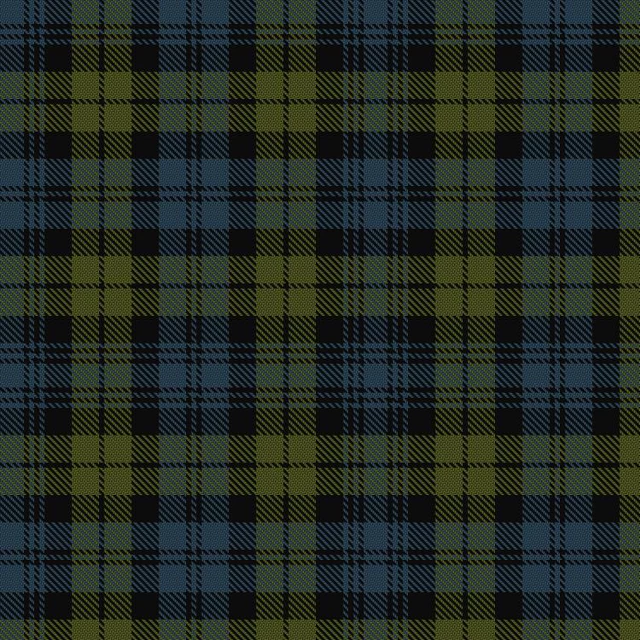
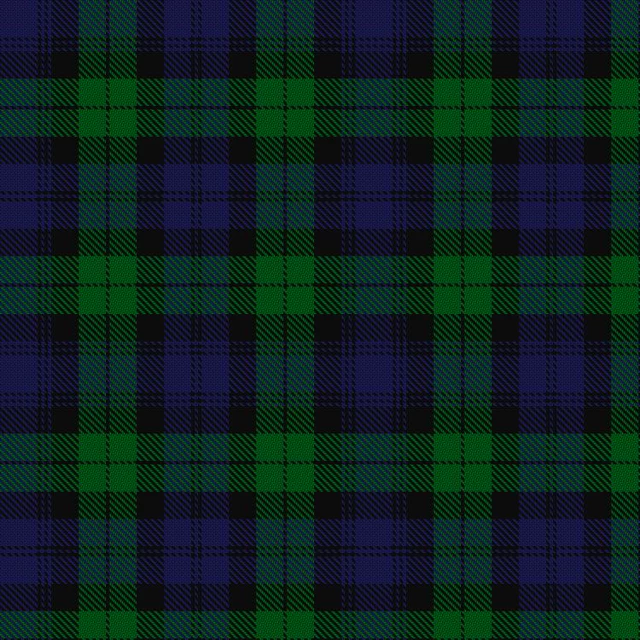
The Campbell clan tartan is the Black Watch sett in lighter shades. The Scottish Register of Tartans dates it to 1739 and says it became the Campbell tartan in the early 1800s. The Clan Campbell Society of North America says the present Duke of Argyll approves it and that the past seven chiefs disavowed the Campbell of Argyll sett.
Clan/Family
No restriction recorded
Evidence level C
Image: Scottish Register of Tartans, rendered from the registered threadcount. Crown copyright, National Records of Scotland.Image source: the record this swatch comes from. Licence: Crown copyright, National Records of Scotland (Scottish Register of Tartans). Re-use beyond fair dealing needs NRS permission.
Type
Clan tartan
Classification
Clan/Family
Earliest known date
1739
Registered
Not recorded
Associated clan
Campbell
Who can wear it
No restriction recorded
Evidence level
C
Also known as
Campbell Clan
Campbell tartan #1
Overview
The Campbell tartan and the Black Watch tartan share a pattern. The Campbell version is woven in lighter shades of blue and green. The Clan Campbell Society of North America calls this the principal Campbell tartan and says the Duke of Argyll approves it. The Scottish Register of Tartans lists it as Campbell, Clan/Family, dated 1739, reference STA 1.
The register's Black Watch (Government) record (STA reference 207) notes that the Cockburn Collection (1810 to 1815) includes four specimens of the Government tartan labelled Campbell Argyll, Grant, Munro and Sutherland.
From the historical notes. Evidence level A. Sources: [2]
Pattern
The Clan Campbell Society of North America describes the Campbell sett as thirteen bands of blue, green and black, identical to the Black Watch sett but in lighter shades. The register's Campbell record says the same, with Black Watch in darker dyes. The register holds the threadcount only behind a login, so none is given here; the swatch image is the register's own rendering of the registered sett.
Origins
The register dates the Campbell (Clan/Family) entry to 1 January 1739 and ties it to the founding of the 43rd Regiment, later the Black Watch. It gives no designer. The Clan Campbell Society of North America says the Black Watch was drawn from independent companies, three of them Campbell. Neither source describes a record of the pattern being chosen for the clan on a particular date.
The register's Campbell (Clan/Family) record, STA reference 1, gives a tartan date of 1 January 1739 and designer unknown.
From the historical notes. Evidence level A. Sources: [3]
Development
The register says the pattern became the official Campbell tartan in the early 1800s, without citing a document. Sources do not agree on the direction of the link. The register presents Campbell as a clan use of the Black Watch pattern. The society presents Black Watch as the Campbell sett in darker dyes, and the Cockburn Collection (about 1810 to 1815) holds a specimen of the Government tartan labelled Campbell Argyll. What the surviving records show is a shared sett and a shared early nineteenth-century labelling. They do not show which name came first, and no source consulted settles it. The Cockburn specimens add a point: the same Government sett carries four clan labels in that one collection, so a label on an early specimen records what a collector or merchant called the cloth, not necessarily a clan's own claim to it.
Clan relationship
The chiefs are the Dukes of Argyll. The society says the present Duke approves the Campbell tartan, and the register says he wears it. The society names four official Campbell tartans, citing Alastair Campbell of Airds, The Campbell Tartan (1985): Campbell, Campbell of Cawdor, Campbell of Breadalbane and Campbell of Loudoun. The three branch setts are described in the sections below.
Name and variants
The register lists several Campbell entries. Campbell (Clan/Family, STA 1) is the Black Watch-based sett. Campbell (Military, STA 12) is dated 1870. Campbell Dress #1 and Campbell Hunting are also listed, but their records were not read. Campbell of Argyll appears in four versions. The society says the past seven chiefs disavowed the Campbell of Argyll sett and quotes Airds: it is not a pattern with the chief's approval as an official Campbell tartan. Registration does not imply chief's approval, so a registered Argyll sett can be both on the register and unapproved.
Check before repeating
Misconceptions
Campbell of Argyll sounds like the chief's own tartan, but the clan society says it is the one the chiefs disavowed. Campbell and Black Watch are the same sett, not two different designs, although the Campbell shades are lighter. What the record does not show: a threadcount for any of these entries (all behind the register login), who first wove the Campbell version, or why the Argyll sett was made. The society's account of the disavowals comes from one author's 1985 book and has not been checked against that book.
Cawdor sett
Campbell of Cawdor is the first of the three branch setts the Clan Campbell Society of North America lists beside the main Campbell tartan. The society describes it as the Black Watch sett with red and light blue stripes added, and calls it one of Wilson's variations on the military sett. The register's record (STA reference 2) gives a tartan date of 1 January 1798, names no designer, and says the present chief authorises it.
Its note carries a naming history that the society's summary leaves out: the pattern was numbered first, was named Argyle in 1798 and Argylle in 1819, and only later appeared as Campbell of Cawdor. On that sequence Cawdor is the latest of three names on one cloth, not the oldest. The register cites the Cawdor name in W. and A. Smith (1850) and in the 1880 Clans Originaux, and records a sample in the Scottish Tartans Authority Dalgety Collection. Both printed appearances are mid-nineteenth century, so the earliest documented tie between this sett and the Cawdor family is no earlier than 1850 in the sources read.
Three limits apply. The 1798 date is the register's date for the pattern, not a date on which the Cawdor Campbells adopted it. The phrase "Wilson's variation" is the society's wording; the register names no maker for the added stripes. The threadcount is held only for logged-in register users, so none is given here.
For a reader choosing between the setts: Cawdor is the one that is both chief-authorised and distinguishable from plain Campbell by red and light blue, whereas Breadalbane and Loudoun are told apart by yellow, and by white and yellow.
Breadalbane sett
Campbell of Breadalbane takes the Campbell colours and adds yellow stripes. The register files it under Military, not Clan/Family (STA reference 209, designer Wilsons of Bannockburn, tartan date 1 January 1793). That classification matters: the pattern is recorded first as a regimental cloth, and its use as a Campbell clan tartan is the clan society's later adoption.
The register's note calls the entry a careful reproduction of the Campbell of Breadalbane worn by the Fencibles from 1793 until their disbandment in 1802, authenticated from a regimental uniform belonging to Major Campbell and from period illustrations. So the 1793 date belongs to the original regimental cloth, and the register's own record rests on a uniform and illustrations this site has not seen. The reproduction's date is not stated.
The society gives 1810 as the earliest sighting, which is a different claim from the register's 1793 and sits seventeen years later. Neither source explains the gap. The most that can be said is that a yellow-striped Black Watch variant is recorded in a regimental context at the end of the eighteenth century and is in circulation under the Campbell name by 1810 on the society's account.
The society says the sett is traditionally worn by the Breadalbane or Glenorchy branches. The register's military category places no limit on wearers, and nothing read here shows a ruling by a chief on who may wear it. Of the four official Campbell tartans it is the closest in colour to Loudoun, which carries a white and yellow stripe where Breadalbane carries yellow only.
Loudoun sett
Campbell of Loudoun is the least common of the four official Campbell tartans. The society calls it the rarest, says the chief, Mac Cailein Mor, acknowledges it, and lists it from Alastair Campbell of Airds (1985). It is almost identical to Breadalbane, with a white and yellow stripe where Breadalbane has yellow only.
The register's record (STA reference 4436) is in Clan/Family, names no designer and gives a tartan date of 30 November 1988. That date is a recording date and says nothing about the pattern's age. The note is more informative: it says the entry appears to be the accepted version shown in the 1906 W. and A. K. Johnston books, and that it differs from the earlier sett in Clans Originaux, where the blue has no black tramlines. At least two printed Loudoun patterns therefore exist, and a cloth sold as Loudoun may follow either. The register places Castle Loudoun in Ayrshire, five miles east of Kilmarnock.
What the record does not show: who made the 1906 version, when the Loudoun name was first attached to a sett, and the threadcount, which sits behind the register login.
The society says the tartan is for people with Loudoun lineage or a connection to that cadet branch. The register states no rule. Because two versions exist, anyone ordering Loudoun should ask the weaver which printed source the cloth follows.
Colours
dark blue#2C2C80Approximate
green#006818Approximate
black#101010Approximate
Approximate hex values estimate the thread colour; they are not specified by a registry.
Dates in the record
The dates this record holds, and the opening sentence of each historical note that names a single year. A year is the one the source gives; it has not been checked independently here.
Earliest known date held in this record.
The register's Campbell (Clan/Family) record, STA reference 1, gives a tartan date of 1 January 1739 and designer unknown.
The register lists a second, separate Campbell entry in the Military category, STA reference 12, dated 1870, with the note that it is illustrated in Kenneth Macleay's Highlanders of Scotland (1870).
The same society says the past seven chiefs have disavowed the Campbell of Argyll sett, citing Alastair Campbell of Airds, The Campbell Tartan (1985), and lists Campbell, Cawdor, Breadalbane and Loudoun as the four official Campbell tartans.
The Clan Campbell Society of North America says the Campbell tartan is the Black Watch pattern in lighter shades, with thirteen bands, and that the present Duke of Argyll approves it.
The same society says the past seven chiefs have disavowed the Campbell of Argyll sett, citing Alastair Campbell of Airds, The Campbell Tartan (1985), and lists Campbell, Cawdor, Breadalbane and Loudoun as the four official Campbell tartans.
The register's Black Watch (Government) record (STA reference 207) notes that the Cockburn Collection (1810 to 1815) includes four specimens of the Government tartan labelled Campbell Argyll, Grant, Munro and Sutherland.
The register's Campbell (Clan/Family) record, STA reference 1, gives a tartan date of 1 January 1739 and designer unknown. Its note says the tartan originates from the founding of the 43rd Regiment (later the Black Watch), became the official Campbell clan tartan in the early 1800s, is worn by the present Duke of Argyll, and that modern Black Watch uses the same pattern in darker dyes.
The register lists a second, separate Campbell entry in the Military category, STA reference 12, dated 1870, with the note that it is illustrated in Kenneth Macleay's Highlanders of Scotland (1870). The fetched record does not say how it relates to the Black Watch pattern.
The register holds at least four Campbell of Argyll entries (Campbell of Argyll, #2, no guards, and Smiths). The main record says the design appears in the Cockburn Collection (1815), the Mitchell Library Glasgow, Logan (1831) and the Vestiarium Scoticum (1842), and gives no designer or date of its own.
No restriction is recorded for this tartan. Whether it counts as a universal tartan is not established.
The register entries for Campbell say nothing about who may wear it. The Clan Campbell Society of North America describes Campbell as the principal clan tartan and names four tartans as official Campbell tartans. It advises against the Campbell of Argyll sett for anyone who wants to be correct, because the chiefs have not approved it. Anyone who wants to wear it for a family reason can ask the society which of the four fits their branch.
No law restricts any tartan. As a clan tradition, Campbells and people who accept the clan connection wear the Campbell tartan, and the society names four tartans as official Campbell tartans: Campbell, Cawdor, Breadalbane and Loudoun. The society ties Breadalbane to the Breadalbane and Glenorchy branches and Loudoun to the Loudoun branch.
Where a status is not established, treat it as unknown rather than as permission or prohibition. Clan societies and chiefs may state their own preferences.
Black Watch is the same sett in darker dyes. Campbell of Cawdor, Breadalbane and Loudoun are described as Black Watch with added stripes, in red and light blue, yellow, and white and yellow respectively.
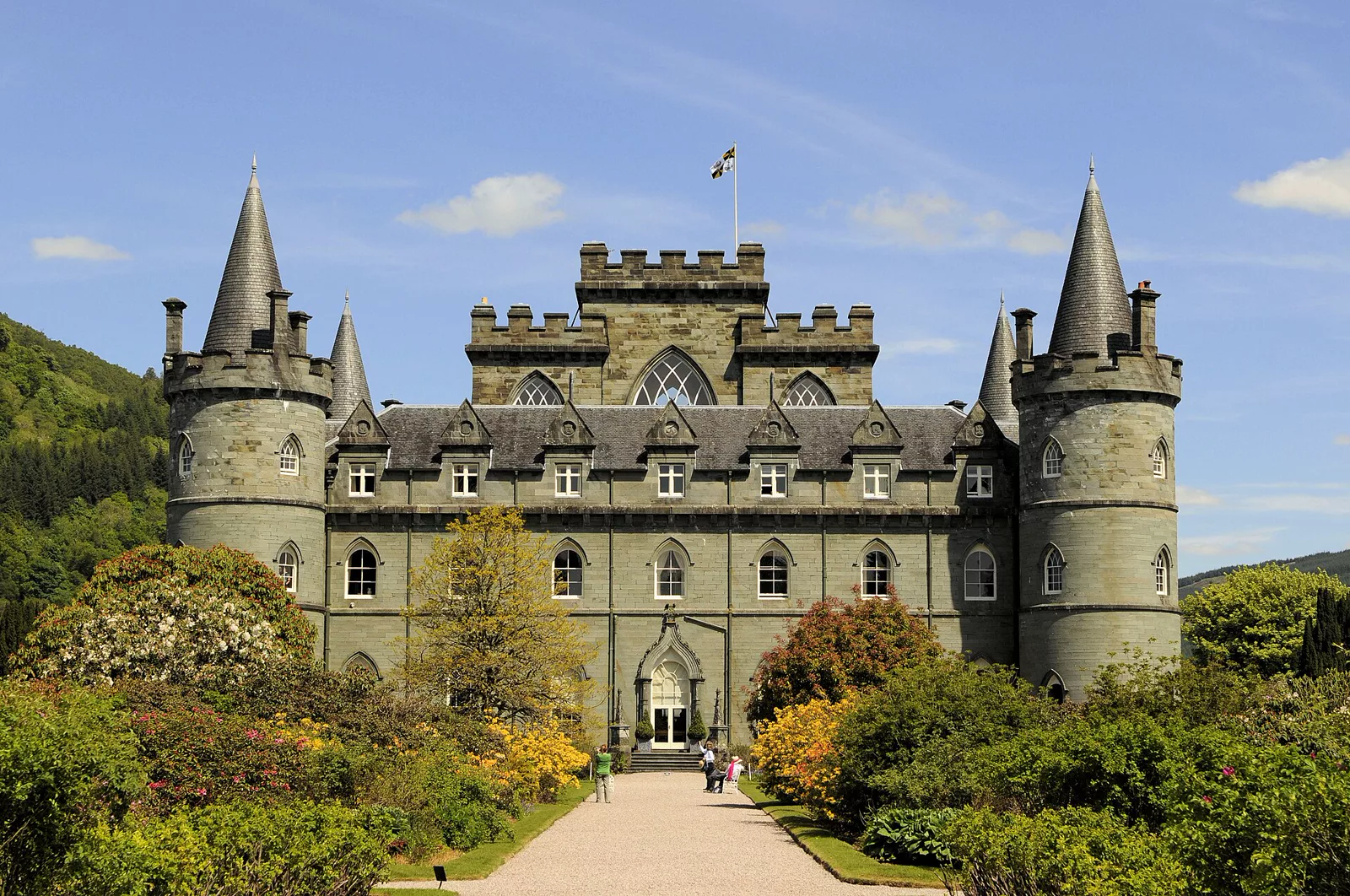
A clan of Argyll whose chief is the Duke of Argyll, with the principal seat at Inveraray Castle on Loch Fyne. The chief's Gaelic style is Mac Cailein Mòr, from Cailean Mòr (Colin the Great), killed in the 1290s. The Campbell tartan is the Black Watch sett in lighter shades, but the Black Watch sett itself is shared with other clans and its origin is not credited to the Campbells.
Photo: Son of Groucho from Scotland, CC BY 2.0
An association between a tartan and a clan is a claim with its own sources. It does not mean every bearer of the clan name has a right to the tartan, or the reverse.
Sources
Clan Campbell tartanClan Campbell Society (North America) · accessed · evidence level C