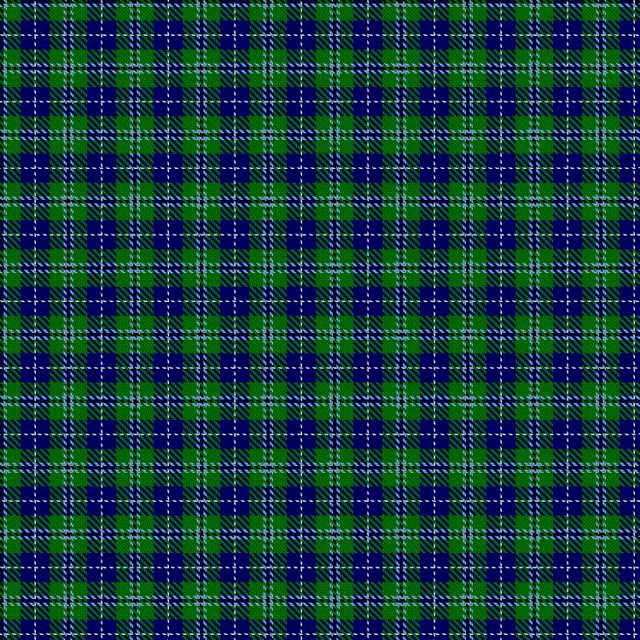
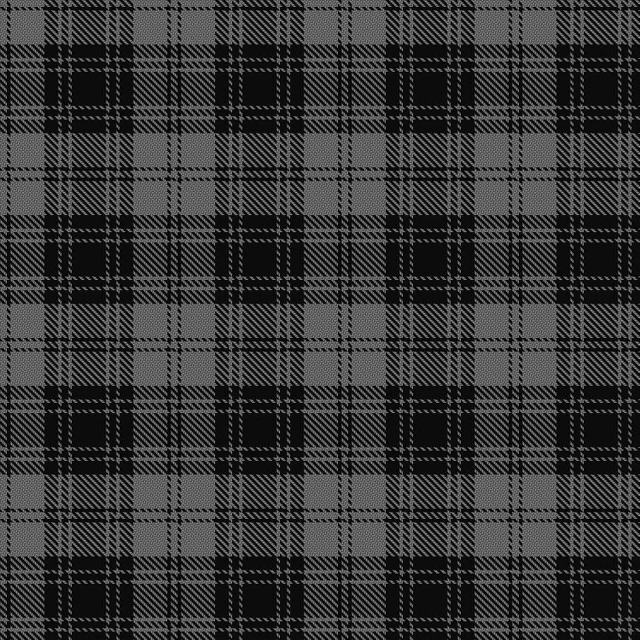
The Scottish Register of Tartans lists the accepted Douglas tartan as a Wilsons of Bannockburn sett of 1819 in green, blue and black with light blue and white lines. It was called Douglas Hunting by 1880. "Black Douglas" is a later design.
Clan/Family
No restriction recorded
Evidence level A
Image: Scottish Register of Tartans, rendered from the registered threadcount. Crown copyright, National Records of Scotland.Image source: the record this swatch comes from. Licence: Crown copyright, National Records of Scotland (Scottish Register of Tartans). Re-use beyond fair dealing needs NRS permission.
Type
Clan tartan
Classification
Clan/Family
Earliest known date
1819
Registered
Not recorded
Associated clan
Douglas
Who can wear it
No restriction recorded
Evidence level
A
Also known as
Douglas Hunting
Overview
The accepted Douglas tartan is a green, blue and black sett with light blue and white lines. The Scottish Register of Tartans lists it as SRT 1034, designed by Wilsons of Bannockburn, and says it first appeared in Wilson's 1819 list as no. 184. It calls it the accepted Douglas Clan/Family tartan.
The register records several other Douglas setts, some with a stronger claim to the name than others, and treats Douglas Grey and Black Douglas as separate entries.
The register records Douglas (SRT 1034) as designed by Wilsons of Bannockburn, also known as Wilson's No. 148, and calls it the accepted Douglas Clan/Family tartan.
From the historical notes. Evidence level A. Sources: [1]
Pattern
The colours on record are green, dark blue, black, light blue and white. The register's threadcount is not shown without a login, so this site has not read it. The register states the count was checked against D.C. Stewart's Setts of the Scottish Tartans (1950), which is a mid-twentieth-century check of an older weaver's pattern, not an original document.
The colours shown here are approximations. Different weavers shift the shades, and a Douglas in a modern ground and an ancient ground can look quite unlike each other while being the same sett.
Origins
The register credits the pattern to Wilsons of Bannockburn and says it appeared in the firm's 1819 list under the number 184 and is also known as Wilson's No. 148. The two numbers are both given in the register's own notes and the sources read do not explain why a record would carry both.
A second register entry, Douglas, Green (Wilsons'), quotes a list Wilsons sent to Logan about 1830 saying No. 148 had been sold as Douglas for a considerable time. That places the use of the name in the early nineteenth century, in a commercial catalogue.
The register says the name Douglas was certainly attached to it by 1880, when it appeared as Douglas Hunting in Clans Originaux. Nothing read for this page shows the Douglas chiefs choosing it, or the family wearing it before the weaver sold it under their name.
The register lists Douglas, Green (Wilsons') (SRT 1032, 1819, Wilsons of Bannockburn).
From the historical notes. Evidence level A. Sources: [2]
Development
The register gives a short run of reference points. A weaver's list of 1819, a statement of about 1830 that the cloth had long been sold as Douglas, the 1880 appearance as Douglas Hunting, and the 1950 threadcount check. After that it records later variants under the same surname: alternative threadcounts, colourways from West Coast Woollen Mill and Edinburgh Woollen Mill, and Douglas of Roxburgh, a 1984 design by Jack Dalgety that the register says is not a stock item for any weaver.
The Green (Wilsons') entry also says the Gurkhas used darker shades of the design. The sources read here do not say which units or when, so the military use is recorded as the register's note and not developed further.
Name and variants
"Douglas Hunting" is the 1880 name. "Douglas Modern", "Ancient" and "Weathered" are weaver colourways, and the register has no entries under those names. "Douglas Ancient Dress (WCWM)" and "Douglas Ancient Red" are separate register entries from named mills.
"Black Douglas" is a trap. The register lists Douglas, Black (SRT 1029, dated 1920) and says it is often called Black Douglas but that the historical Black Douglas, the medieval family, is unconnected with it.
Clan relationship
The register classes the main Douglas as Clan/Family and calls it the accepted Douglas tartan, which is its own judgement. It does not say when a chief approved it. The clan record for the Douglases sits on its own page, and a Douglas surname is a custom, not a condition.
Check before repeating
Misconceptions
The register says the Black Douglas tartan is unconnected with the historical Black Douglas. The register's accepted Douglas is also a nineteenth-century weaver's pattern and not evidence of cloth worn by Douglas lords. The 1819 date is the earliest the register shows, not a proof of origin.
Not established
What the record does not show
The register does not say who at Wilsons designed the pattern, why it carries two numbers, or when a Douglas chief first accepted it. It does not name the Gurkha units or dates for the military use. The sources read do not show any pre-1819 Douglas cloth, and the Vestiarium and personal entries do not change that.
Other douglas register entries
The register's twenty-four Douglas results include personal tartans for individuals and families, which are not clan setts. The clan and trade entries are documented very differently from the accepted pattern:
Douglas (alternative threadcount): a variation on the accepted Douglas, given the same 1819 date as the parent but with no designer.
Douglas (WCWM): a Fashion entry by West Coast Woollen Mill, recorded as 2002, with no further note.
Douglas Ancient Dress (WCWM): the note says a sample was donated by W. H. Johnstone of Skippack, USA, and that this is a trade sett called Ancient Dress Douglas, marketed by West Coast Woollen Co of Vancouver since 1981. It adds that the archived sample contains grey that may be read as green.
Douglas Ancient Red: Edinburgh Woollen Mill, 2002, no details.
Douglas Variation: a trade sett from a Glasgow retailer, Peter Henderson, the register notes, a firm famous for bagpipes that was no longer in business in 2006.
Douglas, (Brown): found in the McBain and Bishop sample book (page 118). The register suggests it may be a confusion with the normal Douglas, in reproduction shades.
Douglas of Roxburgh: a 1984 design by Jack Dalgety, not a stock item for any weaver.
Only two of these are clan designs by a documented source with an early date: the accepted Douglas and the Green (Wilsons') record. The rest are trade, fashion or sample-book entries whose connection to the family is that a weaver chose the name.
Which douglas cloth is which
The register's own notes suggest a practical way to sort them.
Wilsons-derived, early nineteenth century: the accepted Douglas (SRT 1034) and Douglas, Green (Wilsons'). Both point to the firm's list of 1819 and the pattern numbered 148 in the Wilson records.
Copies and reproductions of that sett: the alternative threadcount and Douglas (Brown), which the register itself treats as variations or confusions with the accepted tartan.
Mill and retailer colourways: Ancient Dress, Ancient Red, the West Coast Woollen Mill fashion entry and the Henderson trade sett. They are labelled by shade or mill and cannot be dated to the family.
Different designs under the surname: Douglas Grey from the Vestiarium Scoticum, Douglas, Black (1920) and Douglas of Roxburgh (1984).
If you want the pattern the register treats as the Douglas tartan, ask for SRT 1034 by number, and look at the colours: green, blue and black, with light blue and white lines. A cloth sold as "Ancient" Douglas may be that sett in lighter shades, or it may be the separate Ancient Dress trade sett from Vancouver, and the label alone does not say which.
Colours
black#101010Approximate
light blue#6C9AD0Approximate
green#006818Approximate
dark blue#2C2C80Approximate
white#F0F0F0Approximate
Approximate hex values estimate the thread colour; they are not specified by a registry.
Dates in the record
The dates this record holds, and the opening sentence of each historical note that names a single year. A year is the one the source gives; it has not been checked independently here.
The register records Douglas (SRT 1034) as designed by Wilsons of Bannockburn, also known as Wilson's No. 148, and calls it the accepted Douglas Clan/Family tartan.
The register lists Douglas Ancient Dress (WCWM) as a trade sett called Ancient Dress Douglas marketed by West Coast Woollen Co, Vancouver, since 1981, from a sample donated by W. H. Johnstone of Skippack, USA, and notes the archived sample contains grey that may be read as green.
Douglas of Roxburgh (SRT 961 in the register's URL, STA 4699) is credited to Jack Dalgety, 1984, with the register note that no information exists and it is not a stock item for any weaver.
The register records Douglas (SRT 1034) as designed by Wilsons of Bannockburn, also known as Wilson's No. 148, and calls it the accepted Douglas Clan/Family tartan. It first appeared in Wilson's 1819 list as no. 184, and the name Douglas was certainly attached to it by 1880, when it appeared in Clans Originaux as Douglas Hunting. The threadcount is confirmed by D.C. Stewart, Setts of the Scottish Tartans (1950).
The register lists Douglas, Green (Wilsons') (SRT 1032, 1819, Wilsons of Bannockburn). Its note says Wilson's sent a list of tartans to Logan about 1830 stating that No. 148 had been sold as Douglas for a considerable time, that it is often called the green Douglas, and that the Gurkhas used darker shades of the design.
The register lists Douglas, Black (SRT 1029, 1920) and says it is often called Black Douglas but that the historical Black Douglas is unconnected with it. It notes the sample came from the Inverness Museum via Ross-Craven research and is similar to Alvis of Lee.
A register search for "douglas" returns 24 results, among them Douglas (alternative threadcount), Douglas (WCWM), Douglas Ancient Dress (WCWM), Douglas Ancient Red, Douglas of Roxburgh, Douglas Variation and Douglas (Brown), alongside personal and name tartans.
Douglas of Roxburgh (SRT 961 in the register's URL, STA 4699) is credited to Jack Dalgety, 1984, with the register note that no information exists and it is not a stock item for any weaver. Douglas Ancient Red (STA 4701, Edinburgh Woollen Mill, 2002) is noted only as no details.
The register lists Douglas Ancient Dress (WCWM) as a trade sett called Ancient Dress Douglas marketed by West Coast Woollen Co, Vancouver, since 1981, from a sample donated by W. H. Johnstone of Skippack, USA, and notes the archived sample contains grey that may be read as green.
The register lists Douglas Variation as a trade sett from a Glasgow bagpipe-maker and retailer, Peter Henderson, and Douglas, (Brown) as a name found in the McBain and Bishop sample book (page 118) that may be a confusion with the normal Douglas in reproduction shades.
The register lists Douglas (alternative threadcount) as a variation on the accepted Douglas with the date 1819, and Douglas (WCWM) as a West Coast Woollen Mill Fashion entry recorded as 2002.
No restriction is recorded for this tartan. It is not recorded as a universal tartan.
No law restricts it. The register says there are no laws about which tartan a person may wear. By custom it is worn by people with a Douglas link.
No law restricts the Douglas tartan. The Scottish Register of Tartans states there are no laws about which tartan a person may wear, only traditions. By custom it is worn by people with a Douglas link, and the Gurkha use noted by the register shows it has also been worn well beyond the family.
Douglas Grey is the Vestiarium Scoticum design of 1842 and is a different cloth with a different source. Douglas, Green (Wilsons') is a separate register entry from the same weaver, dated 1819, whose note refers to No. 148. Douglas, Black is a twentieth-century sample from the Inverness Museum that the register notes is similar to Alvis of Lee.
A Lowland family named for Douglasdale in Lanarkshire, which produced the Black Douglas Earls of Douglas, ended in 1455, and the Red Douglas Earls of Angus, who outlasted them. Secondary sources say the name has no chief recognised by the Lord Lyon, so the register's accepted Douglas tartan, a Wilsons of Bannockburn sett of 1819, rests on custom rather than on a chief's approval.
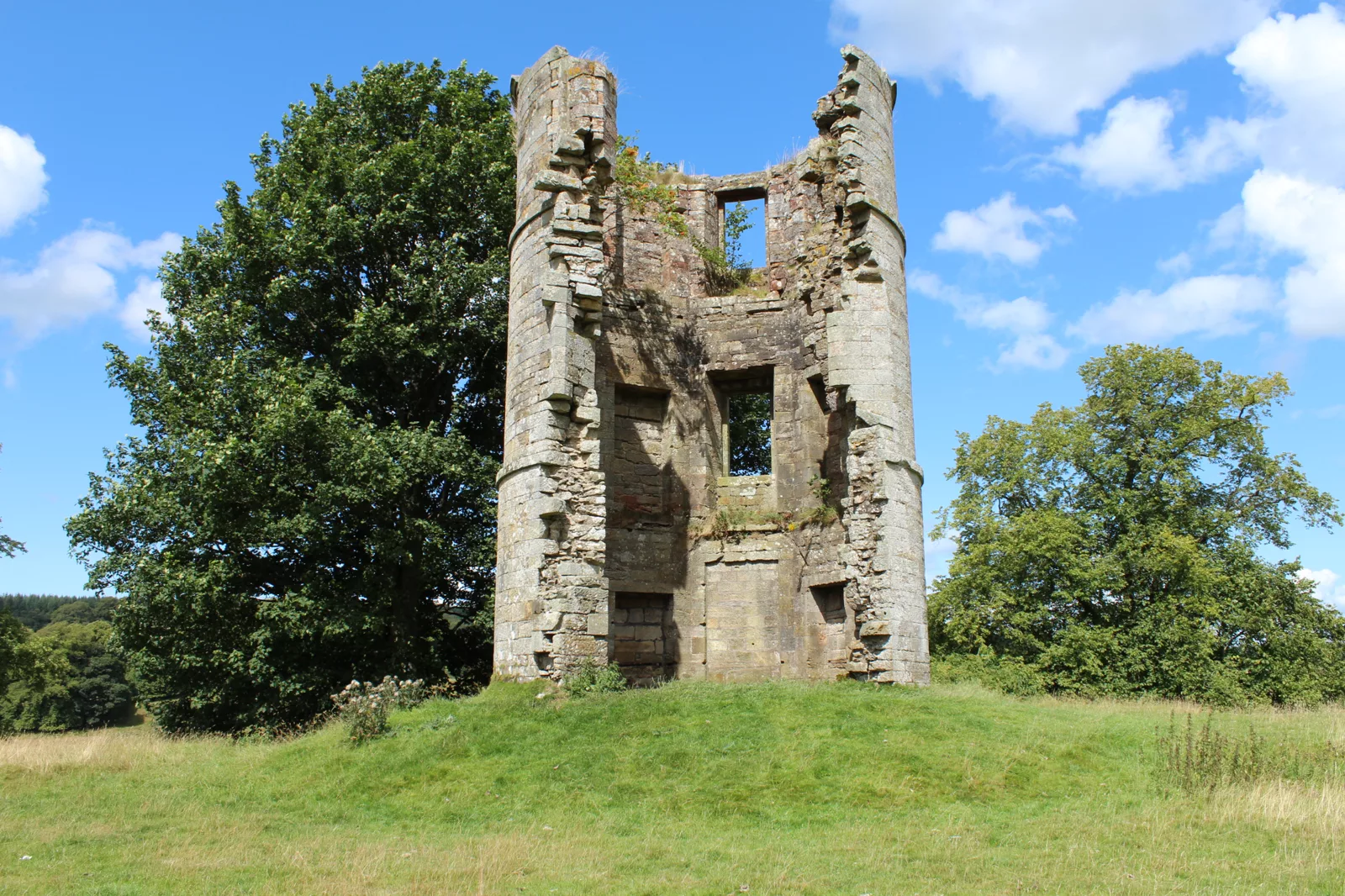
Photo: Billy McCrorie, CC BY-SA 2.0
An association between a tartan and a clan is a claim with its own sources. It does not mean every bearer of the clan name has a right to the tartan, or the reverse.