Tartan etiquette
Who can wear which tartan?
No law in Scotland says who may wear a tartan. A few are restricted by the people who own them, clan tartans carry a custom of allegiance, and the Register records both without enforcing either.
.jpg)
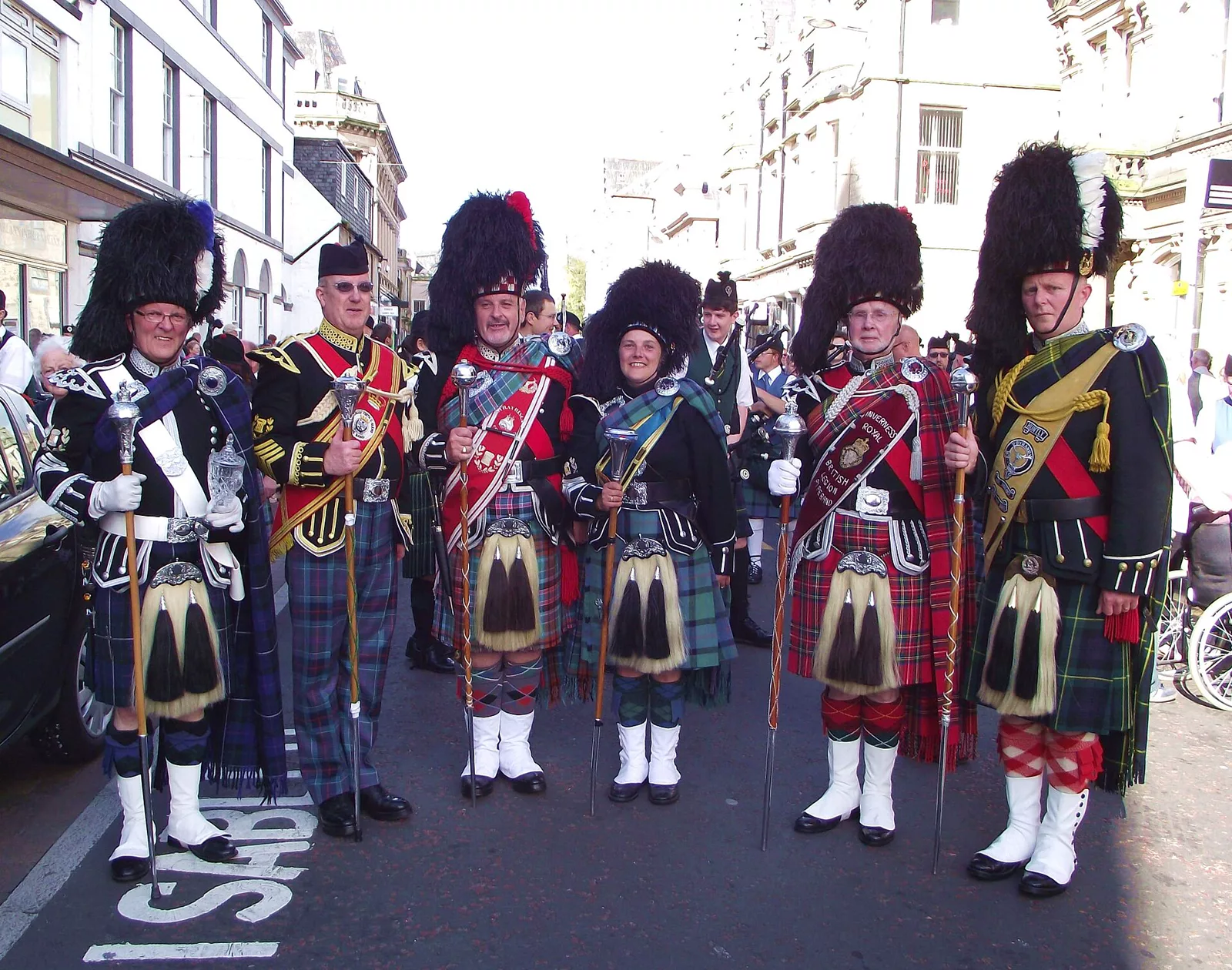
Legally, anyone may wear any tartan. The Scottish Register of Tartans says there are no laws about which tartan you may wear, only traditions. What exists instead is three different things that are often run together: the wishes of whoever owns or commissioned a particular design, the approval of a clan chief, and custom. Separating them answers most versions of the question, and the Register’s own records show where each applies.
What the law covers
The only statute in this area is the Scottish Register of Tartans Act 2008. Section 2 defines tartan as a design capable of being woven, consisting of two or more alternating coloured stripes that combine vertically and horizontally to form a repeated chequered pattern. It sets up a register. It does not say who may wear anything.
The Register is run by the Keeper of the Records of Scotland. Its restrictions page lets a registrant record three kinds of limit: a wearing or use restriction (the examples it gives are immediate family, a group, a regiment or a corporate body), a weaving restriction, and a catch-all for others. The same page states: ‘The Keeper is not responsible for enforcing restrictions and has no authority to do so.’ A recorded restriction is therefore a statement of the owner’s wishes, and the Keeper may reword it. The registration guidance also says inclusion on the Register does not protect intellectual property rights. Where an owner wants legal protection, that is a separate step, such as the UK Intellectual Property Office design registrations that appear in some recent records.
Three kinds of limit
1. Restriction by an owner
A few tartans are held by a person or body who can say no. The clearest case is the Balmoral tartan, and the Register’s own records are more specific than the retellings.
- Balmoral (Original). Category Royal. The restriction reads: ‘By convention, restricted to the Royal Family and Piper to the Sovereign. Since 1936 the tartan has also been worn by the Balmoral Estate Pipers.’ The design is dated 1850 in the record. The notes say it is reputed to have been designed by Prince Albert in 1853, but later research by the tartan historian Peter MacDonald shows it was in use by 1850, and that its precise origins are still being researched.
- Balmoral (Green lines). Category Royal, ‘Restricted to the Royal Family.’ The record says this version was said to have been woven in 1951 by James Ives & Co. of Yeadon, Leeds, for car rugs for King George VI.
- Balmoral (Lavender). Category Other. It is described as an erroneous version published in D. W. Stewart’s Old & Rare Scottish Tartans in 1893, with the restriction ‘by convention not woven for commercial use’.
- Balmoral Glen Gelder, registered 14 November 2024, and King Charles III, registered 4 September 2023. Both are Royal category. The first is restricted at the discretion of the King and may be woven only with written permission from Balmoral Castle & Estate or the Scottish Tartans Authority acting for the Royal Household. The second is stated to be intended for the private use of the King, and its record notes a UK design registration dated 30 July 2024. Its notes also say the design is based on the Balmoral sett.
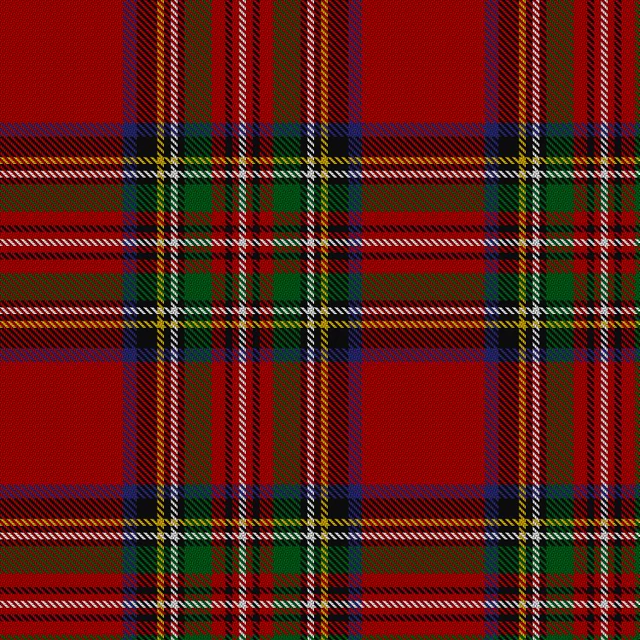
The Register’s Royal Stewart record adds a reason why Balmoral is the royal exception. It says George V tried to restrict Royal Stewart to the Royal Family, but that this ‘proved impossible because of its widespread use over many years as a popular fashion tartan’, so he restricted the Balmoral tartan instead. The Royal Stewart record has an empty restrictions field. Royal Stewart is a royal tartan with no recorded restriction. Balmoral is the royal tartan that is held back.
Other restrictions come from organisations that commissioned a design, and what they restrict varies. The Psychological Operations Regiment tartan, category Military, records an intention that it be worn by serving and former members of defined United States and allied units. The Royal Regiment of Fusiliers tartan, also Military, restricts something else: retail production is limited to one company and weaving to weavers it approves. That restriction says nothing about who may wear the cloth. Reading a record’s restriction text before assuming what it covers is the only reliable way to tell.
Neither the Black Watch (Government) nor the Royal Stewart record has anything in its restrictions field. The Black Watch record describes a tartan thought to have been designed in 1739 when the Independent Companies were consolidated as the 43rd, later 42nd, Regiment. Whether the regiment’s association has its own expectations is a question for the association; this guide found no rule that keeps civilians from wearing it. See Black Watch.
2. Approval by a chief
The Standing Council of Scottish Chiefs says that a tartan which uses the name of a clan may do so only if the chief of that clan has approved the particular design. The Register applies the same idea to naming. Where a tartan name is a surname that has a chief, head of the whole name or commander, written approval from that person is required, and the tartan goes into the Clan/Family category, which the Register defines as a tartan to be worn by members of a Scottish clan or family as recognised by the Court of the Lord Lyon. A new clan tartan must be approved by the chief. The Register also says the applicant must be the chief or hold the chief’s written authority, or, where there is no chief, hold the authority of the clan or family society.
This governs what a new design may be called. It does not stop anyone wearing an existing clan tartan, and nothing in the sources above says a chief can prevent it.
3. Custom
The chiefs’ council says there are no strict rules on who has the right to wear a particular tartan. People normally wear only the tartan, if any, of their surname, or a district tartan connected with where they live or where their family come from. It adds that wearing a particular clan tartan indicates that the wearer bears an allegiance to the chief of that clan. The Register’s advice to a visitor is similar: traditionally people wear the tartan related to their surname, and if there is none, a district tartan for the area their ancestors came from. It adds that a number of tartans have been designed for anyone to wear.
The National Library of Scotland makes a point that explains why custom, not law, governs this. Not every Scottish surname has a tartan, so people often wear the tartan of their mother’s maiden name or of a Scottish district.
Why clan tartans are a custom and not a rule
The custom is real, but it is not ancient, and that affects how much weight to give it.
The National Library of Scotland says there is no particular evidence that clan tartanry existed before the mid-18th century, and that the system of associating tartans with surnames developed in the 19th century, after Walter Scott’s arrangements for George IV’s visit in 1822. An encyclopedia entry drawing on National Museums Scotland’s Hugh Cheape says patterns have no traceable historical links with specific families or clans, and that the associations were actively promoted from the early 19th century by writers, weavers and tailors.
The Scottish Tartans Authority’s history of tartan supplies the mechanism. It says that most pre-1850 patterns bearing clan names trace back only to the early 19th century and the Bannockburn firm of William Wilson and Sons. When the Highland Society of London asked chiefs from about 1815 to send in sealed samples of their clan tartan, most of the samples appear to have been designed and woven by Wilsons, so they cannot predate about 1765, when that business began. Two cases are given: the chief of the Robertsons is said to have asked old men of his clan what the true pattern was, found no one agreed, and sealed a pattern that cannot be dated before the late 18th century; the chief of the MacPhersons sealed the cloth Wilsons sold as No. 43, which the firm had sold to a man named Kidd and later to a Mr MacPherson in the West Indies. The paper reads these as evidence that the idea of clan tartans took off in the early 19th century. In 1831 James Logan complained that the 1822 enthusiasm had led to curiosity about the tartans people were ‘entitled to wear’, and that ‘fanciful varieties of tartan and badges were passed off as genuine.’
The Register’s Black Watch (Government) record points the same way. The Cockburn Collection, 1810 to 1815, holds four specimens of that one cloth labelled Campbell Argyll, Grant, Munro and Sutherland.
A clan society’s statement of the position quotes Scott in 1829 calling the idea of distinguishing clans by tartan ‘a fashion of modern date’. We have only the society’s quotation, not the original.
None of this makes the custom empty. A clan society, a chief and a family may attach real meaning to a tartan whose association is under 200 years old. It does mean that ‘you must be of the clan to wear it’ is a social expectation with a known date of origin and not a historical law.
Who counts as belonging to a clan
The Standing Council’s guidance says every person who has the same surname as the chief is deemed a member of the clan, and that a person who offers allegiance to the chief is recognised as a member unless the chief decides not to accept it. That second clause explains how people with other surnames connect.
Sources disagree about someone who carries their mother’s clan name only as a middle name or ancestry. One reference article says some authors hold that membership passes through the surname and that a person without the clan surname, or a sept surname, should not wear their mother’s clan tartan. It also reports that some clan societies allow or deny permission to wear a chief’s personal tartan. The National Library of Scotland, by contrast, simply notes that people often wear the tartan of their mother’s maiden name. These are positions, not rulings. The two are reconciled in practice by asking the clan society, which is entitled to say whom it welcomes.
Septs and surnames
A sept list is a common way to find a tartan, and a weak one. The Clan Buchanan Society says sept lists date back to the 19th century when clan societies and tartan manufacturers tried to capitalise on enthusiasm for all things Scottish, linking as many surnames as possible to a clan whether or not there was a historical connection. It also says it is the chief’s prerogative to accept a family as a sept or affiliated family. The Clan Carruthers Society quotes Sir Thomas Innes of Learney, Lord Lyon from 1945 to 1969, writing in 1952 that septs ‘must be regarded as a rather wonderful effort of imagination’, and quotes Sir Crispin Agnew of Lochnaw that sept lists in clan and tartan books ‘have no official authority’. Both quotations are second-hand. See how to find your family tartan for how to weigh a sept link.
What the Register’s categories imply
Every registered tartan has one of nine categories. They describe what a design is for, not who may wear it, but they help.
| Category | What the Register says it is | What follows for wearing |
|---|---|---|
| Clan/Family | To be worn by members of a Scottish clan or family as recognised by the Court of the Lord Lyon | Custom of allegiance applies; the chief approved new ones |
| Name | Named for an individual or family | Often personal or immediate-family; check the notes |
| District | Associated with a geographical area | Customarily worn by people connected to the place |
| Corporate | A company or organisation | The organisation may expect membership or approval |
| Commemorative | Created for a specific public event or person | Read the record |
| Military | Any branch of the armed forces, including volunteer regiments | Read the record; restrictions vary |
| Royal | A direct connection to British or foreign royalty | Some are restricted, Royal Stewart is not |
| Fashion | Created for fashion or retail, usually without a personal association | No personal link is expected; check the record for restrictions |
| Other | Anything else | Read the record |
A registered family tartan can say who it is for. The Gallamore record, in the Clan/Family category, says it was designed for a woman of that name and ‘can be worn by all of the name’. That is the designer’s statement, not a rule.
A short way to decide
| If the tartan is… | Then… |
|---|---|
| A clan tartan for your own surname, or a clan you belong to | Customary and welcome |
| A clan tartan for a clan you have no link to | Legal; custom says it signals allegiance to that chief, so many people avoid it; the clan society can tell you its position |
| A district tartan | Customarily worn by people from or connected to the place |
| A tartan with a Military or Corporate category | Read the record’s restrictions and ask the body; they may restrict wearing, production or neither |
| A Royal tartan with a restriction stated, such as Balmoral | Do not wear or sell it without permission |
| Royal Stewart, Black Watch, or a design with no restriction stated | No restriction recorded in the Register |
| A tartan registered as Fashion, or one the Register’s advice describes as designed for anyone | No personal link expected; check the record for restrictions |
One reference article lists the Black Watch, Caledonia, Hunting Stewart, Jacobite, shepherd’s check and district tartans as traditional examples of ‘universal’ tartans that anyone may wear. That list is a convention in a level D source, and the Register’s own records are better evidence for any single tartan.
Worked cases
You have a Scottish surname with a clan. Wear your clan tartan if you wish; the chiefs’ council says this is what people normally do. If the surname appears only on a sept list, ask the clan society before treating the link as settled.
You have no Scottish surname but Scottish ancestry through your mother. The sources disagree on whether her clan tartan is yours. A district tartan connected to where her family lived is the option every source accepts.
You want a tartan for a wedding or kilt hire. A design with no recorded restriction, such as Black Watch or Royal Stewart, avoids the question. If the party is wearing a particular clan tartan for a family reason, ask the family, not the shop.
You have found a tartan with a stated restriction. Read what it covers. The Fusiliers record limits who produces it. The Psychological Operations record states who it is intended for. The Balmoral records limit who wears it.
Manners
Most people do not mind who wears their tartan, and wearing one with respect is not controversial. Where the stakes are social, such as a clan gathering, a wedding with a kilted party or a regimental event, ask the host or the clan society. They set the expectation, not the law. For the garment itself, see what is a kilt and types of kilts.
Continue learning

Related guides
Sources & further reading
- Scottish Register of Tartans: frequently asked questions
- Scottish Register of Tartans Act 2008, section 2: the Scottish Register of Tartans
- Tartan: who may wear it (Standing Council of Scottish Chiefs)
- What are septs? (Clan Buchanan Society)
- The romantic myth of a clan sept
- Tartan
- Scottish Register of Tartans: Stewart, Royal
- Scottish Register of Tartans: Black Watch (Government)
- Scottish Register of Tartans: restrictions
- Scottish Register of Tartans: categories
- Scottish Register of Tartans: tartan name guidance
- Scottish Register of Tartans: King Charles III (reference 14030)
- Scottish Register of Tartans: Balmoral (Original)
- Scottish Register of Tartans: Balmoral (Green lines)
- Scottish Register of Tartans: Balmoral (Lavender)
- Scottish Register of Tartans: Balmoral Glen Gelder (reference 14550)
- Scottish Register of Tartans: Psychological Operations Regiment (reference 10822)
- Scottish Register of Tartans: Royal Regiment of Fusiliers (reference 11751)
- Scottish Register of Tartans: Gallamore (reference 1300)
- Guidance: who is a member of a clan (Standing Council of Scottish Chiefs)
- Scottish traditional culture: clans, tartan and heraldry
- A Short History of Tartan
- Tartan (Encyclopedia of Clothing and Fashion)
- Clan Carruthers: Tartan, the official position