Foundations
What is tartan?
A woven pattern of crossing coloured stripes, defined by its thread count. What makes a cloth a tartan, how the pattern is recorded, how old the evidence is, and what a registry entry does and does not prove.
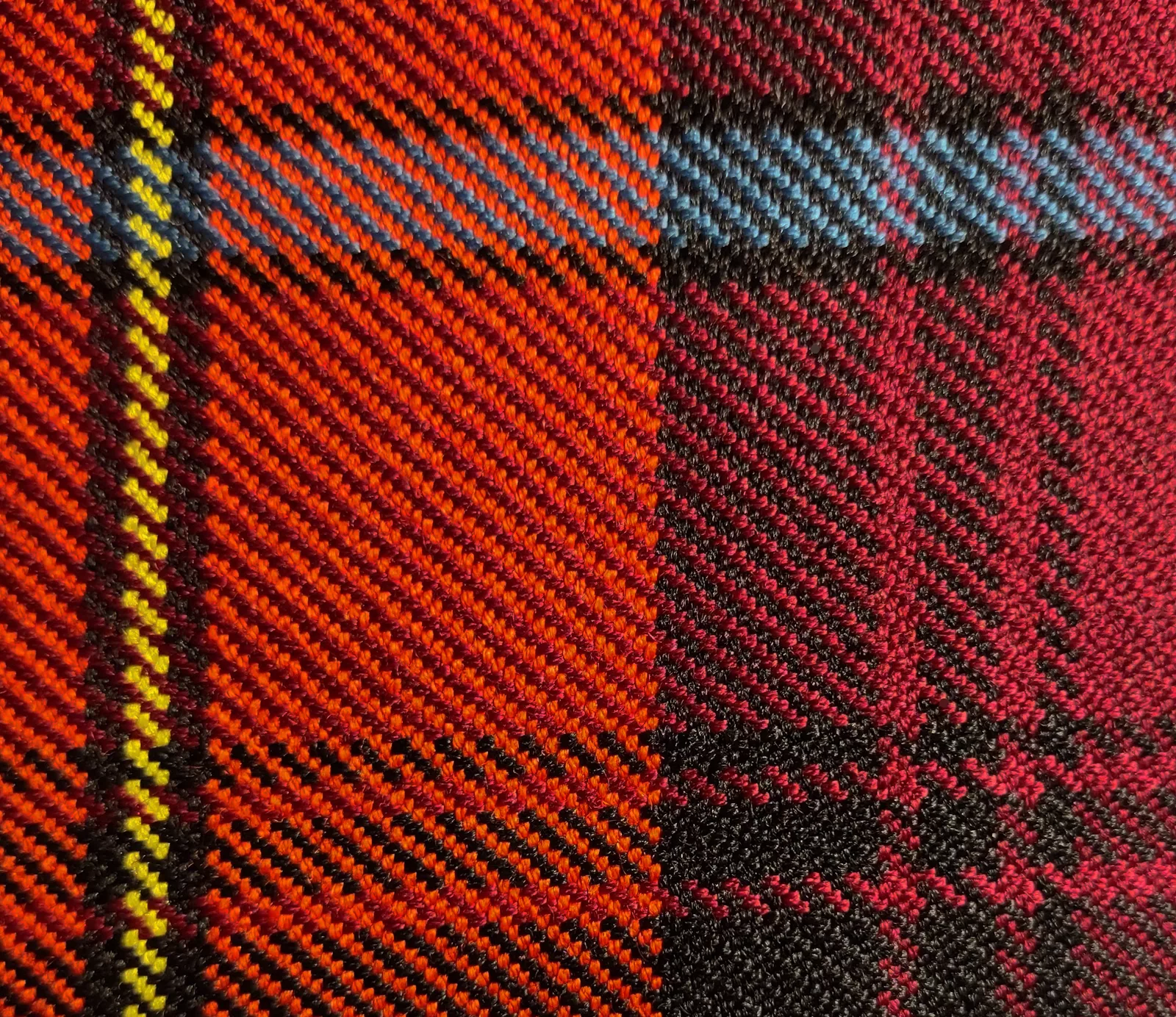

A tartan is usually woven in wool, but the pattern can be printed, knitted or reproduced on any material. What identifies a particular tartan is its sett: the smallest block of stripes that repeats across the cloth. Two cloths with the same sett and colours are the same tartan, whatever their weight or finish.
The definition says nothing about Scotland, clans, kilts or wool. Those associations are real, and most of this page is about how they formed, but they come from history and custom, not from what the word means.
How the pattern is built
Warp threads run the length of the cloth and weft threads cross them. In tartan the warp and weft carry the same stripe sequence, so where a red warp stripe meets a red weft stripe you get solid red, and where red crosses green the cloth shows a blend of the two. The Scottish Register of Tartans describes these as solid colours where matching shades cross and “half-tone” effects where different colours intersect. Those overlaps give tartan its extra colours and its checked look.
Most tartans are woven in a 2/2 twill: each weft thread passes over two warp threads and under two, shifting by one thread on every pass. The shift produces a faint diagonal in the cloth. The Register notes that most tartans use this weave, but twill is not part of the legal definition, which asks only that the design be capable of being woven. Some period cloth was woven with a different count in warp and weft, which gives stripes more than checks; the modern convention of a balanced, identical warp and weft is a convention, not a law of the cloth.
Reading a thread count
A sett is written down as a thread count: capital letters for colours, each followed by the number of threads in that stripe. The Register calls it the DNA of a tartan, because a weaver can set up a loom from it.
Its own worked example reads B24 W4 B24 R2 K24 G24 W2. That means 24 threads of blue, 4 of white, 24 of blue, 2 of red, 24 of black, 24 of green and 2 of white. It is an illustration of the notation and not a named tartan.
There are two kinds of count:
- Symmetrical (reflective). The pattern mirrors itself at pivot points, so only half is written, from one pivot to the next. The Register marks the pivots with a slash, as in B/24 W4 B24 R2 K24 G24 W/2. The weaver reads the sequence forward to the second pivot and then back again. In the example, the stripe sequence between pivots uses 104 threads, and the full repeat, with the pivot stripes counted once each, is 182 threads.
- Asymmetrical (repeating). The pattern does not reflect. It has no pivots, and when it reaches the end it starts again from the beginning. The Register frames these counts with three dots at each end.
A count states proportions, not absolute size. The same count woven in a finer yarn gives a smaller repeat, and woven in a heavier one a larger repeat. Yarn weight, the dye shades chosen and the scale of the sett all change how the result looks, which is why a registry entry or a clan society may hold a specification and a swatch that do not match exactly.
Colour variants
Many tartans are sold in several palettes, named “modern”, “ancient”, “weathered” and similar. These describe sets of dye shades, not different patterns and not the age of the design. The reasoning behind the names is partly historical: vegetable and other natural dyes were used until about 1855, and the first of the chemical dyes, Perkin’s Purple, was produced in 1856. The stronger, darker shades the new dyes gave are what “modern” colours reflect. One tartan writer with no named credentials argues that the “ancient” palettes of the mid-20th century are paler than genuinely old specimens, and that the origin story told for “reproduction” shades (a piece dug up at Culloden in the 1950s) has never been documented by the firm that introduced them. Treat the labels as trade palettes. If a design’s authenticity matters, ask for the threadcount and the registry entry, not the palette name.
Where the word comes from
The Dictionary of the Older Scottish Tongue entry for tartan was unavailable when this page was written (the dictionary site reported a fault in the source file), so the earliest dictionary citations were not checked. Reference works give an uncertain origin. The Online Etymology Dictionary dates the English word to the mid-15th century as a kind of woollen fabric, probably from French tiretaine, meaning a coarse, strong cloth, and gives the sense of a woollen cloth woven with crossing stripes of colour from about 1500 in Scotland. Other derivations are proposed, including Gaelic tarsainn, “across”, and French tartarin, a rich cloth; sources disagree and none is conclusive.
The word, then, first named a kind of cloth, and only later a pattern in the modern sense. This matters because an early record of the word does not tell you the cloth was striped, and an early striped cloth does not tell you what it was called.
What counts as the earliest tartan
Checked and striped woollen cloth is old, and no single piece is a definitive “first tartan”.
The best-known early find is the Falkirk fragment. On 9 August 1933 workmen levelling ground near Falkirk, a short distance from the Antonine Wall, broke into a buried Roman jar holding nearly 2,000 silver denarii, the latest of them dating the burial to around AD 230. A piece of woollen cloth had been pushed into the mouth of the jar as a stopper. It is held with the hoard by National Museums Scotland. The technical report is G. M. Crowfoot, “Two Textiles from the National Museum, Edinburgh”, in the Proceedings of the Society of Antiquaries of Scotland for 1950. We have not been able to read that paper, which our fetcher could not access, so the details below come from a secondary website of unestablished authorship and are reported, not confirmed:
- a small check of two natural wool colours, dark brown and a pale greenish cream, with no dye;
- woven as a 2/2 twill, in a check of roughly eight threads in each direction;
- spun in the Z direction, whereas most later tartans are described as S-spun.
What the fragment shows is that weavers in Roman-period Scotland could make a patterned check in natural-coloured wool on the same twill ground that later tartan used. What it does not show is any continuity of tradition between a third-century stopper and a Highland cloth of the 1500s. Nothing in the record links them, and a claim that the Falkirk piece was an ancestor of clan tartan goes beyond the evidence.
The first written appearances are Scottish. The Wikipedia article on tartan, which reproduces the references, quotes the Treasurer’s accounts of 1532 to 1533 recording “ane uthir tartane galcoit gevin to the king be the Maister Forbes”, another tartan coat given to the king, and an entry of 1538 for King James V’s tailor, Thomas Arthur, listing “heland tertane to be hoiss”, Highland tartan for hose. These show that the word and a Highland association with the cloth were in use at the Scottish court by the 1530s. They do not say what the patterns looked like.
From regional cloth to named tartans
For much of its history tartan in the Highlands was a matter of what weavers in an area produced, what dyes were to hand and what the wearer could afford. It was not a code of clan identity. The Wikipedia article on tartan, summarising specialist work, describes the Independent Highland Companies raised in 1725 to 1729 as wearing uniform tartans of blue, black and green with differencing over-checks. These companies were amalgamated in 1739 into the regiment later numbered the 42nd, the Black Watch, and its tartan became a base for later regimental and clan designs. That is a military uniform, chosen by the army, which is a different thing from a family pattern.
The Dress Act, 1746 to 1782
After the Jacobite rising of 1745, Parliament banned Highland dress in 1746. Wikipedia’s summary of the Act gives these points: it came into force on 1 August 1746; it named “the Plaid, Philabeg, or little Kilt, Trowse, Shoulder-belts” and tartan or party-coloured plaid for coats; the penalty was six months in prison for a first offence and seven years’ transportation for a second; and soldiers in the king’s forces were exempt. The History of Parliament Trust describes the ban and its military exemption in the same terms and records the repeal in 1782, which the Highland Society of London helped to secure.
The ban did not end tartan weaving. The best-documented producer in this period is William Wilson and Son of Bannockburn, near Stirling, outside the Highlands. The Wikipedia article on tartan, summarising specialist work, says the firm was founded around 1765 and from about 1770 produced virtually all regimental tartan, and that by the 1790s some gentry were helping to design tartans for their own use, according to surviving Wilson records. The firm’s papers are held at the National Library of Scotland (MSS.9662 to 9684, covering 1709 to 1886), though we have not read the finding aid and the firm’s own pattern books are the primary evidence for this period.
Naming by clan
The idea that each clan has its own tartan hardens in the early 19th century. In 1815 the Highland Society of London, founded in 1778, resolved to ask chiefs for samples of their clan tartans, to be authenticated by the chief; the account comes from a web source of unestablished authorship, so treat it as reported. In 1822 George IV visited Edinburgh between 12 and 29 August. Walter Scott staged the visit, and Highland dress was expected at its events. The effect was to make tartan, which had been the dress of a region and of regiments, a national costume that Lowlanders also wanted to wear, and so to create demand for named patterns.
Scott himself was sceptical of the clan idea. In a letter of November 1829, discussed in the Wikipedia article on the Vestiarium Scoticum, he wrote that “the idea of distinguishing the clans by their tartans is but a fashion of modern date”. The Vestiarium Scoticum, published by William Tait of Edinburgh in 1842 under the name John Sobieski Stuart, claimed to reproduce a 15th-century manuscript of clan tartans. It is now generally accepted that neither the authors nor the book were what they claimed, yet its designs fed into patterns still recorded as clan tartans.
The wider historiographical argument is Hugh Trevor-Roper’s chapter “The Highland Tradition of Scotland” in The Invention of Tradition (1983), which holds that the distinct Highland culture of kilt and clan tartan is largely a retrospective invention. That reading is influential and has been challenged, and this site does not rest anything on it. A narrower point is better supported. Wikipedia quotes the researcher Peter Eslea MacDonald as concluding that most pre-1850 patterns bearing clan names can be traced back no further than the early 19th century and the Wilson firm. Which tartans a clan wore before then, and how old any given named design is, is often undocumented.
Kinds of tartan
Tartans are grouped by what they are linked to. This is how the site classes them; the lines between groups are not sharp, and one design can sit in more than one.
- Clan or family tartans, associated with a clan or family and, for the use of a clan name, approved by the chief.
- District tartans, associated with a place instead of a family.
- Military tartans, associated with a regiment or unit. The Black Watch tartan, for instance, is recorded here as a military tartan.
- Corporate, commemorative and fashion tartans, designed for an organisation, an event or a collection.
- Universal tartans, designed to be worn by anyone.
Who may wear each kind is a separate question, answered in who can wear which tartan.
Registration
The Scottish Register of Tartans was opened in 2008 under the Scottish Register of Tartans Act 2008 and is run by the National Records of Scotland. It describes itself as a single independent record to promote and preserve information about historic and contemporary tartans. It passed 10,000 registered designs in April 2025, and accepts designs from families, clubs, companies and productions around the world. Heritage is not a requirement: the Register states that you do not have to be Scottish to register a design.
What the Register checks:
- A threadcount. An application without one is rejected.
- A unique name. A name must be unique within the Register, and the applicant needs authority to use it. A name belonging to a company or another person needs written consent.
- Difference from existing designs. A design must be sufficiently different from registered ones to avoid confusion. Applicants can compare designs before submitting, and the Register may still ask for changes.
- Clan status. A new clan tartan must be approved by the clan chief, and only clans and families recognised by the Court of the Lord Lyon qualify to be registered as clan or family tartans.
What registration does not do:
- It does not confer copyright or design rights. The Register says inclusion does not protect your intellectual property, since copyright is not devolved to Scotland. The explanatory notes to the Act deal with this at registration: an applicant who holds rights in the design must authorise the Keeper to register it, and every applicant must give an indemnity against any damages the Keeper has to pay as a result.
- It does not verify history. Registry notes are good evidence for registry facts, such as what was recorded, when and by whom. They do not by themselves show how old a tartan is, or that a family connection claimed in the notes is sound.
- It does not give every surname a tartan. The Register says there is not a tartan for every name, even though the name may be Scottish. To trace one, see how to find your family tartan.
Reading a tartan claim
When a seller, a society or a book makes a claim about a tartan, four checks cover most of it:
- Is there a thread count? Without one, a “tartan” cannot be reproduced or compared. A colour description is not a specification.
- Is it in the Register, and under what name? Registry data tells you who submitted it and when, which is often later than the claimed origin.
- What kind of tartan is it? Clan, district, military and fashion designs carry different expectations, which the next guide covers.
- Does the date have a document? A first-recorded date from a dated pattern book, regimental order or registry entry is evidence. “Traditional” or “ancient” is not.
Related
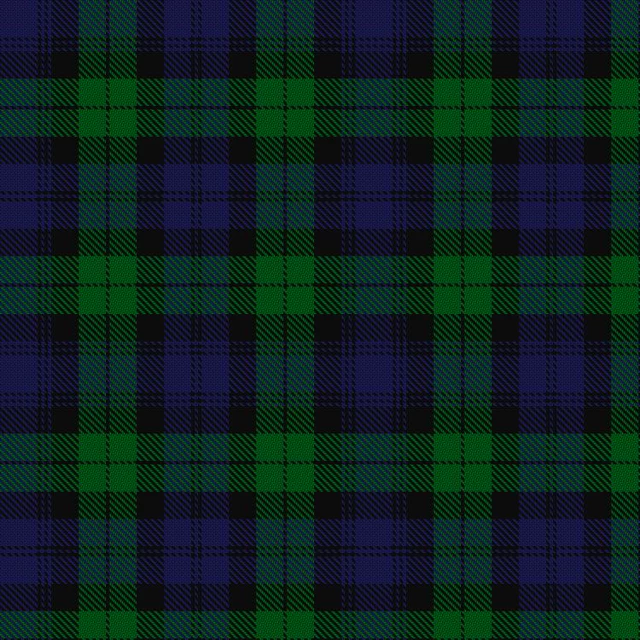
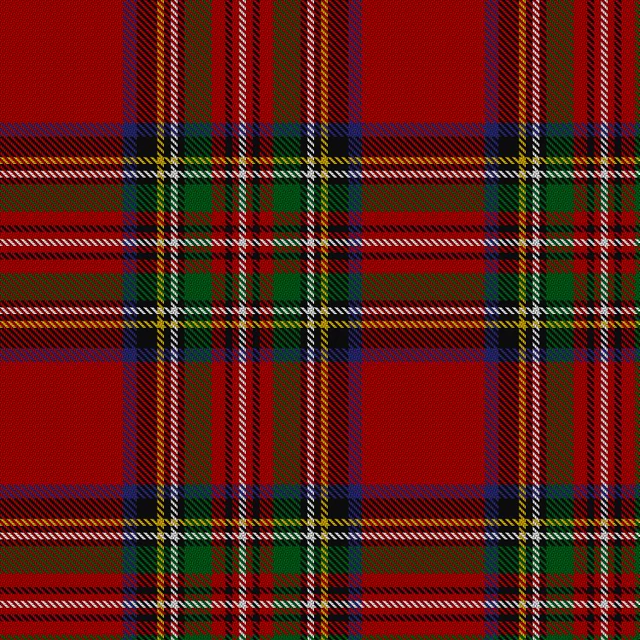
Two tartans documented on this site show how the record varies: Black Watch and Royal Stewart. For the difference between this word and “plaid”, read tartan vs plaid.
Continue learning
Related guides
Sources & further reading
- Scottish Register of Tartans Act 2008, section 2: the Scottish Register of Tartans
- Scottish Register of Tartans: frequently asked questions
- The Scottish Register of Tartans: threadcount guidance
- Scottish Register records 10,000th tartan
- Scottish Register of Tartans Act 2008, explanatory notes on section 6
- Tartan
- What is Tartan? (tartandictionary.org)
- The Falkirk Tartan (tartandictionary.org)
- Two Textiles from the National Museum, Edinburgh
- Tartan (Online Etymology Dictionary)
- Tartan colour variants (scottishtartans.co.uk)
- William Wilson and Son, tartan manufacturers, Bannockburn (papers)
- A Farewell to Arms, Kilts and Sporrans: banning Scottish Highland dress in the aftermath of Culloden
- Dress Act 1746
- Highland Society of London
- Visit of George IV to Scotland
- Vestiarium Scoticum
- The Highland Tradition of Scotland (in The Invention of Tradition, ed. Hobsbawm and Ranger)