Tartan fabric
Types of tartan fabric: weaves, finishes and look-alike cloths
Cloth sold as tartan differs in yarn, weave and finish, and several popular checked fabrics are not tartan weave at all. This guide separates the kinds and says what the evidence supports.
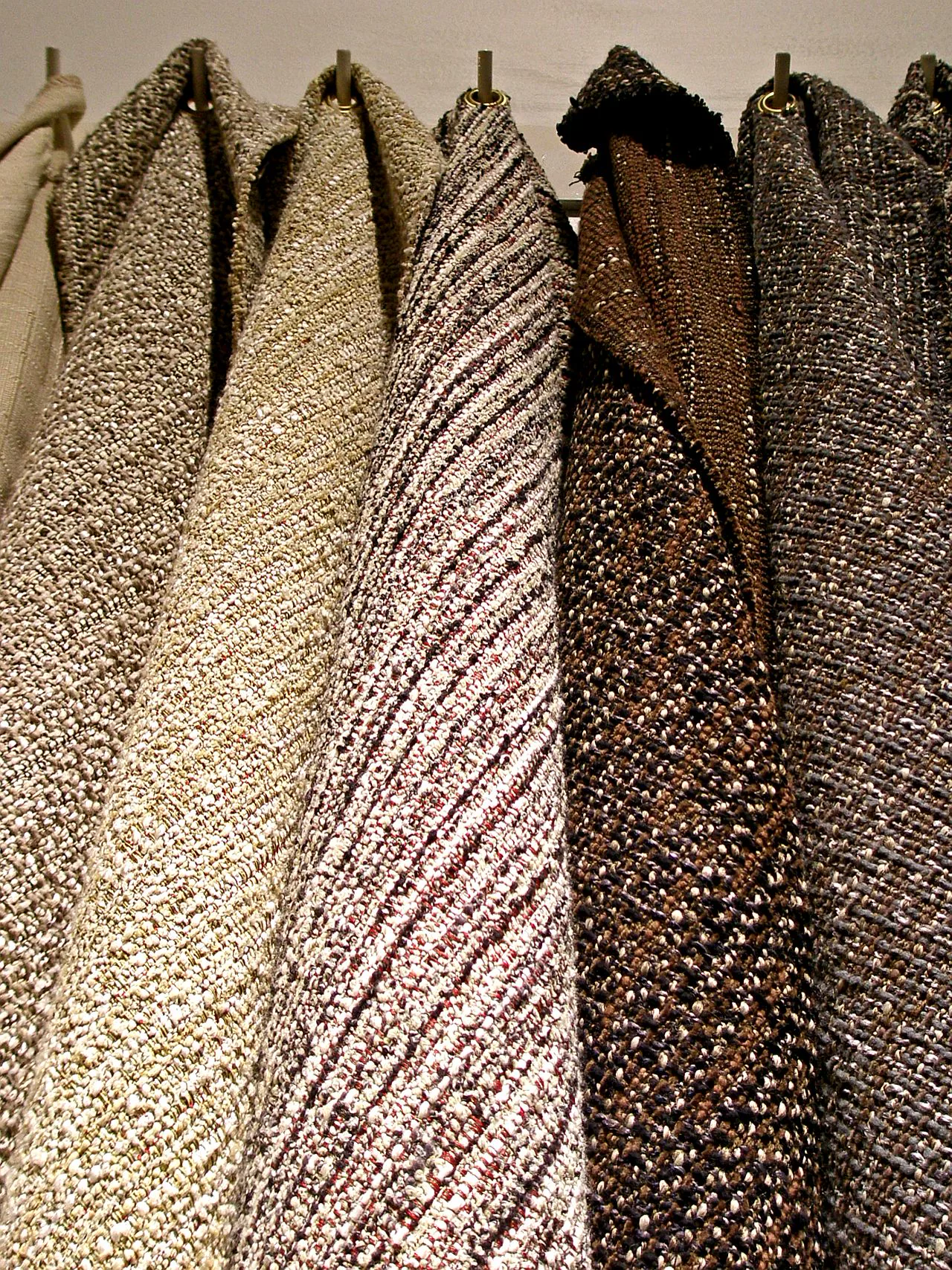

There are three separate questions behind “what kind of tartan fabric is this”: what the yarn is, how it was woven, and what was done to the cloth afterwards. Most listings answer only the first. This page takes the three in turn, then covers the checked cloths that borrow the look of tartan without sharing its construction. For weights, widths and swatch reading, see the tartan fabric hub; for a head-to-head of fibres, see wool against acrylic.
The reference type: worsted wool in a 2/2 twill
Tartan in its traditional form is worsted wool woven as a 2/2 twill. The weft passes over two warp threads and under two, stepping one thread sideways on each pass, which leaves a diagonal rib at about 45 degrees. One reference account says a 2/2 twill gives a cloth about 50 per cent denser than a plain 1/1 weave of the same yarn gauge, and so more weatherproof (Wikipedia). That is an encyclopedia statement rather than a measurement, but the direction of the claim matches what weaving references say about twill in general: the longer floats and offset interlacing spread stress, so twill resists abrasion and wrinkling better than plain weave, and its smooth surface resists dirt and stains more effectively (Textile School).
Twill is also classed by the direction of the diagonal, S (left-hand) or Z (right-hand), and by its ratio: 2/1 and 3/1 twills exist, and denim is a 3/1 warp-faced example (Wikipedia). Tartan is the 2/2 case. The same reference notes that twills have a technical face and back, unlike plain weave.
What “worsted” means
Worsted yarn is made from long-staple wool whose fibres are combed straight and parallel before spinning, which removes short fibres and, per the encyclopedia account, the natural crimp. The result is a stronger, finer and smoother yarn than woollen spinning produces (Wikipedia). A hand-weaving supplier makes the same point for tartan specifically: worsted spinning aligns the fibres, giving a smooth texture, more sheen and better drape than the same cloth woven from woollen-spun yarn. It also warns that “worsted weight” and “worsted spun” are different things, one being a thickness class for knitting yarn and the other a way of preparing the fibre (Camilla Valley Farm). That supplier’s own figures, a 2/16 yarn at 4,400 yards per pound set at 32 to 36 ends per inch in twill, are for handweavers and say little about mill cloth, though it notes that one machine-woven mill sample was about 40 ends per inch.
Hard cloth and finished cloth
Straight from the loom, tartan can be harsh and uneven. The encyclopedia entry on tartan describes “hard tartan” as cloth made from tightly wound, non-fuzzy thread, a rougher and denser material that was common until the 1830s (Wikipedia). Some makers still offer a hard finish for people who want cloth closer to what they think earlier weavers produced, though the sources read for this page do not say which makers or in what quantities.
The finishing that softens cloth is a separate step from weaving, and its names are used loosely. Fulling, also called waulking in Scotland, cleans cloth of oils and dirt and shrinks it by friction and pressure; the milling half of the process interlocks the fibres by felting and tightens the cloth (Wikipedia). Yet the general reference on worsted says worsteds were traditionally scoured but not fulled (Wikipedia). Both can be true of tartan: a mill may scour and press worsted cloth lightly rather than full it as heavily as a woollen. This page could not obtain a mill’s own technical account of what its finishing line does, so it does not claim a specific process, temperature or shrinkage figure.
Woollen-spun cloth: tweed is not tartan
Tweed is a rough, soft, open woollen cloth that can be woven in plain, twill or herringbone structures. Its colour effects come from mixing dyed wool before it is spun, rather than from a set sequence of coloured warp and weft threads (Wikipedia). That makes tweed a texture-first cloth and tartan a pattern-first cloth. The two are different fabrics even when a tweed carries a check, as in houndstooth or Glen plaid.
The word itself is said to be a trade accident. The same source relays a traditional story that a London merchant around 1831 misread “tweels”, Scots for twill, on correspondence from a Hawick mill as a reference to the River Tweed, and the cloth was marketed under that name. It also notes that bagpipes were sometimes covered in tweed as an alternative to tartan.
Harris Tweed is the one tweed with a legal definition. Under the Harris Tweed Act 1993 it must be hand woven by islanders at home in the Outer Hebrides, finished in the islands, and made from pure virgin wool dyed and spun there; the Harris Tweed Authority, a statutory body set up by the Act, maintains the standard and the Orb mark (Wikipedia). A Harris Tweed in a tartan pattern is possible in principle, but nothing read for this page establishes how common it is, so do not assume one exists for a named tartan.
Wool blends and cashmere
Not all wool tartan is pure worsted. A Savile Row tailor describes two tartans woven with a 100 per cent worsted warp and a 100 per cent cashmere weft, 11 ounces in weight, which it describes as lighter and softer than traditional tartan (Huntsman). That is a tailor describing its own cloth, so treat it as an example that such constructions exist rather than as a trade norm.
Cashmere is the fine undercoat of the cashmere goat. US labelling rules, as summarised by the encyclopedia, require an average fibre diameter of no more than 19 microns, no more than 3 per cent of fibres over 30 microns by weight, and a coefficient of variation no higher than 24 per cent. The fibre is often blended with others to cut cost or to add properties such as elasticity from wool or sheen from silk (Wikipedia). The US figures are a labelling rule for the US market, not a UK or Scottish standard.
Kinloch Anderson lists its wool tartan as 100 per cent wool in lightweight, medium and heavy grades, plus “Hand of England” variants of each and special ranges at extra cost; it sells by the metre in 140 cm double width, or 80 cm single width where a tartan is only woven that way (Kinloch Anderson). The listing does not define what “Hand of England” means, so it is a named range here, not a described finish.
Synthetic and viscose tartan
Polyviscose is the common name for polyester and viscose blended. Viscose is a regenerated cellulose fibre that takes dye well and drapes softly, but loses strength when wet, and regular viscose is described as dry-clean only; it is often blended with polyester to improve durability and reduce shrinkage (Wikipedia). Polyester resists wrinkling and absorbs little water, and as a thermoplastic it can be heat set (Wikipedia). Together these match one retailer’s description of polyviscose tartan as colour-holding and easier to care for than wool, with a similar look but not the same weight or feel (UT Kilts).
Acrylic is the other common synthetic, described by a trade publisher as wool-like in feel at lower cost, low in water absorption, and prone to pilling (Fibre2Fashion). Woolmark credits wool, not these fibres, with natural crimp that helps shape recovery (Woolmark), though it is a wool body and the claim is promotional in tone. No independent comparison of pleat retention was found, and the comparison itself is the subject of the wool against acrylic guide.
Checked cloths that are not tartan weave
Three common fabrics carry tartan-like checks without being a 2/2 worsted twill. They matter because “tartan flannel”, “madras” and “gingham plaid” appear in product listings alongside real tartan, and the cloths behave differently.
Flannel is a fabric type, not a pattern. It is a soft woven cloth, originally of carded wool or worsted yarn and now also of cotton or synthetics, made in twill or plain weave and often brushed with a fine metal brush to raise a nap, which can hide the weave. The encyclopedia entry notes that “flannel shirt” is widely misapplied to any plaid shirt and describes the origin as uncertain, with a Welsh origin suggested and a similar Welsh fabric referred to in the 16th century (Wikipedia). A brushed cotton in a tartan-style check is therefore a flannel carrying a plaid, and has none of the worsted structure.
Madras is a lightweight cotton originally from Chennai, authentically hand woven and checked or plaid in design; authentic madras is meant to show the same pattern on both sides, and its dyes are known to bleed when washed (Wikipedia). Gingham is a medium-weight balanced plain weave of dyed cotton or cotton-blend yarns, typically in checks, stripes or plaid-style duotones; it was striped when first imported into Europe in the 17th century and from the mid-18th century was increasingly woven in checks (Wikipedia). Because both are plain weave, they lack the diagonal rib.
| Cloth | Typical yarn | Weave | What to watch |
|---|---|---|---|
| Traditional tartan | Worsted wool | 2/2 twill, same sett in warp and weft | Check width, weight and whether the cloth is hard or finished. |
| Wool and cashmere tartan | Worsted wool with cashmere | Twill | Softer; one tailor lists 11 oz. Blend structure varies by maker. |
| Polyviscose or acrylic tartan | Synthetic or regenerated fibre | Usually twill | Fibre percentages are often unstated. |
| Tweed with a check | Woollen-spun wool | Plain, twill or herringbone | Pattern comes from mixed dyed wool, not a sett. |
| Flannel plaid | Cotton, wool or synthetic, often brushed | Twill or plain | Nap can hide the weave; flannel names a fabric, not a pattern. |
| Madras | Cotton | Plain, hand woven | Dyes bleed in washing; not tartan weave. |
| Gingham | Dyed cotton or blends | Balanced plain weave | Checks, not a tartan sett. |
Older and rarer weaves
Cloth sold today is a narrow slice of what has been woven. A fragment from a Highland peat bog, reported in 2023, was dated by radiocarbon to the first half of the sixteenth century. Its chemical analysis found no artificial dyes, which first became available in the mid-nineteenth century, and described a red and yellow ground with green overstripes, with a dark brown that may come from the fleece’s natural colour, in a rustic weave with pattern inconsistencies (Archaeology). The encyclopedia entry on tartan adds that some uncommon early 18th-century samples of hard tartan are woven in herringbone rather than twill, and that before the 19th century weft threads were often up to a third thicker than the warp, which affected how setts were counted (Wikipedia). None of these constructions is a current product category, but they explain why historical reproductions and modern cloth need not match.
The same entry separates balanced-warp weaving, where the pattern repeats from a centre pivot and finishes with complete setts at each edge, from offset or unbalanced weaving, where the cloth ends mid-pattern because pieces are meant to be seamed. If you are matching a pattern across a seam, that distinction is worth asking about.
Choosing between them
For a pleated garment that has to hold a sharp line, the sources read here point to worsted wool twill as the reference construction, with synthetic alternatives offered as lower-maintenance but different in weight and feel. For cushions, curtains or ribbon, the weave matters less than colour range and width. The sibling pages on tartan home decor and tartan pillows cover those uses. For the vocabulary underneath all of this, see what tartan is and tartan against plaid.
What the evidence does not show
Most of the technical statements above come from general reference works, not from a mill or standards body. Three gaps are worth stating. No source read for this page gives an independent comparison of how wool, blend and synthetic tartan wear or hold pleats. No mill source read gives its own finishing steps for worsted tartan. And commercial weight and range names, such as light, medium, heavy or Hand of England, are the sellers’ own and not defined by a trade standard. Where a claim here rests on a single retailer, the text says so.
Related guides
Sources & further reading
- Tartan
- Characteristics of Twill Weave: structure, properties and applications
- Wool tartan fabric by the metre
- What is the wool fibre?
- What is polyviscose? Fabric and kilt use explained
- What is acrylic fabric: properties, varieties, uses and global market
- Worsted
- Fulling
- Flannel
- Tweed (cloth)
- Harris Tweed
- Twill
- Tartan weaving yarn
- Scotland's oldest tartan
- Huntsman tartans
- Cashmere wool
- Rayon
- Polyester
- Madras (cloth)
- Gingham
- Tartan cloth by the metre