Home
Tartan Blankets and Throws: Fibre, Size, Care and History
What a tartan blanket or throw is made of, how big the listed sizes are, why makers and the wool industry give different care advice, and what surviving eighteenth-century barred blankets do and do not show.
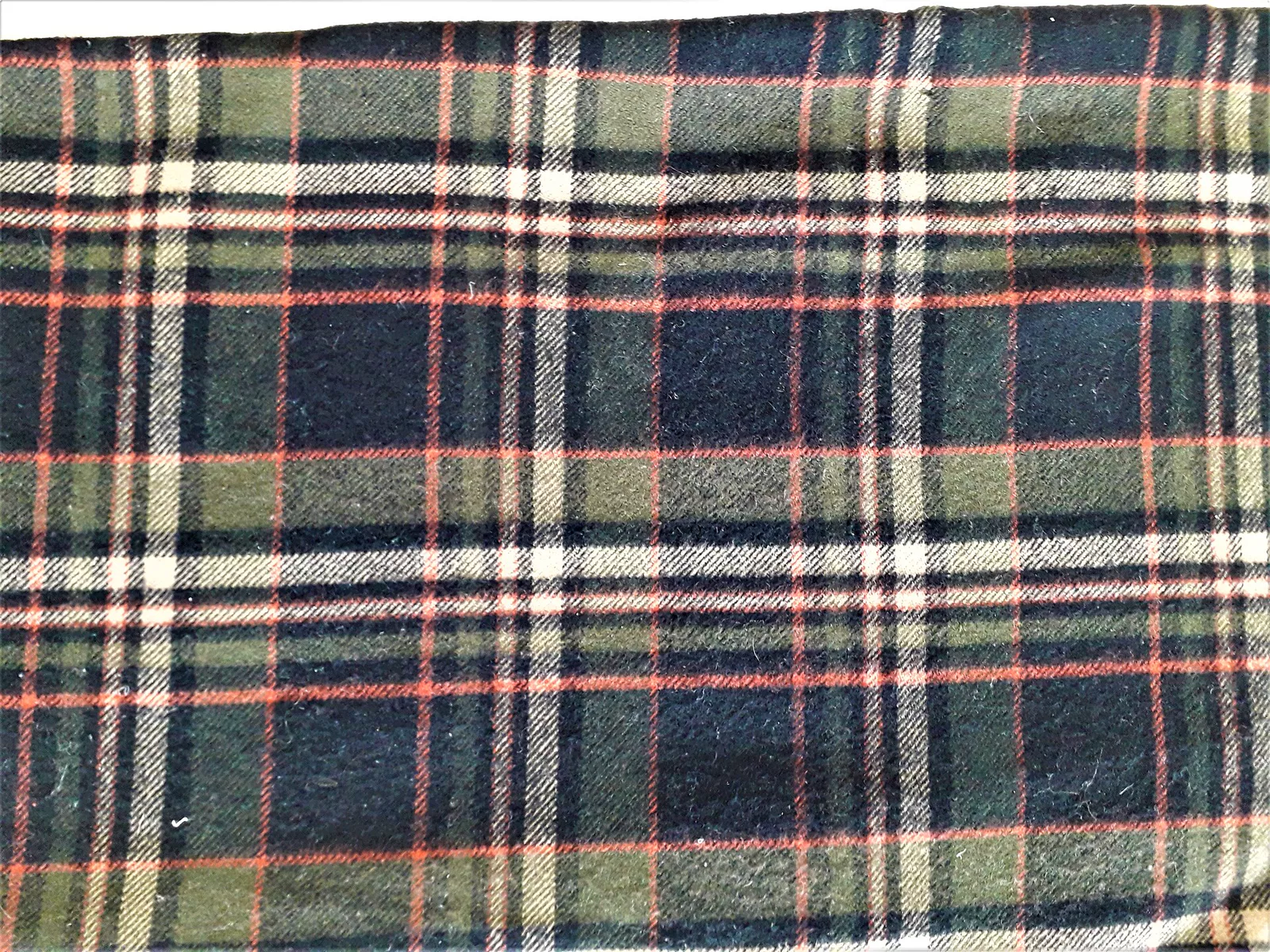

A tartan blanket is a blanket first and a pattern second. The tartan tells you which sett was woven; it says nothing about the fibre, the weight, the size or how the cloth should be cleaned, and those four decide whether the blanket suits a bed, a sofa or a picnic. The checks below start with the listing details you can compare and end with the history, because the oldest surviving Highland blankets are more modest, and less tied to clans, than modern product pages suggest.
The wider design questions, including how much tartan a room can carry, are on tartan home decor. Rugs and cushions have their own pages; this one is about blankets and throws. For the meaning of the word in Scotland and North America see tartan vs plaid.
Read the fibre line
Wikipedia lists wool, cotton, acrylic, polyester, mink and fleece as the common blanket materials, and says wool blankets are warmer than cotton and relatively slow to burn (Wikipedia). Tartan blankets are sold in most of these. For wool, three terms appear on listings and they are not interchangeable.
Lambswool is a defined kind of wool: Wikipedia says it is wool of 50 millimetres (2 inches) or shorter from a sheep’s first shearing, usually at around seven months, and describes it as soft, elastic and slippery (Wikipedia). A listing that says only “wool” has told you less. Two maker listings read for this page show the problem. Lochcarron’s clan tartan throw is stated as “100% lambswool”. Johnstons of Elgin names its double-face check throw a lambswool throw, but the fibre line on the same product page reads “100% Wool”. The two are not necessarily in conflict, since lambswool is wool, but the second line does not confirm the first. Where the distinction matters to you, ask the maker.
The Woolmark Company, an industry body, publishes fibre figures from a CSIRO factsheet that show why wool is often chosen for blankets and bedding where flame is a concern.
| Fibre | Limiting oxygen index (%) | Ignition temperature (°C) | Melting temperature (°C) |
|---|---|---|---|
| Wool | 25.2 | 570 to 600 | Does not melt |
| Cotton | 18.4 | 255 | Does not melt |
| Polyester | 20.6 | 485 to 560 | 252 to 292 |
| Nylon | 20.1 | 485 to 575 | 160 to 260 |
Woolmark’s reading is that wool needs more oxygen than the atmosphere holds (about 21 per cent) to burn, does not melt or drip, and tends to self-extinguish when the flame is removed (Woolmark). These are laboratory figures about fibres from a body that promotes wool. They do not rate a finished blanket, they say nothing about acrylic, which is not in the table, and they are not a reason to leave a blanket near a heater or open fire.
The same body says wool blankets “have been shown to offer better thermal insulation, moisture transport, and moisture buffering” than a cotton and acrylic blanket (Woolmark). The page’s reference list includes a 1986 paper in the Journal of the Textile Institute, but the numbering is garbled and the link between that paper and the blanket claim is not clear. The page gives no sample size or method. Treat it as a marketing statement from an industry body, not as a current comparison, and not as evidence about any particular tartan throw. Wool compared with acrylic as tartan cloth is covered on wool vs acrylic tartan, and the cloth side of the question on tartan fabric.
What the listed sizes are
Two Scottish makers’ listings give figures that can be set side by side. Both are commercial pages and neither gives a weight.
| Maker and item | Fibre line | Stated size | Care label | Other statements |
|---|---|---|---|---|
| Lochcarron of Scotland, clan tartan lambswool throw | 100% lambswool | 140 by 185 cm (about 55 by 73 inches) | Dry clean only | Eleven tartans on offer; described as lightweight, soft and warm; made in the maker's Borders workshops. |
| Johnstons of Elgin, double face lambswool throw | 100% Wool | 190 by 140 cm (74.8 by 55 inches) | Dry clean; fold to prevent stretching | Reversible double-face construction, check pattern with fringe, woven as a picnic blanket; made in Scotland. |
The two throws are close to the same size, 55 inches by about 73 to 75, with the long side quoted first by one maker and second by the other. Nothing in either listing says whether the size includes the fringe. Neither listing sets out what “double face” means in structure. It is described as reversible, which implies a pattern readable from both sides, but no weave is stated. The tartans offered in the Lochcarron listing are named by the maker. A named tartan on a throw tells you the sett woven, not that the buyer belongs to a family or clan; for the real position on who may wear or use which tartan see who can wear which tartan.
For a bed blanket there is no source here. No independent measure was found for what size a throw or blanket should be for a bed or sofa, so the sensible step is to measure the piece of furniture, then compare with the stated size and ask whether the fringe is included.
Care: the wool body against the makers
The most obvious conflict on this subject is care. Both maker listings say the throw should be dry cleaned. The Woolmark Company’s own guidance for wool blankets is different, and it is written for blankets in general rather than for these two products (Woolmark).
| Point | Woolmark guidance | Maker listings read |
|---|---|---|
| Label | If the blanket is machine washable, follow its care instructions. | Dry clean (both listings). |
| Between washes | Shake outside, hang where air moves, brush along the grain with a soft garment brush. | Johnstons: fold the item to prevent stretching and distortion. |
| Washing | For heavily soiled blankets only: gentle wool cycle, cold water, wool detergent. No dryer. | Not recommended on either label. |
| Drying | Hang flat over a line outdoors, away from direct sunlight; the page warns a dryer can ruin softness and shape. | Not stated. |
| Stains | Spot clean at once with warm water and mild detergent; blot, do not scrub. | Not stated. |
| Storage | Dark, cool place in an air-tight container or bag; cedar chips to deter moths. | Not stated. |
The sensible reading is that the label on the blanket in your hand overrides general guidance, since the maker knows the finishing and the dyes. Woolmark’s advice is the fallback for a wool blanket that carries a machine-washable label. For a blanket that carries a dry-clean label, the airing and brushing steps in the middle of that advice involve no washing and so do not conflict with the label. Whether a particular dry-clean throw would survive a gentle wool wash was not established, and nothing read says it would.
What barred blankets show about the history
Modern product pages often present the tartan blanket as a clan object. The surviving evidence is less tidy, and more interesting.
Three things in that paper are worth keeping. First, the sett is very close to the Blanket Sett recorded in the 1819 Key Pattern Book of Wilsons of Bannockburn, which noted four half setts with a border. The author says he cannot tell whether Wilsons knew the Blair piece or copied a similar old pattern, and suggests the arrangement may have been a generic blanket pattern. Second, he says accurate dating is difficult because such domestic plaids, not being intended to be worn, were not banned by the Act of Proscription, although the structure, fineness and natural dyes suggest the first half of the eighteenth century. Third, he notes that no record at Blair says who owned it, and that very little research has been done on blanket patterns. Nothing in the paper connects the piece to a clan.
A second paper by the same author, from 2011, shows how reuse blurs the record. A tartan listed in the Scottish Tartans Society’s 1970s records as “Curtains Found at Nethybridge” appeared to be the same as a plaid the National Trust for Scotland bought in 2007 and displays at its Culloden visitor centre, and the author concluded that it was an eighteenth-century joined plaid of about 1730 to 1770 rather than curtains. It had been cut and reused, he could not say why, and the Trust did not tell the author from where or whom it was bought. The paper gives the plaid’s two lengths as about 27.5 inches wide each, a joined width near 55 inches, and says that old plaids were cut up for curtains, bed hangings and the like. A footnote adds that the Act of Proscription banned Highland dress, tartan coats and plaids, though not tartan itself (Nethybridge plaid).
What these two papers show, with their limits, is that in the eighteenth century tartan cloth served for bedding and hangings as well as dress, that a pattern might be a generic blanket sett rather than a family one, and that old plaids were reused. They are single-author papers on single objects, examined by eye from photographs or in the archive, with no laboratory dating. They do not show how common any of this was.
The commercial background is better recorded. The collection at Heriot-Watt University includes barred blankets alongside plaids and a kilt from the early nineteenth century, and the university says Wilsons of Bannockburn kept weaving tartan because it operated outside the area covered by the ban (Heriot-Watt). A news item on the Bannockburn archaeology project says William Wilson established the mill complex in the late eighteenth century, as one of the first factories in Scotland to mass-produce tartan, that it expanded in the first half of the nineteenth century and that demand rose after George IV’s 1822 visit to Scotland, and that the business declined from the start of the twentieth century, with the factory demolished in the 1950s (The Past). That item does not mention blankets or home furnishings, so Wilsons’ blanket sett is known from the 1819 pattern book as cited by MacDonald, not from the mill’s production history.
Before you buy
Related guides
Sources & further reading
- Blanket
- Lambswool
- An Unnamed 18th Century Blanket Pattern at Blair Castle
- An Unnamed C18th Plaid from Nethybridge
- Textile collection: tartan
- Rediscovering the tartan mills of Bannockburn
- Wool facts: wool is resistant to fire (GD2405)
- Merino wool blankets and pyjamas
- Scottish tartan pure lambswool throw
- Double face lambswool throw
- How to wash and dry wool blankets