Tartan fabric
Tartan fabric: weights, fibres, widths and how to read a swatch
Tartan cloth is sold by weight, fibre and width, and the weight decides what it can be made into. This page explains the terms and what to check before you buy.
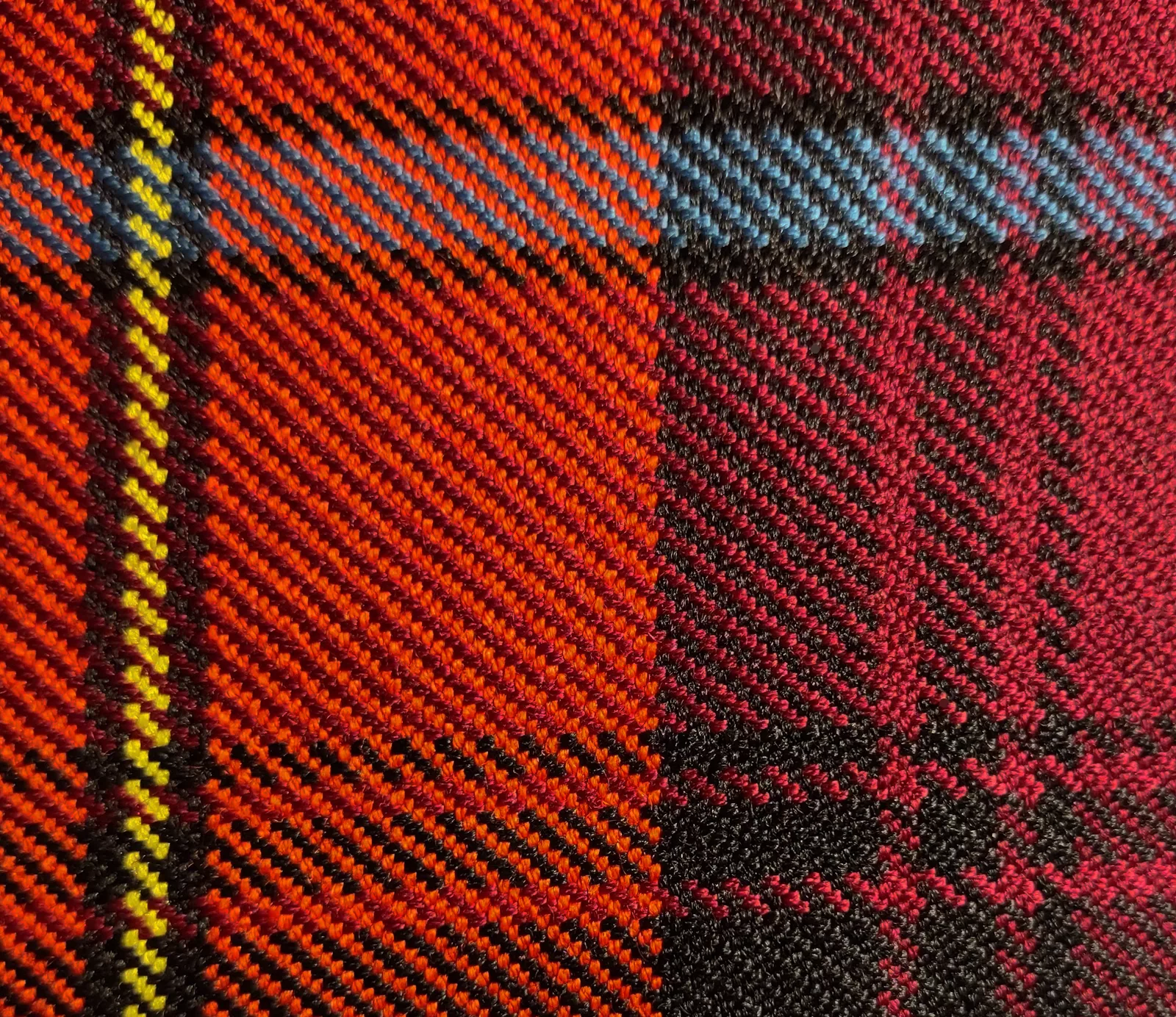

Three numbers on a tartan listing decide most of what the cloth can do: its weight, its fibre content and its width. The pattern is a fourth, separate choice. In North America the same cloth is often called plaid; the difference in usage is covered in tartan vs plaid.
Weight: what the ounces mean
Mill and kiltmaker weights are quoted in ounces per linear yard of cloth of a stated width. One small-scale research site gives its figures for cloth 54 inches wide (Crossing Tartans). Because the width is part of the definition, an ounce figure cannot be turned into grams per square metre without knowing it, and two sellers quoting “13 oz” may not be describing identical cloth.
| Weight (oz per linear yard) | Metric figure given | Uses listed by the source |
|---|---|---|
| 8 oz | 270 g | Cushion covers, soft furnishings, dresses |
| 10 oz | 335 g | Curtains, cushions, skirts, trousers, waistcoats, ties |
| 13 oz | 415 g | Kilts, heavy curtains, trousers, jackets |
| 16 oz | 500 to 515 g | Kilts, heavy trousers, jackets |
The figures above come from a single source, so treat the boundaries as indicative. Mills also use their own names. Kinloch Anderson sells “light”, “medium” and “heavy” cloth (Kinloch Anderson). Lochcarron names three kilt cloths, Reiver (lightest), Braeriach (medium) and Strome (heavy), and gives Strome as about 490 to 500 g per linear metre, or 16 oz per linear yard (Lochcarron). Both are retailers describing their own ranges, not a trade standard.
Kilt weight against lighter cloth
Practitioner notes agree on the broad picture. A highland-dance mailing-list guide says dancers’ kilts use 10 oz cloth and a man’s kilt uses 13 oz or, preferably, 16 oz (scottishdance.net). The Crossing Tartans authors say traditionalists favour 16 oz for durability, call 13 oz “respectable for a kilt”, and advise that a kilt in 10 oz or 8 oz is not recommended except for highland dancing. They also say the choice comes down to individual taste and suggest handling different weights before buying.
Lighter cloth is the usual choice for scarves, skirts, cushions and curtains. Heavier cloth suits garments that rely on hanging weight and pleat structure; what a kilt is made of and the main kilt types are covered separately.
Fibres: wool, polyviscose and acrylic
| Fibre | What the sources say | Limits of the evidence |
|---|---|---|
| Worsted wool | The traditional tartan fibre. Wool fibres are naturally crimped, which helps with insulation and shape recovery, and they take up moisture vapour. | The fibre source is a wool industry body, so its tone is promotional. |
| Polyviscose | A blend of polyester and viscose, described by one retailer as holding colour, resisting wrinkles, needing less care than wool and being lighter, with a similar look but not the same weight or feel. | Retailer description only; the blend ratio is not given. |
| Acrylic | Gives a wool-like feel at lower cost, absorbs little water, cannot be heat set and tends to pill with friction. | Read from a trade-publisher summary; not checked against the full text. |
Wool details come from Woolmark. The polyviscose description is from one retailer and the acrylic properties from Fibre2Fashion.
What the weave looks like
Tartan is woven as a 2/2 twill: each weft thread goes over two warp threads, under two, and steps one thread sideways on the next pass, which leaves a faint diagonal rib. Twill notation of this kind, and the longer floats that make the surface smooth, are explained by Textile School. In tartan the colour sequence of the warp is repeated in the same order and size in the weft, and a sett normally reverses at pivot points (Wikipedia).
Width: single and double
Kinloch Anderson states that most of its tartans are woven in double width, 140 cm, and some in single width, 80 cm. The highland-dance guide gives the standard width as 60 inches, about 152 cm. The two figures differ, so the stated width on the listing matters more than the label “double width”. Because yardage is quoted along the length, a narrower cloth needs more length for the same job.
Repeat size and how much cloth you need
The sett sets the scale of the pattern, and it varies between tartans. For a kilt the repeat matters directly: the highland-dance guide says a single pleat is made up of a full sett width, with about an inch showing. Its worked example is a 42-inch hip measurement needing 4 yards of double-width tartan with an 8-inch sett, and about 3.15 yards for a 6-inch sett.
That is one practitioner’s arithmetic, compiled from a mailing list, and it assumes a particular pleating method. Yardage for a kilt varies with sett size, pleating style and body size, so use the measuring guide and the maker’s own quote rather than a rule of thumb. Furnishing fabric works differently; the matching rule for curtains is on the home decor page.
Ribbon
Ribbon is a narrow product with its own listings. One Scottish retailer describes two kinds: wool tartan ribbon, which it says is made from strips of edged or hemmed wool cloth and is available in over 500 tartans, and polyester ribbon in a limited range of tartans (Scotland Shop). That is a retailer’s description, not a standard. The practical point is that the range of tartans you can find depends on the material, so check both before you settle on a pattern. Tartan webbing, which pet collars use, is a related product; the tartan dog collars page covers how it compares with leather and which hardware to look at.
Colour ranges: the same tartan in four shades
One tartan name can cover several cloths. The reference entry on tartan lists four standard palettes: modern, with darker, fully saturated colours; ancient or old colours, a lighter set suggesting aged cloth; weathered or faded, lighter again; and muted, between modern and ancient and described as closest to the results of natural dyes (Wikipedia). The same entry says natural dyes began to be replaced by artificial dyes in the mid-19th century, so “ancient” describes a shade, not a dyeing method.
For a buyer the consequence is practical. Two swatches labelled with the same clan or district name can look quite different side by side, and a screen photograph will not settle it. Ask for the range by name, and if you are matching an existing garment, ask for a physical swatch of the range it was made in. Mills also use their own range names, as the Kinloch Anderson listing does when it offers “Hand of England” variants of each weight alongside special ranges at a higher price (Kinloch Anderson). The listing does not say what the label means, so ask the seller to define it.
How dense the cloth is
Weight is one measure; thread density is another. The reference entry on tartan states that since about 1808 the standard warp reed width has been 37 inches, the Scottish ell, and that a 30-Porter reed has 600 openings across that width with two threads in each, giving 1,200 warp and weft threads per square yard (Wikipedia). That is a historical standard for the reed, not a specification for every cloth now sold, and modern mills use their own constructions. It is still a useful reference point when a listing quotes a thread count: a figure far below it suggests a looser cloth, though no source read for this page sets a threshold for what counts as loose.
Care follows the fibre
The fibre decides the cleaning route, and the care label overrides any general rule. Woolmark’s guidance for wool garments is to check the label, use a wool cycle or lukewarm hand wash with a mild detergent, and dry flat, noting that wool resists stains and odour and needs washing less often (Woolmark). Woolmark is a wool body, so read that as the industry’s recommendation, not a neutral test. For polyviscose, the two fibres pull in different directions. Regular viscose is described as dry-clean only and weak when wet, while polyester resists wrinkling and absorbs little water (Wikipedia, Wikipedia). Blends are often made to balance this, but the blend ratio sets the outcome, which is why an unstated percentage matters.
If cloth will be cut for pleating, hemmed for curtains or sewn into a cushion, the maker’s care instructions for that specific cloth are a better guide than any general table. The kinds of cloth, and how finishes change their feel, are set out in types of tartan fabric, the fibre trade-offs in wool against acrylic, and cut lengths for a kilt in the yardage guide.
Reading a swatch
For the next step, the tartan finder helps match a name to a record, and what tartan is explains the setts and terms used above.
Related guides
Sources & further reading
- Tartan fabric weights (Crossing Tartans project notes)
- Making a kilt (notes collated from the highland-dance mailing list)
- Tartan
- Characteristics of Twill Weave: structure, properties and applications
- What is the wool fibre?
- What is acrylic fabric: properties, varieties, uses and global market
- What is polyviscose? Fabric and kilt use explained
- Wool tartan fabric by the metre
- Lochcarron of Scotland tartan fabric weight ranges (Strome, Braeriach, Reiver)
- Tartan ribbon, woven or printed in Scotland
- How to wash wool
- Rayon
- Polyester
- Tartan cloth by the metre