Scottish clothing
Types of kilts: traditional, modern, utility and casual compared
How the main kinds of kilt differ in cloth, pleating and fastening, what pleating to the sett or to the stripe means, and what kiltmakers say about fabric weight.
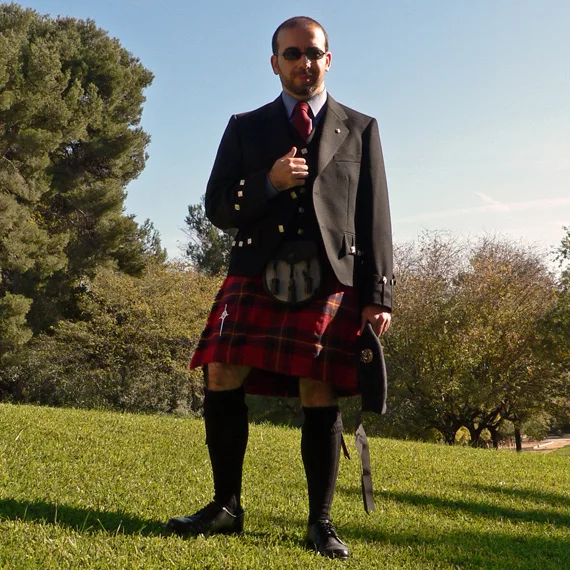

Kilts fall into two broad groups. A traditional kilt is a wrapped, pleated garment in worsted wool tartan, buckled at the waist. Modern and utility kilts borrow the knee-length wrapped shape but change the cloth, the fastening or both. Within the traditional group the choices that matter most are pleat style, how the tartan is pleated, how much cloth goes in, and fabric weight. This page compares those types; for what a kilt is in the first place, see what is a kilt. To size one, use how to measure for a kilt or the kilt size calculator.
The types side by side
| Type | Construction | Cloth | Fastening | Typical use |
|---|---|---|---|---|
| Traditional | Wraps at the natural waist; flat aprons at the front, pleats at the sides and back; about knee length | Twill woven worsted wool in tartan; commonly 13 or 16 oz per yard, with a wider range of 10 to 22 oz | Straps and buckles | Highland dress, formal and ceremonial wear, dancing and piping |
| Modern | Wrapped knee-length garment; some closely modelled on the traditional kilt, others alike only in length | Leather, denim, corduroy, cotton and others, as well as wool | Snaps, studs or velcro in place of buckles on many | Formal or casual dress, sport, outdoor recreation, work |
| Utility | Pockets or attached tool belts, designed for wear without a sporran | Fabrics such as leather, denim, corduroy or cotton | Snaps, studs or velcro | Casual and work wear; appeared from the late 1990s |
| Casual (seller label) | Sellers describe it as a kilt cut with less cloth, commonly called a 5-yard kilt, with shallower pleats | Not established; sellers mention lighter wool or cotton | Not established | Sellers recommend it for warm weather, travel and games |
Modern and utility kilts are not covered by the rules that apply to traditional ones, so the same word can describe quite different garments. Wikipedia’s article on the kilt says contemporary kilts range from near copies of the traditional kilt to garments “similar only in being knee-length skirt-like garments”. Check the cloth, pleating and fastening in any description rather than relying on the type name.
Older and regional forms
Two garments sometimes get called kilts but are different types. The belted plaid is a single untailored length of cloth gathered by hand and held by a belt. The Scottish Tartans Museum’s page on the early kilt dates the first documented mention to 1594, says the plaid was about 4 to 5 yards long (nine yards of the 25-inch cloth of the time made a plaid 4.5 yards long), and notes that because its folds were not sewn they could be readjusted. The tailored kilt, with pleats sewn in and the skirt made as a separate garment, is the ancestor of what is sold today. The same museum puts the first tailored kilts in the military in the 1790s and gives 1792 on its early-kilt page. Wikipedia attributes a version of the small kilt to Thomas Rawlinson in the 1720s. The two accounts do not agree on the date, and this page does not settle it.
The Irish kilt is a separate type altogether. The Scottish Tartans Museum says it dates from the late 19th-century Gaelic Revival, that it has been a solid colour, generally saffron or green, from the start, and that it is worn by Irish pipe bands and by military pipers. Solid colour is not unknown in Scotland: the same page mentions a solid Scottish kilt in a 1635 portrait, though tartan was far more common there.
Pleat styles
Knife pleats are simple folds that all lie the same way. Wikipedia says they are the most common in modern civilian kilts. Box pleats are two knife pleats set back to back. Regiments make their own choices even when the tartan is the same: Wikipedia’s example is that the Argyll and Sutherland Highlanders use box pleats while the Black Watch make their kilts of the same tartan with knife pleats.
The Scottish Tartans Museum gives a dated sequence. The first tailored kilts of the 1790s were box pleated to the line, with no tapering, pleats sewn down about 5 inches, and the length running selvedge to selvedge, about 25 inches. Civilian kilts were loosely pleated at first and began to be pleated to the line about 1820. In 1853 the Gordon Highlanders became the first regiment to adopt the knife pleat, and by 1900 knife pleating was acceptable in civilian kilts. The museum adds that sett pleating was becoming popular by then, and that it raised cloth needs to six to eight yards or more.
A rarer variant is Kingussie pleating: a centre box pleat with knife pleats on either side running in opposite directions. The museum shows an outfit worn by William Muirhead, born in Edinburgh in 1835 and taken to the United States in 1854, and says its kilt is only the second found pleated this way. That is a museum’s observation about two surviving kilts, not a count of how common the style was.
Pleating to the sett or to the stripe
A sett is the repeating block of a tartan. Pleating to the sett folds the pleats so the whole pattern repeats across the back and the kilt looks like the front. Pleating to the stripe centres one chosen stripe in each pleat, which gives a striped back that differs from the front.
Wikipedia calls stripe pleating military pleating and says kilts for Highland dancing are typically pleated to the sett. The scottishdance.net notes use the same split and call stripe pleating regimental. Wikipedia adds that stripe pleating is also widely used by pipe bands. A kiltmaker’s FAQ makes the practical point that some tartans look better pleated to the sett. That is a maker’s opinion, not a rule. It is not established here how consistently either custom is followed outside the military and dance worlds.
Pleating to the sett means the repeat has to line up in every pleat, and the size of the sett affects how much cloth is needed. The sources read here do not give a figure comparing the two methods, so ask a kiltmaker to quote both for the tartan you have chosen.
How much cloth: yardage labels
Sellers sort kilts by cloth quantity. The two labels in common use are 8-yard (the traditional or regulation kilt) and 5-yard (casual). These are trade labels, not defined by a museum or reference work among the sources read.
The reference figures give a range. Wikipedia says a modern kilt for a typical adult uses about 6 to 8 yards of single-width cloth (about 26 to 30 inches wide) or about 3 to 4 yards of double-width cloth (about 54 to 60 inches). The scottishdance.net notes work an example: a 42-inch hip in double-width tartan needs about 4 yards, and a 56-inch hip or waist with an 8-inch sett needs just over 5 yards. A child’s kilt with a 26-inch waist and a 6-inch sett is put at roughly 2 to 2.5 yards.
Those figures make a useful cross-check. Four yards of cloth about 56 inches wide covers the same area as eight yards about 28 inches wide, so the “8-yard” label and the 4-yard double-width figure describe about the same amount of cloth. A 5-yard kilt in single-width cloth is therefore a lighter build, but a 5-yard figure in double-width cloth would be a generous one. Always ask which cloth width a quoted yardage refers to.
One seller’s buyer guide (Scottish Kilt Shop, 2022) says an 8-yard kilt has deeper, more numerous pleats and a heavier swing, while a 5-yard kilt uses shallower pleats, weighs less and costs less. It recommends 8-yard for a formal kilt for weddings and calls it the expected standard for strict formal events, and 5-yard for casual wear, warm weather, travel and Highland games. It adds that large setts show fewer full repeats on a 5-yard kilt. That is retailer copy, offered as one seller’s position and not verified against a maker’s measurements here.
Fabric weight
Weight is stated in ounces per yard of cloth. Wikipedia gives a range from regimental worsted of about 18 to 22 oz down to light worsted of about 10 to 11 oz, with 13 oz and 16 oz the most common for kilts. The scottishdance.net notes say dancers’ kilts use 10 oz wool, while men’s kilts are 13 oz or, preferably, 16 oz, which they say “holds the pleats like iron”. The kiltmaker’s FAQ compares 20 oz and 11 oz cloth, judges the 11 oz one too light for everyday wear, and mentions tropical climates in connection with fabric weight.
Clan Campbell Society (North America) draws a further line by occasion: day kilts use heavier material and evening kilts lighter, and if an evening kilt is very light, kiltmakers sometimes sew elastic along the inside of the pleats about 6 inches above the hem to keep it from swinging too far during a dance. These are practitioners’ views, not measured results. The pattern across them is consistent enough to use: heavier cloth is said to hold a pleat more firmly, while lighter cloth moves more.
Choosing between them
Start from where the kilt will be worn. For Highland dress at formal events the traditional wool kilt is the garment most Highland dress guides assume; a kilt belt and buckle and kilt pin belong with it, and the outfit often includes one of the Scottish caps. For dancing, the sources point to sett pleating and a lighter cloth. For military or band uniformity, stripe pleating is the established practice, and regimental pleat style is specific to the regiment. For work, travel or everyday use, a utility or modern kilt trades tradition for pockets and easier fastening, and many are designed to be worn without a sporran, according to Wikipedia. Garments made for women follow their own conventions, covered at women’s kilts.
A few questions settle most orders. What is the cloth width behind the quoted yardage? Is the kilt pleated to the sett or the stripe, and does the tartan’s sett suit it? What weight in ounces per yard is it, and is that right for the climate and the occasion? Does it fasten with buckles or with snaps, studs or velcro? Those four answers describe the kilt better than any type name.
Sources
Construction, yardage ranges, fabric weights, regimental pleat examples and the description of contemporary kilts come from Wikipedia’s articles on the kilt and the utility kilt. Dancers’ weights, the 42-inch and 56-inch yardage examples and the opinion on 16 oz come from the scottishdance.net page. The dated pleating history, the belted plaid, the Kingussie kilt and the Irish kilt come from pages of the Scottish Tartans Museum and Heritage Center. Day and evening weights come from Clan Campbell Society (North America). The pleating and weight opinions come from a kiltmaker’s FAQ (a page of short fragments), and the 8-yard and 5-yard descriptions from a retailer’s blog; both are commercial and labelled as such above.