Scottish dress
How to measure for a kilt
Three measurements do most of the work: waist at the navel, widest part of the hips and length. Take them in the right place and twice.
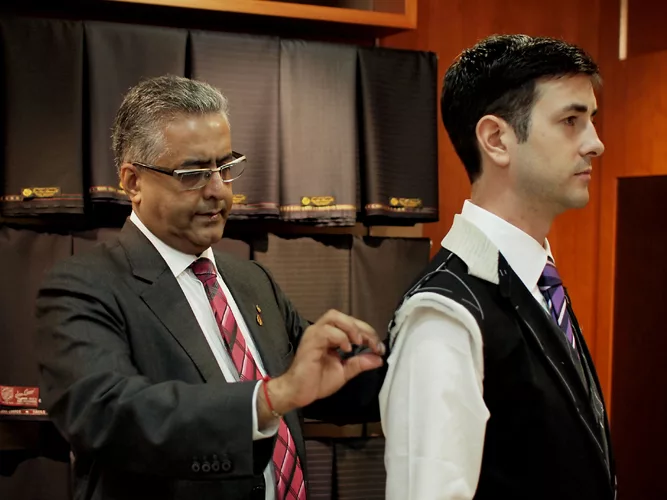

Measure three things: the natural waist, the fullest part of the hips or seat, and the length from the waist down to the middle of the kneecap. Many makers also ask for your height as a cross-check. Have someone else hold the tape, stand straight and relaxed, and repeat each reading. When you have the numbers, the kilt size calculator can turn them into a size.
The makers whose instructions we read agree on those three measurements and disagree on small points: where the waist sits, how loose the seat tape should be, and whether to measure length standing or kneeling. The sections below set out each point and where the disagreement lies, so you can see why a maker’s own instructions override any general guide.
The measurements
Waist. Take the natural waist, which a kilt sits on. This is higher than a trouser waist, and several makers warn that the number will differ from your jeans size. They define the spot in different ways:
- At the navel (Welsh Tartan Centre: “a snug measurement at the widest point of the tummy, at navel height”).
- At the top of the hip bone, in line with the navel (Lochcarron of Scotland).
- About 2 inches above the hip bone (Clan Ewing).
- About 1.5 inches above the hip bone (Kilts For Hire).
Wikipedia’s description of the kilt puts the natural waist “between the lowest rib and the hip”. These are close but not identical, which is one reason to use the maker’s own definition. Stand straight and do not hold your breath in. Pull the tape firm, because the kilt has to stay up without help.
Seat. Measure around the fullest part of the hips or seat, with the tape level at front and back. Kilts N Stuff puts it 6 to 8 inches below the waist. Lochcarron and Clan Ewing both have the measurement taken loosely over trousers, with two fingers inside the tape and the pockets empty. The Welsh Tartan Centre allows three fingers. Fit policies differ, so a looser or tighter allowance is a maker’s choice and you should use the one on the order form.
Length. Makers use two methods:
- Standing, down the body. Hold the tape at the waist line and run it to the middle of the kneecap. Lochcarron starts at the top of the hip bone, Atlanta Kilts at the waist or navel, and Kilts For Hire at 1.5 inches above the hip bone. Feet are comfortably apart.
- Kneeling, to the floor. Kneel upright on both knees with a straight back and measure from the navel to the floor, with a helper reading the tape. ScotlandShop calls this the way to take the traditional measurement. The Welsh Tartan Centre measures from the kilt waist to the floor along the side of the body and then subtracts half an inch.
The two methods target the same hem position, the middle of the kneecap, by different routes. They are not interchangeable readings: the Welsh maker subtracts half an inch from its kneeling figure, and no maker we read applies a matching correction to a standing one. Use only the method the maker asks for.
Height. Lochcarron asks you to remove your shoes, stand against a wall on a hard floor and measure from heel to crown, because “a full height measurement is required to determine the kilt length measurement is correct.” Clan Ewing makes the same request. Height works as a sanity check on the length figure.
Where the hem should sit
Wikipedia’s article on the kilt says a well-fitted kilt reaches “no lower than halfway across the kneecap and no higher than about an inch above it”. The Scottish Tartans Authority, quoted in a 2011 Globe and Mail article, says the most common fault is kilts “hingin’ doon” below the knees and that a good bit of leg should show between the hose top and the hem. The same article says a kilt should fall to the top or middle of the knee and just graze the floor when you kneel.
Some of the larger gaps between sources are about people, not rules. ScotlandShop gives a rule of thumb that a man’s kilt length is about a third of his height, with a table running from 22 to 22.5 inches for 5 ft 6 in to 5 ft 7 in up to 27 to 27.5 inches for 6 ft 5 in to 6 ft 7 in, and says not to worry if you do not match it, since “long torsos and short legs or vice versa make for quite different results”. Kilts For Hire, a hire firm, gives its own chart from 21 inches at 5 ft 2 in to 26.5 inches at 6 ft 4 in. At the same height the two charts do not agree exactly, and both are a firm’s own guidelines, not a standard. They help you spot a figure that looks wrong. They do not replace measuring.
ScotlandShop adds that the waist position changes with the jacket: with a Prince Charlie jacket, which is cut short, the kilt is worn high, while with an Argyll jacket or none it can sit a little lower and the length is adjusted to match. Atlanta Kilts notes that women’s kilt lengths vary and may sit above or below the knee by preference. ScotlandShop also says that length is a personal choice: if you want the kilt above or below the knee, that is fine.
How the kilt is cut from your numbers
Wikipedia says a custom kilt needs at least three measurements, the waist, the hips and the length, and that a rise and a fell measurement may also be needed. A full kilt uses about 6 to 8 yards of single-width cloth or 3 to 4 yards of double-width, and “8 yards of fabric would be used regardless of size” for a full kilt. Pleats are generally about half an inch to three quarters of an inch wide, depending on the size of the sett and the amount of fabric, and the kilt is usually made without a hem. Wikipedia adds that very large waists may need 9 yards.
Traditional orders at several makers also ask you to choose how the pleats are set. Lochcarron and Clan Ewing describe the choice in the same terms: sett shows the full tartan design in the pleating, and stripe puts a vertical line of the tartan in the middle of each pleat. They say civilian kilts are traditionally pleated to the sett and military kilts to the stripe, and that the choice is yours. Lochcarron offers it on traditional kilts only. Neither choice changes where you measure.
Practical points
- Use a soft tailor’s tape and read it in inches if the maker asks for inches. Lochcarron asks for height in feet and inches.
- Empty your pockets. Kilts For Hire also asks you to remove bulky clothing.
- Do not bend or lean while a reading is taken. Kilts N Stuff warns that “if you bend even a little while trying to do it yourself, the measurements will change.”
- Measure twice. If the two readings differ, take a third and use the one that repeats.
- Write down which method and landmark you used, so that you can send the same figures to a second maker and check what that maker wants.
- For a casual kilt, Kilts N Stuff notes you may measure the waist where your trousers sit instead of at the navel, depending on how you intend to wear it. Check this against the product page.
- If you fall between sizes or your numbers sit oddly against the height charts, ask the maker before ordering.
Next
What is a kilt explains the parts these measurements relate to. Types of kilts covers how cloth amount and fit change by style. To pick a tartan, use the Tartan Finder.
Related guides
Sources & further reading
- Kilt Measurement Guide
- Kilt
- Measuring guide for kilts (Lochcarron of Scotland)
- How to wear: kilt length (ScotlandShop)
- Kilt length measurement guide (Atlanta Kilts)
- Measurement instructions (Kilts N Stuff)
- Kilt measurements (Clan Ewing)
- How to measure: kilt package (Welsh Tartan Centre)
- How to measure for a kilt (Kilts For Hire)
- How to wear a kilt (The Globe and Mail)