Scottish dress
What is a kilt?
A knee-length wrap garment of pleated twill wool, worn at the waist. Its parts, how it differs from a skirt, and what the evidence says about how the belted plaid became the modern kilt.
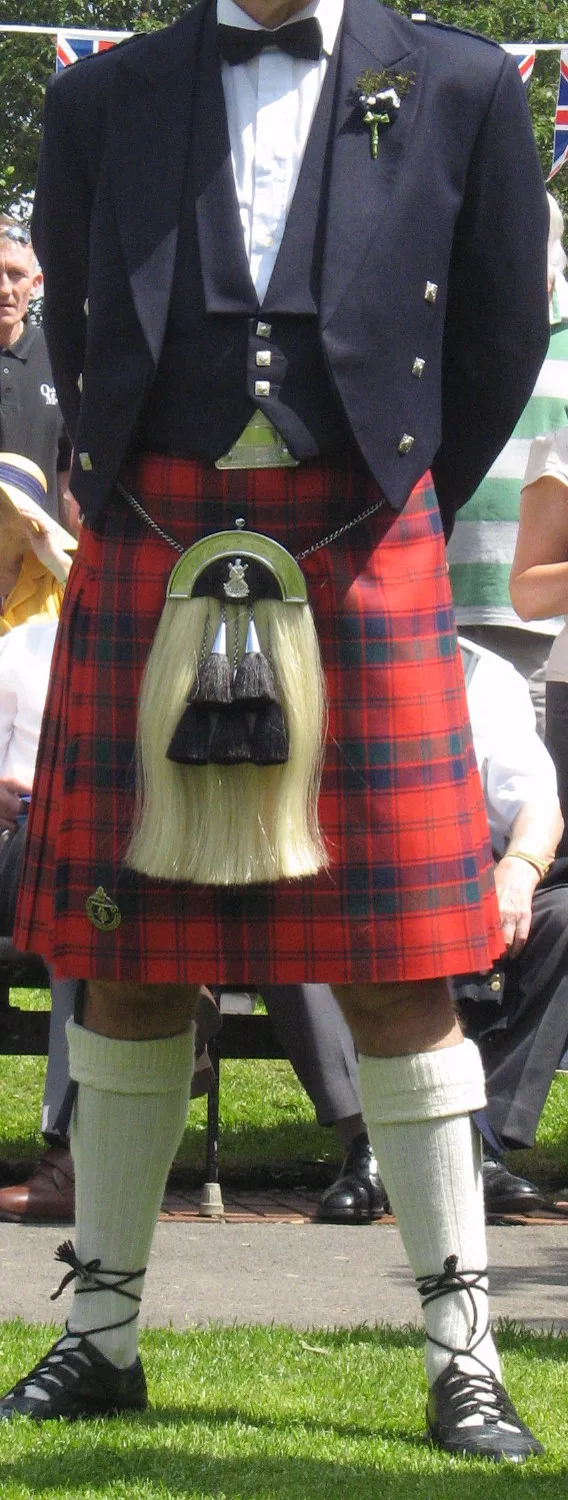
A kilt is a garment resembling a wrap-around, knee-length skirt, made of twill-woven worsted wool and pleated at the sides and back. It is worn at the natural waist and fastened with straps and buckles. It is most often made in a tartan, though plain-coloured kilts exist. The modern form is the lower half of an older garment, the belted plaid, with the pleats stitched down. How and when that happened is partly documented and partly still argued over, and this guide keeps the two apart.
The parts
The Scottish kilt is a tailored garment wrapped around the body at the natural waist, between the lowest rib and the hip. It starts at one side, usually the wearer’s left, goes around the front and back, and crosses the front again to the opposite side.
- Aprons. Where the cloth overlaps at the front, the layers are flat. They are called aprons: the outer one is the front apron and the inner one the underapron.
- Pleats. The single layer around the sides and back is pleated.
- Straps and buckles. The fastenings are straps and buckles on both ends. The strap on the inside end usually passes through a slit in the waistband and buckles on the outside, though it can also stay inside the waistband.
- Length. The hem sits at about the centre of the knee.
- Kilt pin. A pin may be fastened to the free corner of the front apron. It goes through that layer only, not the one beneath, because its job is to add weight, not to hold the kilt shut.
Kilts are usually made without a hem. A hem would add bulk and spoil the way the garment hangs. These construction details come from the encyclopedia overview used for this guide, a level D source.
Cloth and quantity
The kilt seen at Highland games is woven in worsted wool in a 2/2 twill: each weft thread passes over two warp threads and under two. The diagonal line this produces is the twill line. When the twill is woven to a set colour pattern, it is tartan. For the pattern itself, see what is tartan.
Fabric weight is quoted in ounces per yard and runs from about 10 to 11 ounces for a light worsted up to 18 to 22 for heavy regimental cloth. The most common kilt weights are 13 and 16 ounces. The same overview gives the usual quantities for an adult as about 6 to 8 yards of single-width cloth (roughly 26 to 30 inches wide) or 3 to 4 yards of double-width cloth (54 to 60 inches). For a full kilt it gives 8 yards regardless of size, with the number and depth of the pleats adjusted to the wearer, and 9 yards for a very large waist.
Those figures describe present practice. Surviving kilts from around 1800 used much less. One box-pleated kilt in the Scottish Tartans Authority’s collection is made from a single width of hand-woven cloth 25 inches wide. Another, now in the Lanark and District Museum in Ontario, uses 3¾ yards of single-width cloth, also 25 inches wide, with 13 broad box pleats. Both are dated by the Authority’s researcher to roughly 1800 to 1820. The first has four horn buttons, probably for braces, and a tie at the corner of the apron. The second has a single plain button at the waist and was likely fastened with a waist-tie, which that paper calls the standard method in the early 19th century.
Pleating to stripe or to sett
When the pleats are folded, the maker chooses what shows. In a pleat to stripe, each pleat is arranged so that the same stripe of the tartan lands on the visible edge, giving a vertical band of one colour sequence. In a pleat to sett, the pleats are folded so a full repeat of the pattern shows across them. The McNicol kilt above is described as pleated to stripe with skill. The earlier MacDuff kilt is recorded in a kiltmaker’s note as ‘pleats to nothing’: no attempt was made to pleat to a particular stripe, which the Authority’s paper says was the usual practice at the time, so the choice was not standard even then.
One personal essay that draws mainly on the dress historian John Telfer Dunbar says military kilts usually put the dominant stripe on every pleat, while civilian kilts in the 19th century came to repeat the sett across the pleats. That is a single secondary account, and it is offered here as a description of a convention, not a rule. The choice of how to pleat is covered in types of kilts.
Kilt or skirt
Both are knee-length wrapped or pleated garments, so the line between them is partly about construction and partly about naming. A kilt is made from a long length of cloth, wrapped, pleated and sized to the wearer, and in tartan the pleats are normally set to show a chosen part of the pattern. A great many skirts are shaped, gathered or sewn into a closed tube instead. The word kilt also marks a tradition: the overview used here describes it as originating in Highland dress for men, and says that since the 19th century it has become associated with the wider culture of Scotland. The two overlap at the edges. Women’s kilts are covered on their own page, women’s kilts.
The word itself comes from an older verb. According to the Dictionary of the Scots Language and the Oxford English Dictionary, as summarised in the encyclopedia article, to kilt meant to gird up or tuck up the skirts around the body, and the verb is thought to be of Scandinavian origin.
The belted plaid
The kilt’s immediate ancestor is the belted plaid, called the great kilt, or in Gaelic the féileadh mòr (filleadh mòr in some spellings). It was made of thick woollen cloth, two loom widths sewn together to give a width of 54 to 60 inches and a length of up to 7 yards. It was gathered into pleats by hand, belted at the waist, and the upper part could be worn as a cloak, drawn over the shoulder or over the head.
The documentary record for it is thin before the late 16th century. The earliest written source that definitely describes a belted plaid is dated 1594, according to the history-of-the-kilt overview. That date matches an account by the Irish chronicler Lughaidh Ó Cléirigh, quoted in the Dunbar-based essay, of Highlanders serving under Red Hugh O’Donnell in Ireland. He describes mottled cloaks of many colours with a fringe to the shins and calves, and belts worn over the loins outside the cloaks. The essay’s own comment is that it describes a belted plaid accurately. The Ó Cléirigh passage reaches us through that essay, not through the chronicle, so the date is better supported than the exact wording.
Later accounts are fuller. The same essay quotes Thomas Morer, who visited Scotland in 1689, saying Highland plaids were ‘about seven or eight yards long’ and covered the body from the neck to the knees. It quotes Martin Martin’s Description of the Western Islands of Scotland, published in 1703, describing a plaid of about seven double ells, tied round the middle with a leather belt and ‘pleated from the belt to the knee very nicely’, with a pin of bone or wood at the breast on foot. The essay notes that Martin does not mention the philabeg.
For a picture, the Glasgow Museums portrait of Lord Mungo Murray, painted by John Michael Wright around 1683, is described by the museum service as the earliest major full-length portrait of a sitter in Highland dress. It shows a belted plaid, worn with a fashionable doublet, a gun, pistols, a dirk and a basket-hilted sword. Another version has been in the Scottish National Portrait Gallery since 1925. The plaid in that picture predates clan tartans, which matters for the questions below.
The small kilt
The small kilt, the philabeg (Gaelic féileadh beag), is the lower half of the belted plaid made as a separate garment. The history-of-the-kilt overview dates its emergence to the late 17th or early 18th century. Beyond that, the origin is disputed, and the dispute has a specific shape.
The Rawlinson story. In a letter printed in the Edinburgh Magazine in March 1785, though said by some to have been written in 1768, Ivan Baillie of Aberiachan said the small kilt was devised by Thomas Rawlinson, an English Quaker. Rawlinson was managing partner of an ironworks at Invergarry. He is said to have found the great plaid cumbersome for men at work and had his workmen wear the lower part only. The Invergarry lease is documented: an agreement of 23 March 1727, a furnace first blown in on 25 August 1729, and a furnace blown out on 9 February 1736. What is not documented is that Rawlinson invented a garment. The claim rests on one letter written decades later, by a person described in a reference article as a promoter of union with England and hostile to the Highlands.
How scholars have treated it. The overview of the kilt’s history lists the positions with sources. John Telfer Dunbar’s History of Highland Dress (1979) quotes the letter approvingly. J. G. Mackay called it a myth in 1924. Hugh Trevor-Roper accepted it in 1983. Murray Pittock in 2010 and John Purser in 2020 are cited as rejecting it, Purser on the ground that nothing in Rawlinson’s papers supports it. Matthew Newsome argues there are illustrations of Highlanders wearing only the lower half of the belted plaid long before Rawlinson came to Scotland, with some indication of use in the late 17th century and definite use by the early 18th. The same Dunbar-based essay says Edmund Burt wrote of Highlanders wearing a short ‘quelt’ and left the Highlands before Rawlinson arrived, a point it uses against the story. Burt’s text was not checked directly for this guide. The balance of the cited scholarship rejects the Rawlinson account as an invention story, while agreeing that the small kilt is early 18th century or somewhat earlier.
The Dress Act and what survived it
After the Jacobite rising, Parliament passed an act whose long title reads: for the more effectual disarming the Highlands in Scotland, and for more effectually securing the peace of the said Highlands, and for restraining the use of the Highland dress. It received royal assent on 12 August 1746 (19 Geo. 2 c. 39). The dress clause came into force on 1 August 1747. It forbade any man or boy in Scotland to wear ‘the clothes commonly called Highland clothes (that is to say) the Plaid, Philabeg, or little Kilt, Trowse, Shoulder-belts, or any part whatever of what peculiarly belongs to the Highland Garb’, and added that no tartan or party-coloured plaid or stuff was to be used for great coats or upper coats. The penalty was six months’ imprisonment without bail for a first offence and transportation for seven years for a second.
Soldiers in Highland regiments were exempt, as were gentry, the sons of gentry and women, according to the Scottish Tartans Authority’s history. That history also says the ban applied only to the part of Britain north of a line from Dumbarton to Perth. The Use of Highland Dress Act 1782 (22 Geo. 3 c. 63), in force from 1 July 1782, removed it. One account credits the Duke of Montrose as the main promoter, though that rests on a single popular source.
Two things follow that are easy to overlook.
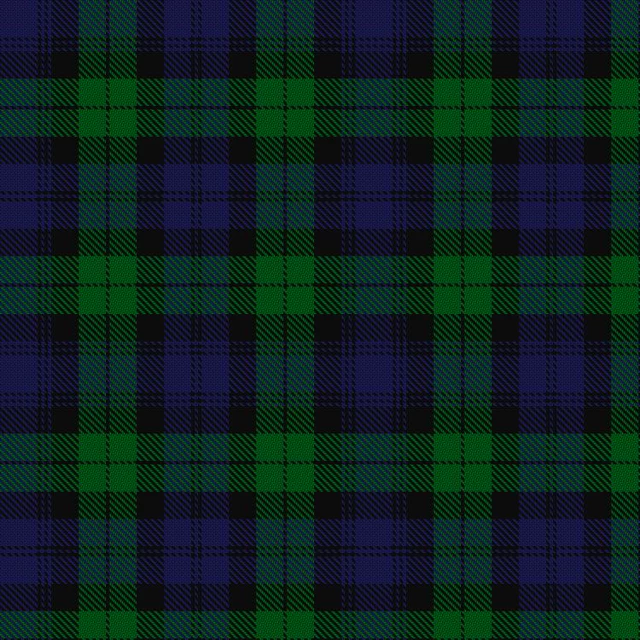
First, the garment did not disappear. A. V. B. Norman’s note on Highland dress after the ’45 in the Proceedings of the Society of Antiquaries of Scotland cites a letter of 30 December 1769 from Sir Robert Murray Keith in Dresden asking for ‘a plaid of my colours, sewed and plaited on a waist belt’, and a portrait of him painted in 1770 wearing a great plaid of dark green and black tartan with a regimental coat. The same note discusses a grenadier of the 42nd Highland Regiment painted by David Morier in 1751 and William Gordon, painted by Pompeo Batoni in 1766 in the uniform of the 105th Highlanders, which show Highland regiments in their own dress. The 42nd’s dark tartan, now called Black Watch, dates from 1739; see the Black Watch page.
Second, the stitched kilt that people now picture appears to have taken shape late. The Scottish Tartans Authority’s paper on the McNicol kilt says that because of the effects of proscription, civilian kilts were a relatively new fashion around 1800 to 1820, and that all other surviving kilts of the period it knew were made from cloth by a manufacturer, normally William Wilson and Son of Bannockburn. The Wilsons’ mill sat south of the Highland boundary and supplied the military and the growing number of regiments, according to the same Authority’s history of tartan. Dunbar’s account, as relayed by the Dunbar-based essay, is that military quartermasters and clothing contractors did much to form the kilt as it is now made.
From Highland garment to Scottish dress
The shift from regional dress to national symbol came after repeal. The National Library of Scotland says there has been enthusiasm for tartan, particularly as a symbol of a family name, since the 19th century, and that the surname-tartan system developed then, after Walter Scott’s arrangements for George IV’s visit to Scotland. The Scottish Tartans Authority’s history dates that visit to 1822 and says the event was largely stage-managed by Scott, who urged the Scots to turn out in their true tartans. The Highland Society of London had been founded in 1778 as a London club for expatriate Scottish gentry, and from about 1815 it collected sealed samples of clan tartans.
For the modern reader, the useful point is the distinction between a garment and a pattern. A kilt is a way of cutting and pleating cloth. Whether it is in a clan tartan, a district tartan or a plain colour is a separate decision; who may wear which is the subject of who can wear which tartan, and the word plaid is untangled in tartan vs plaid. The Scots word plaid itself is recorded from 1510 in the Dictionary of the Older Scottish Tongue, for a length of cloth worn as a garment or bedcovering, with an etymology the dictionary calls uncertain.
Next steps
Different styles of kilt are set out in types of kilts. To order or buy one, take the measurements in how to measure for a kilt. The shopping and styling side is at kilts.
Continue learning

Related guides
Sources & further reading
- Kilt
- History of the kilt
- A Farewell to Arms, Kilts and Sporrans: banning Scottish Highland dress in the aftermath of Culloden
- Plaid (Dictionary of the Older Scottish Tongue entry)
- A note on Highland dress after the '45
- An early MacDuff Kilt
- A Regency Era Kilt made from an 18th Century Plaid
- A Short History of Tartan
- Tartan (Encyclopedia of Clothing and Fashion)
- Scottish traditional culture: clans, tartan and heraldry
- Top five museum acquisitions of the month (March 2020)
- Ancestral Clothing, or did an Englishman invent the kilt?
- The Dress Act of 1746
- Dress Act 1746
- Thomas Rawlinson (industrialist)