Scottish dress
How much fabric for a kilt: yards, widths and pleats
A traditional kilt takes about 8 yards of single-width cloth, which is about 4 yards of double width. Sett size, pleat style and hip measurement move that figure, and kiltmakers give different rules for how.
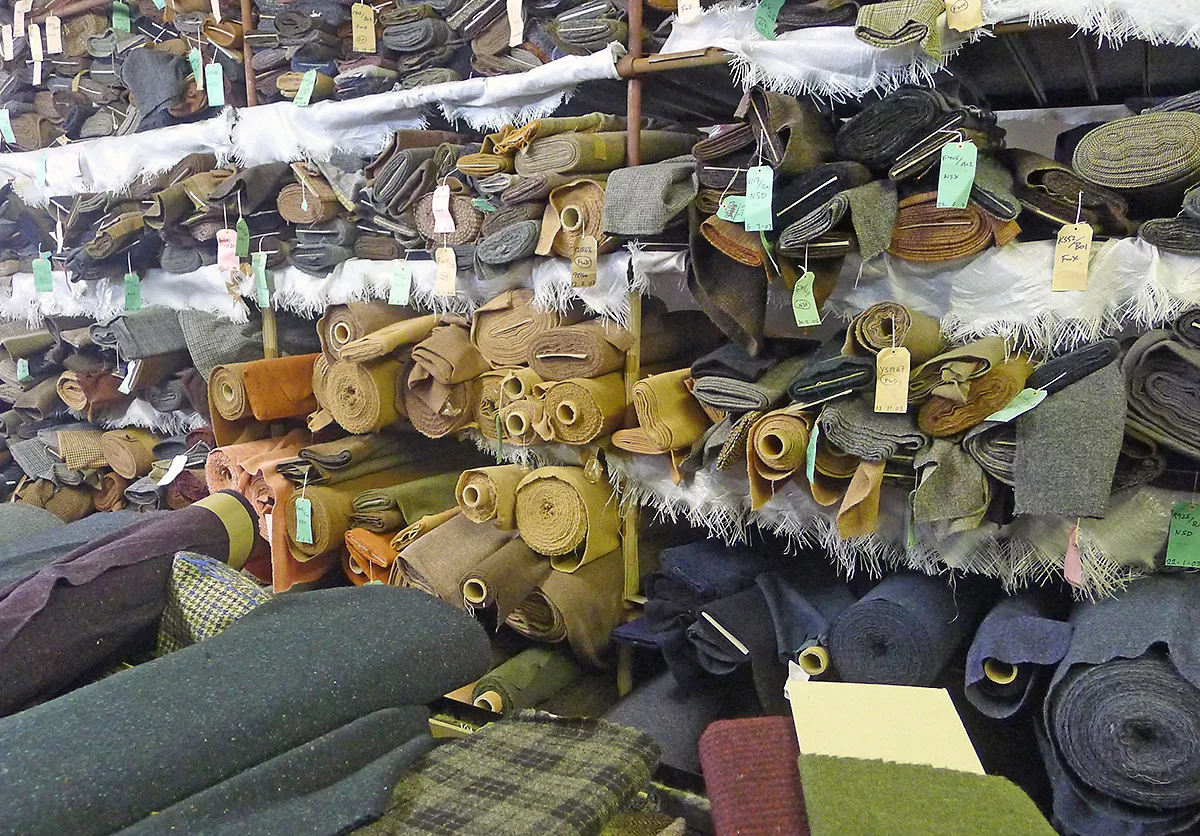

A traditional kilt is normally made from about 8 yards of single-width cloth. The kiltmaker Kinloch Anderson says a kilt is normally 8 yards, or 7.4 metres, of single-width cloth (Kinloch Anderson). Because double-width cloth is about twice as wide, the same kilt takes about 4 yards of it. Larger hips need more: Nicolson Kiltmakers use a 9-yard kilt where the hip or seat measures over 45 inches (Nicolson Kiltmakers). Casual kilts and some pleat styles use much less, between about 4 and 6 yards.
The rest of this page explains why the number varies, how to work out a figure for a given hip and sett, and where the sources disagree. It does not cover price. Measurements for the garment itself are in how to measure for a kilt.
Yards, metres and widths
A yard is 0.9144 metres, so 8 yards is 7.32 metres. Kinloch Anderson states 7.4 metres for its 8 yards; the difference is small, and it is the maker’s own figure. The same maker describes most of its tartans as woven in double width, 140 cm, and some in single width, 80 cm (Kinloch Anderson cloth page). Wikipedia gives general figures of 26 to 30 inches for single width and 54 to 60 inches for double. A highland-dance guide compiled from a mailing list uses 60 inches for the standard cloth (scottishdance.net).
Those widths do not match exactly, and they should not be assumed equal across mills. When cloth is bought by the metre, the stated width on the listing is what converts the quote. Cloth that is 80 cm wide needs more length than cloth that is 140 cm wide, by a factor close to 1.75, not exactly 2. The arithmetic below uses the double-width convention in the sources, in which one yard of double-width cloth gives two yards of kilt material.
What a maker uses for each kilt style
| Style | Cloth stated | Source and note |
|---|---|---|
| Traditional hand-sewn, knife pleats | About 8 yards of single width; as little as 5 for an acceptable kilt | Paul Henry Kilts, a working kiltmaker |
| Knife pleats with wider faces | As little as about 4 yards | Paul Henry Kilts, pleating styles page |
| Box pleats | 4 to 5 yards, wide faces | Paul Henry Kilts; described as a more historic method |
| Military box pleats | 7 to 8 yards, almost always pleated to the stripe | Paul Henry Kilts |
| Harris tweed kilt | About 5 to 6 yards, because of the bulk of the cloth | Paul Henry Kilts |
| Contemporary kilt in denim, cotton or similar | Typically 5 to 6 yards, 12 to 18 pleats | Paul Henry Kilts |
| Full or large kilt | 8 yards, 9 yards for a very large waist | Wikipedia: Kilt |
| Hip or seat over 45 inches | 9 yards | Nicolson Kiltmakers |
Two kiltmaker voices stand behind most of this table. Paul Henry says a traditional kilt has anything from 18 to 32 pleats, and the number depends on the size of the wearer and, often more importantly, on the size of the sett (Paul Henry Kilts). Kinloch Anderson says a standard kilt has between 23 and 43 pleats, each hand deep, and takes an accomplished kiltmaker between 8 and 14 hours. The two ranges overlap but do not agree, and neither gives the share of kilts at each end. Paul Henry, for the same job, writes that it takes perhaps 25 hours or more to plan, measure and hand sew a kilt (Paul Henry Kilts), which is a different count of time from 8 to 14 hours and is not reconciled by either source.
Why a bigger sett needs more cloth
In a kilt pleated to the sett, each pleat is made from a full repeat of the pattern, with only a small part showing at the surface. The highland-dance guide says a single pleat uses a full sett width with an average of about one inch exposed, so a sett of 8 inches uses 9 inches of cloth per pleat. A sett of 6 inches uses 7. A larger sett therefore costs more cloth per pleat, and so across every pleat.
The same guide gives a method for working a total. For a 42-inch hip and an 8-inch sett it counts the apron as twice half the hip, 21 inches times 2, which is 42 inches. It then adds the pleated section as 21 pleats of 9 inches, which is 189 inches (one pleat for each inch of the 21-inch half hip). The subtotal of 231 inches gets 20% added for pleating and centring the pattern, about 46 inches, giving 277 inches. It divides by 72 because a yard of double-width cloth gives two yards of kilt material, which gives 3.86 yards of double width, rounded to 4 yards.
That method reproduces the guide’s other figures. For a 6-inch sett at the same hip the pleated section becomes 21 times 7, or 147 inches, and the total comes to 3.15 yards. For a 56-inch hip with an 8-inch sett, the guide says just over 5 yards, and the method gives 5.13.
| Hip (inches) | 6-inch sett | 8-inch sett | 12-inch sett |
|---|---|---|---|
| 38 | 2.85 | 3.48 | 4.75 |
| 42 | 3.15 | 3.85 | 5.25 |
| 46 | 3.45 | 4.22 | 5.75 |
| 50 | 3.75 | 4.58 | 6.25 |
| 56 | 4.20 | 5.13 | 7.00 |
The 42-inch row for 6-inch and 8-inch setts, and the 56-inch figure for an 8-inch sett, are the guide’s own results. Every other cell is this page applying the same formula, with the 12-inch sett chosen only to show a large pattern. It is arithmetic, not a kiltmaker’s measured order, and it assumes full pleat depth with the sett repeating exactly in every pleat. To get single-width yards, double the figures.
Read the table against the kiltmaker figures and a pattern shows. At a 46-inch hip and 8-inch sett, the method gives 4.22 double-width yards, about 8.4 single-width yards. Nicolson Kiltmakers move to 9 yards above 45 inches, which is in the same range, though the maker’s pleat depth and overlap are not stated. At 42 inches and an 8-inch sett, the method gives 7.7 single-width yards, which an 8-yard kilt covers with a little to spare.
Where the sources disagree
The sources do not state one rule, and they differ in a way that matters when you are planning a purchase.
A fixed 8 yards, or a formula. Wikipedia says that for a full kilt, 8 yards would be used regardless of size, with the number and depth of pleats adjusted to the wearer. Kinloch Anderson’s made-to-order kilt page states a minimum of 8 yards (7.4 m) of full cloth usage to give the maximum depth of every pleat (Kinloch Anderson Deluxe Kilt). The highland-dance guide scales the quantity to the hip and sett, as above. The first two treat 8 yards as a standard that the maker adapts by changing pleat depth. The third treats yardage as an output. Both can be true: a maker with a fixed quantity of cloth varies the pleat, while a method that assumes full pleats shows how much cloth that would take.
What happens at large hips and setts. The formula gives more than 8 single-width yards for any hip over about 43 inches with an 8-inch sett, and more than 9 for a 50-inch hip. The highland-dance guide mentions a nine-yard piece for a large man’s kilt, though only in passing as one theory about the origin of a phrase. Wikipedia says that up to 9 yards may be needed for a very large waist, and Nicolson Kiltmakers use 9 yards above 45 inches. Neither source says anyone uses 10 or 11 yards at a 50-inch hip, so for large hips the evidence is that makers reduce pleat depth, or use a larger quantity, and the sources do not say which. That is a question to put to the maker directly.
Pleat style changes the answer more than size. Paul Henry’s figures show that a box-pleated kilt can use 4 to 5 yards while a military box-pleated kilt uses 7 to 8, so a quantity quoted without a pleat style is incomplete. The same maker says it is possible to make an acceptable traditional kilt with as few as 5 yards. Whether such a kilt hangs as well as an 8-yard one is a judgement, and none of the sources measures it.
A child’s kilt and the belted plaid
The highland-dance guide gives one smaller case: a child with a 26-inch waist and a 6-inch sett needs 2 to 2.5 yards, which it states without a pleat count. No source here covers kilts for women, kilt skirts or other cuts, and this page makes no claim for them.
The older garment, the belted plaid or great kilt, is a different calculation. Wikipedia describes a plaid of approximately 4 to 5 yards in length, made by stitching two pieces of cloth 25 to 30 inches wide side by side because looms of the period produced narrow cloth (Wikipedia: Belted plaid). Two strips of that length come to 8 to 10 yards of single-width cloth by simple arithmetic, which sits close to the modern 8-yard kilt. None of the sources read here says the modern figure descends from them, so the match should be read as a coincidence of arithmetic and not as an established link.
Weight and bulk
Yardage and weight are separate. A heavier cloth does not need more yards, but it makes a thicker pleat, which is why Harris tweed is cut at 5 to 6 yards. For wool, the kiltmaker advice is a weight of 13 to 16 oz (Paul Henry Kilts). Wool against acrylic tartan compares fibres, and the fabric hub explains how ounce weights are quoted. A fabric listed in ounces per yard of a stated width cannot be converted to the weight of a finished kilt without the yardage.
Before you order cloth
For cloth for a first kilt, the safest order is to let the maker state the quantity for your measurements and your chosen tartan. If you buy cloth separately, confirm the width and yardage in writing before ordering. For kilt types and what each is for, see types of kilts, and for how the sett and the pattern were defined, what tartan is.
Related guides
Sources & further reading
- Making a kilt (notes collated from the highland-dance mailing list)
- Wool tartan fabric by the metre
- Kilt
- Which Style (Paul Henry Kilts)
- Pleating styles (Paul Henry Kilts)
- Customer Supplied Fabric (Paul Henry Kilts)
- The Art of Kiltmaking
- The Kinloch Anderson Deluxe Kilt, made to order
- How to measure for a kilt
- Belted plaid