Scottish dress
Types of kilts
Great kilt, traditional eight-yard, casual, military, utility and sports kilts differ in cloth quantity, pleating, waistline and construction. What the sources support, and where the labels are only a seller's convention.
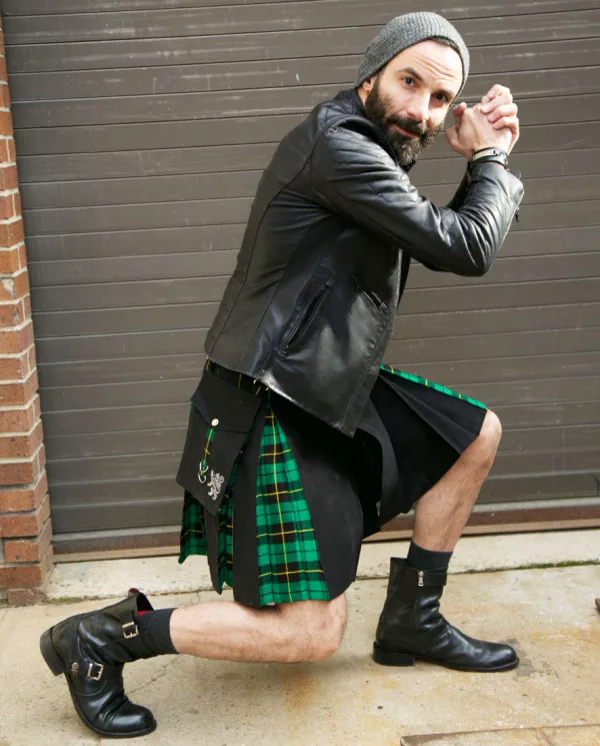

Kilts differ in four ways that can be checked: how much cloth goes into them, where they sit on the body, how the pleats are set, and whether they are sewn by hand. Names such as “traditional”, “casual” and “utility” are used by makers and sellers, not defined by any dress authority, so the same word can describe different garments. Compare the specification a seller gives, not the label.
The types side by side
| Type | Cloth | Sits | Pleats and sewing | Used for |
|---|---|---|---|---|
| Great kilt (belted plaid) | Up to 7 yards, two loom widths sewn together | Wrapped round the body and belted; the upper part can be worn as a cloak | Gathered into pleats by hand and held with a belt; not a tailored garment | Worn from the late 16th century; now historical or re-enactment dress |
| Traditional (eight-yard) kilt | About 8 yards of single-width cloth, depending on waist | High, a couple of inches above the waistband of most trousers | Fully tailored; between 23 and 43 pleats reported by one maker, 25 to 34 by others; hand-stitched or machine-sewn | Formal Highland dress, dancing, weddings |
| Casual kilt | 3 to 4 yards at the low end; about 6 on average in one retailer’s range | Low, like trousers | Shallower and fewer pleats; some machine sewing almost always used | Everyday and active wear |
| Military kilt | Heavyweight cloth, traditionally hard-wearing | Regimental dress rules apply | Traditionally to the stripe; box pleats in some units | Regimental and pipe-band dress |
| Utility kilt | Fabrics such as leather, denim, corduroy or cotton, usually not tartan wool | Varies by maker | Pockets, snaps or Velcro in place of buckles | Work and leisure wear |
| Sports kilt (modern) | Simplified contemporary versions; Wikipedia says lacrosse and field hockey players wear compression shorts or spandex underneath | Varies | Simple construction | Lacrosse and field hockey, as reported in an encyclopedia overview, which refers to female athletes |
The sections below take these in turn and flag what is only reported by one seller.
Great kilt and the move to the little kilt
The belted plaid, or great kilt, came first. Wikipedia’s history article describes it as two loom-widths of cloth, 54 to 60 inches wide in total and up to 7 yards long, gathered into pleats and secured with a wide belt, and gives 1594 for the earliest written description. The Heritage Crafts entry on kilt making dates it from the late 16th century and says it was made “for use not ornament”.
The separate little kilt (féileadh beag, anglicised philabeg) is the lower half made as its own tailored garment. Its dating is where sources disagree. Heritage Crafts gives dates between about 1780 and 1792 for the little kilt with stitched box pleats. The encyclopedia history article says the earliest surviving tailored kilt, held by the Scottish Tartans Authority, dates to about 1796, and that a portrait of about 1747 is probably the earliest to clearly show a small kilt. The popular story that the Lancashire industrialist Thomas Rawlinson invented it in the 1720s comes from a letter of 1768 and is treated by several named scholars quoted in the same article as unproven or a myth. None of this establishes a date for the first little kilt, and this page does not give one.
Heritage Crafts adds a claim about pleat style: it says the knife-pleated kilt is thought to date from 1853. The hedge matters; the summary of the entry that was read gives no document. The knife-pleat kilt is now the common civilian form, with box pleats retained by some military units, according to the encyclopedia overview.
Traditional eight-yard kilt
The traditional kilt is defined mainly by cloth quantity and height. Two retailers and one kiltmaker agree on the number: about 8 yards of single-width tartan, a figure that varies with the wearer’s waist. Kinloch Anderson, which has made kilts in Leith since 1868 and still sells a fully hand-stitched kilt, gives 8 yards (7.4 metres) and says a standard kilt has between 23 and 43 pleats. A travel-guide overview and a weaving mill give a narrower range of 25 to 34 pleats. The difference is plausible because the pleat count depends on the width of the tartan’s repeat and the wearer’s size, but no source reconciles the two ranges, so treat both as typical rather than fixed.
A traditional kilt sits at the natural waist. One retailer puts it “a couple of inches above the waistband of most trousers”. The hem falls at the middle of the knee, and a travel-guide source says the kilt should run from just below the navel to the middle of the knee; if it reaches below the knee when the wearer stands, it is either too long or worn too low. The extra cloth is what produces deep pleats and the movement a kilt has when its wearer walks or dances.
Cloth weight is a separate choice from type. The encyclopedia overview reports weights from about 10 to 11 ounces per yard (lightweight) to 18 to 22 ounces (regimental), with 13 and 16 ounces the most common. The mill Lochcarron lists medium-weight and heavyweight cloths for pleating to sett or to stripe, which shows how cloth weight and pleating are offered as independent options. Weight also changes the pattern: the travel guide notes that heavier cloth uses thicker threads, so a tartan woven in a heavier weight will have a larger sett.
Casual kilt
The casual kilt, sometimes called a sports kilt by retailers, is defined by lower cloth quantity and a lower waistline. One retailer describes it as sitting “like trousers”, made from 3 to 4 yards at the low end and about 6 yards on average in that retailer’s own range, and says some of its casual kilts use machine sewing for technical reasons. Other sellers use other figures that were not read for this page. The retailer’s range runs from 3 to 6 yards, and the label does not tell you where within it a particular garment falls.
What changes with less cloth is pleat depth and swing. The same retailer says the casual kilt gives “not quite the same swing when dancing”, that it is lighter and cheaper, and that to a non-expert it can be hard to tell apart from an eight-yard kilt. It also notes that either style can be made in almost any material, so a casual kilt in family tartan and an eight-yard kilt in denim both exist. The type is a construction choice, not a fabric.
Military kilts and pleating to the stripe
Military kilts are made in heavyweight cloth, and the encyclopedia overview says box pleats are used by some regiments, naming the Argyll and Sutherland Highlanders. What sets military and civilian kilts apart most visibly is the pleat treatment:
- To the sett. Each pleat is folded so the tartan’s pattern continues round the back of the kilt, and the back looks like the front. A mill describes this as the traditional and most common civilian choice. It takes more cloth and more skill because the kiltmaker matches the pattern at every pleat.
- To the stripe. One vertical stripe is centred on every pleat, so the back looks different from the front. A retailer states the convention as “traditionally civilian kilts were pleated to the sett, and military to the stripe”, and a travel-guide source says military pleating is a little easier to tailor and usually uses less material.
Both are acceptable, according to the mill, and the choice of stripe changes which colours dominate the back. The mill also warns that not every tartan suits pleating to stripe. A variant, noted in the travel guide, puts two different features of the tartan on alternate pleats.
Dress for serving soldiers is set by regulation, not by taste. Wikipedia says Scottish-heritage units in Commonwealth armies still wear kilts, and that kilts have not been used in combat since 1940. Which pleat or tartan a given unit uses is a question for that unit’s dress regulations, which this page has not consulted.
Utility, sports and other modern kilts
A separate family has appeared since the late 1990s. The encyclopedia overview says these kilts use leather, denim, corduroy or cotton, often have pockets or tool belts, may close with snaps, studs or Velcro in place of buckles, and are made to be worn without a sporran. The same article lists sports versions worn in lacrosse and field hockey. Some of these garments follow the traditional cut closely and some resemble it only in being a knee-length skirt-like garment for men, so the word “kilt” in a product name tells you little. Heritage Crafts groups them as “contemporary kilts” and notes that wool tweed and cotton versions have gained some popularity.
Irish and other national kilts are a different matter. The encyclopedia overview describes Irish kilts as based on the Scottish design but made in solid colours, mainly saffron or green, and used by pipe bands. They are outside the scope of Scottish dress, and so is the women’s tartan skirt, covered on its own page.
Hand-sewn or machine-sewn
Sewing method is the most common source of price difference and the least visible one in a listing. Kinloch Anderson gives 8 to 14 hours for an accomplished kiltmaker to complete a fully hand-stitched kilt. A retailer that sells both says all of its adult kilts are at least partly hand-stitched, that the main difference is whether the main pleats and lining are machine- or hand-sewn, and that hand stitching “takes longer and so costs more”. It argues the better result is a matter of taste: machine sewing is more even, hand sewing slightly uneven in a way some wearers prefer. This is a seller’s view.
The craft itself is small. Heritage Crafts rates kilt making Endangered, and its survey estimates 11 to 20 professional makers earning their main income, with 20 to 30 more earning part of it. It names a move to cheaper machine-made and imported kilts, the cost of training apprentices and an ageing workforce as pressures. The practical consequence for a buyer is that “hand-made” can mean wholly hand-stitched or only partly so; ask which parts.
Choosing between them
- For formal wear or dancing: an eight-yard kilt, pleated to the sett unless the tartan has a strong stripe you want at the back. Ask about cloth weight separately: a lighter weight suits dancing and warm rooms, a heavier one hangs better outdoors.
- For everyday wear or activity: a casual kilt, in roughly 3 to 6 yards depending on the maker, costs less and weighs less. Accept shallower pleats.
- For a regimental or pipe-band look: a kilt pleated to the stripe, in heavy cloth, though the unit’s rules decide the details.
- For work or leisure with pockets: a utility kilt, bought for its specification, not its name.
Measure before choosing yardage; how to measure for a kilt sets out the waist, hip and length measurements a kiltmaker uses. Check the tartan’s status first in who can wear which tartan. The basics of the garment are in what is a kilt. Headwear that goes with a kilt outfit is covered in types of Scottish hats.
Related guides
Sources & further reading
- Kilt
- History of the kilt
- Kilt making (Heritage Crafts Red List entry)
- The Art of Kiltmaking
- The Difference Between Pleating a Kilt To Sett Or To Stripe
- Choosing a Casual Kilt or Traditional 8 yard Kilt
- Are hand-sewn or machine-sewn kilts better?
- Do you pleat your kilts to the sett or the stripe?
- Scotfax: The Kilt