Scottish dress
Types of Scottish hats
A visual key to the Balmoral, Kilmarnock, Glengarry, Tam o' Shanter, feather bonnet and flat cap: the shape, trim and material that separate them, and the names that collide.
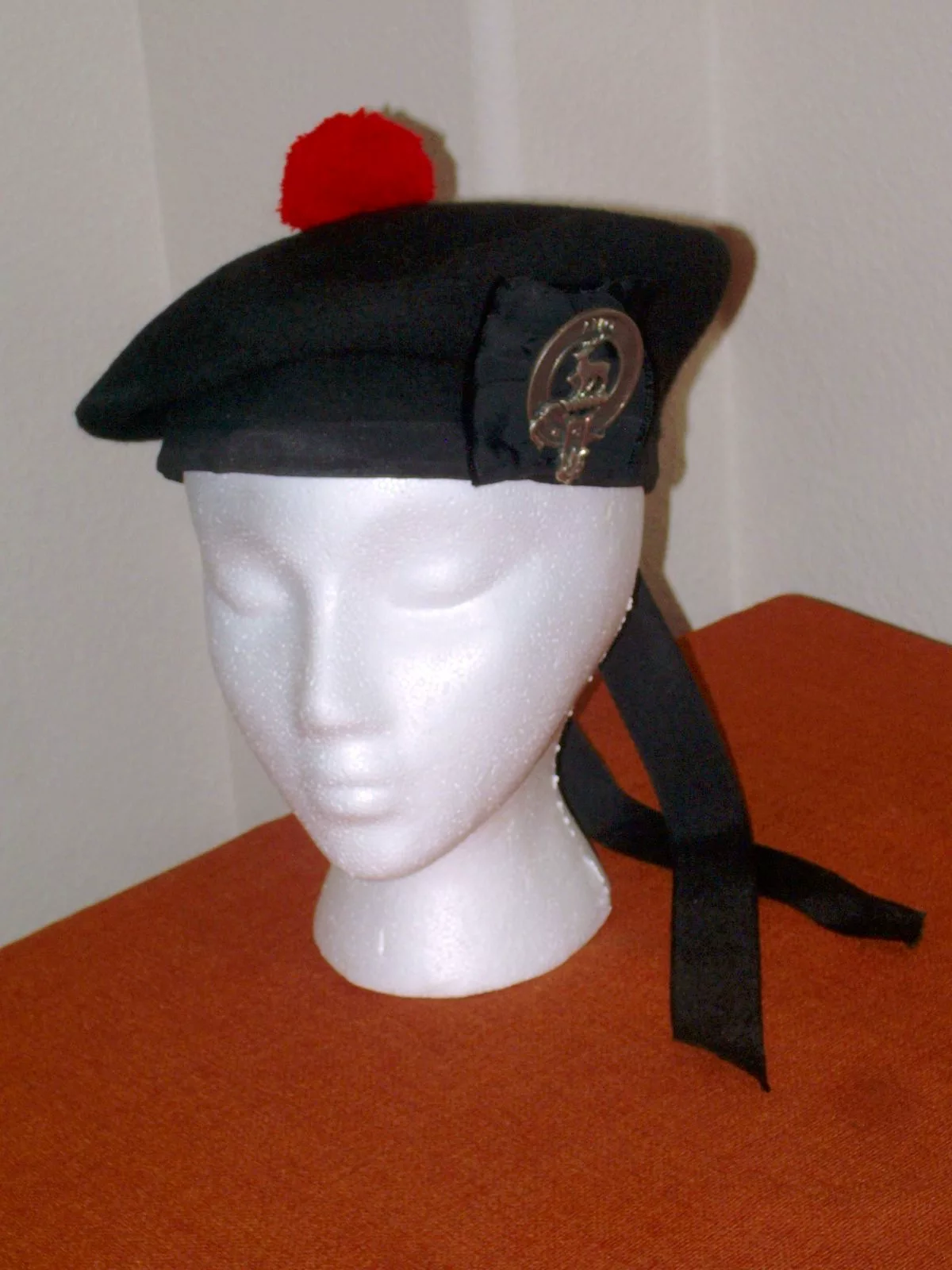

Scottish hats are mostly bonnets: soft or felted wool, no brim, usually with a woollen knot on top. Two features separate most of them. A flat circular crown points to the Kilmarnock, Balmoral or Tam o’ Shanter. A folded boat shape with a point at front and back is a Glengarry. A peak at the front means a flat cap. A tall dome of black feathers is a feather bonnet. The rest of this page works through those features, then through the names that sources use for more than one shape.
This page is the identification key. For choosing, sizing and styling a cap, see Scottish caps.
How to tell them apart
| Hat | Shape | Trim | Material and making | Easily confused with |
|---|---|---|---|---|
| Blue bonnet / Kilmarnock | Broad, flat, round crown, about eleven inches across in the dictionary definition | Red toorie at the centre | Knitted, then milled; blue, black or red | Balmoral (Balmoral descends from it) |
| Balmoral | Soft flat-crowned bonnet | Toorie, left-side badge on a ribbon cockade, ribbons behind, optional diced band | Knitted soft wool; dark blue, black or Lovat green | Tam o' Shanter, Kilmarnock |
| Tam o' Shanter | Flat, round bonnet | Toorie at the centre | Hand-knitted in one piece, stretched on a disc and felted; military version cut from khaki serge | Balmoral |
| Glengarry | Folded side cap, point at front and back | Toorie, left cockade, two ribbons behind, often a diced band | Thick-milled wool | Forage cap (the dictionary compares the shape) |
| Feather bonnet | Tall dome over a frame | Badge and hackle on the left, several tails below the band | Ostrich feathers on a wire cage | Not established in the sources read |
| Flat cap / bunnet | Rounded body with a short stiff front peak | None | Tweed, wool or cotton | Cabbie, driver and ivy caps (alternative names for the same cap) |
The bonnet family
Blue bonnet and Kilmarnock. The Dictionary of the Scots Language defines a Kilmarnock as a broad flat woollen bonnet in blue, black or red, and a 1953 citation describes a crown about eleven inches across with a red toorie in the middle. The entry says “It dates from the sixteenth century”. It adds a second sense, a knitted skull-cap worn at night or by indoor workers such as weavers. The name comes from the Ayrshire town. A museum essay from Dumfries and Galloway gives the trade side: bonnet makers’ incorporations were set up in Aberdeen, Perth, Stirling, Edinburgh, Glasgow and Stewarton (1590) and Kilmarnock (1646). The bonnets were hand-knitted on wooden needles into a circular shape, then waulked or milled to raise the nap and sheared, which thickened the cloth and helped it shed water. They were originally blue; black was worn by clerics, merchants and professional men.
The museum’s own catalogue record for a Kilmarnock bonnet has no date field and marks creator and materials “NA”, so the object cannot be used to date the style. The Scots word for the cloth cap generally is bunnet: the dictionary defines it as a head covering for men and boys, especially a cloth cap with a peak at the front, from Old French chapel de bonet, and finds it in Barbour’s Bruce of 1375.
Balmoral. An encyclopedia article describes the Balmoral as a development of the blue bonnet, knitted, soft, with a flat crown, and says the name was applied to the headdress in the late nineteenth century. It quotes an 1842 Chambers’ Information for the People description of such a bonnet as “worn pretty generally by ploughmen, carters and boys of the humbler ranks”, so the shape was common clothing before it was Highland dress. The same article gives dark blue, black and Lovat green as the usual colours and a red toorie, with a cockade in black, white or red silk and an optional red-and-white diced band. The badge goes on the left and the bonnet is tilted to the right to show it. In the military, a blue bonnet with a stiffened crown was adopted for full dress by some Lowland regiments in 1903, and the Black Watch took a soft blue Balmoral for full dress after the Second World War; the military Balmoral was dropped in the 2006 amalgamation into the Royal Regiment of Scotland.
Tam o’ Shanter. Royal Museums Greenwich states that Burns’s character gave his name to the bonnet he wore, “known as a Tam O’Shanter since the early 19th century”, and the poem was first published in 1791 (the Victoria and Albert Museum and an encyclopedia article say 1790, so the date is reported inconsistently). The V&A holds an early twentieth-century hand-knitted example, and notes that women and children wore versions from the early twentieth century. The same record records that by 1599 at least five bonnet-makers’ guilds existed in Scotland, which dates the trade, not this hat. The encyclopedia article describes the original as knitted in one piece, stretched on a wooden disc to set the flat shape and felted afterwards. Because the name arrived only after about 1800, a bonnet of 1700 is a blue bonnet in the sources, not a “tam”.
Military “tam”. The encyclopedia article says a khaki Balmoral was introduced in 1915 for wear in the trenches, called the “bonnet, tam o’ shanter” and shortened to “ToS”. It replaced the Glengarry as the regulation bonnet with khaki field dress and was cut from separate pieces of serge in place of being knitted. The article says it is worn today with battalion-coloured hackles or toories to tell units apart. A civilian and a military “tam o’ shanter” are therefore different objects under one name.
The Glengarry
The dictionary defines the glengarry as a flat-sided cap of thick woollen material, with a point at front and back and often two ribbons hanging behind, “apparently a development of the Cockit Bonnet”. It dates the name to Macdonell of Glengarry (1771 to 1828), who is said to have popularised the original form in Edinburgh during the 1822 Royal Visit, and cites an 1845 writer who called the form “not of more than about fourty years’ standing”. That points to roughly 1805.
That is not the date most reference pages give. The encyclopedia article says the Glengarry first appeared with the Glengarry Fencibles, formed in 1794 by Alexander Ranaldson MacDonell, and then notes that it is unclear whether early pictures show a true Glengarry that folds flat or the standard military bonnet cocked to one side. A date between 1794 and about 1805 is the most the two sources support. Military use is better dated: the article says the classic military pattern was introduced for 79th Foot pipers in 1841, that it became the characteristic undress headgear of Scottish regiments in the 1850s, and that by 1914 Scottish infantry wore dark blue Glengarries, with the Cameronians in rifle green.
Trim carries information. The diced band was red, white and blue in royal regiments and red, white and green elsewhere, according to the same article. The Royal Regiment of Scotland’s Glengarry is described as blue with red, green and white dicing, a red toorie and a black silk cockade behind the badge.
The feather bonnet
The feather bonnet is a ceremonial piece, not a day cap. The encyclopedia article says it evolved from the knitted blue bonnet with a chequered border and tall hackle, with ostrich feathers added through the seventeenth and eighteenth centuries until the bonnet was fully covered. It quotes an official report of 1790 that bonnets were “so covered with lofty feathers that they appear like grenadier caps”. The feathers are worked onto a light wire cage with four or five tails below the headband, and today it is mostly worn by pipers and drummers. The article cites Abler (1999) and Gordon-Alexander (1898) for this history; those books were not consulted.
Flat cap and tartan caps
A flat cap has a rounded crown and a small stiff peak, in tweed, wool or cotton. The encyclopedia article places it in sixteenth-century northern England and says the Scots word is bunnet. It also cites the Caps Act of 1571, which required most males over six to wear a woollen cap on Sundays and holidays to support the wool trade, as context for the English flat cap. That is an English statute and does not make the flat cap Scottish. The Scots bunnet in the dictionary is the more specific, wider-ranging word: “a cloth cap with a peak”.
“Tartan cap” does not name a shape. The sources describe Balmorals and tams in both plain and tartan cloth, and a tartan flat cap exists, so the phrase means only that the cloth is tartan. Where a listing uses it, find the shape from the table first.
Who made them
Stewarton in Ayrshire, called “the Bonnet Toun”, became the main centre of the trade. The Dumfries and Galloway essay says it took the lead in the nineteenth century through government orders. A Stewarton local history entry says Robert Mackie began making Glengarry and Balmoral bonnets there in 1845 and that the firm survives; a genealogy-school article treats the bonnet makers as one of the Trades House of Glasgow’s crafts. The society’s page gives 1845 for the opening, while the Dumfries and Galloway essay calls Mackies one of the original seventeenth-century Stewarton firms, so the firm’s age is not settled. The essay adds that production is now by machine. For the buyer, “hand-knitted” in a modern listing needs checking, not assuming.
Reading a photograph
- Look for a point at front and back. If the cap folds along a ridge, it is a Glengarry.
- If the crown is round and flat, the shape alone may not settle it. The sources read give no firm outline difference between a Balmoral and a tam. A badge on a cockade at the left, with ribbons behind, is Balmoral trim.
- Check the trim. A cockade and badge with ribbons behind belongs to the Balmoral or Glengarry. A bonnet with only a toorie is more likely to be sold as a tam, though the sources do not state this as a rule.
- Check for a peak. A stiff front peak with no toorie is a flat cap.
- For khaki or serge, think military. A khaki cap with a coloured hackle is the army “tam o’ shanter” of 1915, not the knitted civilian bonnet.
The Kilmarnock, the Balmoral that descends from it and the tam all share a flat-crowned, toorie-topped form, so one bonnet can honestly carry any of the three names, depending on who is writing and when.
Related guides
Sources & further reading
- Balmoral bonnet
- Glengarry (cap)
- Tam o' Shanter (cap)
- Flat cap
- Feather bonnet
- Kilmarnock (Scottish National Dictionary entry)
- Glengarry (Scottish National Dictionary entry)
- Bonnet, Bunnet (Scottish National Dictionary entry)
- Bonnet making
- Kilmarnock bonnet (catalogue record DMCL008a-e)
- The legend of Tam o' Shanter
- Tam o'Shanter (hand-knitted wool hat, T.1665-2017)
- Mackies (A-Z of Stewarton history)
- Scotch Bonnet Manufacturing