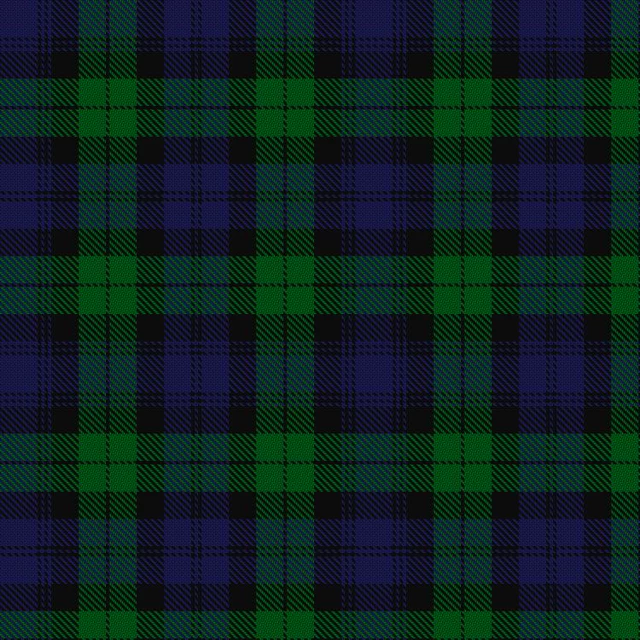
The dark blue, green and black tartan of the 42nd Regiment of Foot, the Black Watch. The Scottish Register of Tartans lists it as Black Watch (Government), a military tartan, and says it is thought to have been designed in 1739.
Regimental (military) tartan
Universal
Evidence level B
Image: Scottish Register of Tartans, rendered from the registered threadcount. Crown copyright, National Records of Scotland.Image source: the record this swatch comes from. Licence: Crown copyright, National Records of Scotland (Scottish Register of Tartans). Re-use beyond fair dealing needs NRS permission.
Type
Military tartan
Classification
Regimental (military) tartan
Earliest known date
Not recorded
Registered
Not recorded
Associated clan
Campbell
Who can wear it
Universal
Evidence level
B
Also known as
Government
42nd
Black Watch (Government)
Old Campbell
Overview
Black Watch is a dark tartan of blue, green and black. The Scottish Register of Tartans lists it as Black Watch (Government), in the military category. It is the uniform tartan of the 42nd Regiment of Foot, and it is also sold and worn as a general-purpose tartan with no clan ownership.
The design history is less settled than the popular story. The register says the tartan is thought to have been designed in 1739. Other accounts place its adoption in 1749 or later, and the earliest specimens that can be dated come from the early nineteenth century.
The Scottish Register of Tartans files Black Watch (Government) as a military tartan with a date field of 1739 and says the tartan is thought to have been designed when the independent companies were consolidated into a regiment that year.
From the historical notes. Evidence level A. Sources: [1]
Pattern
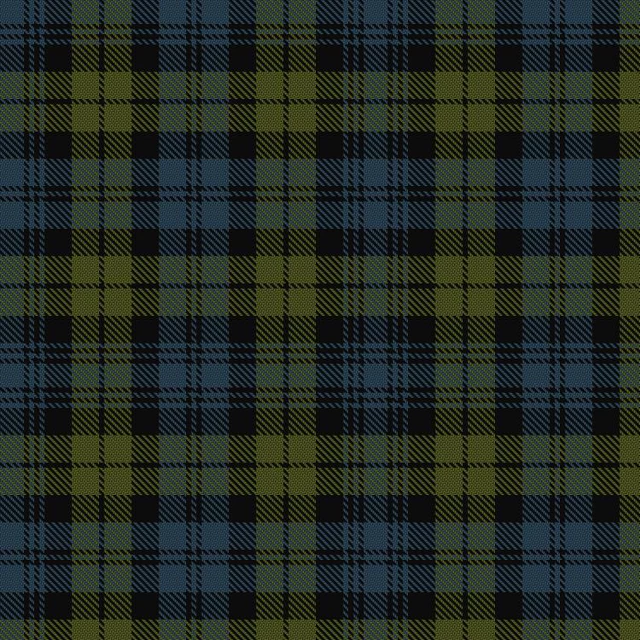
The pattern is built from broad bands of dark blue and green separated by narrow black lines, in a sett of thirteen bands that runs blue, black, blue, black, blue, black, green, black, green, black, blue, black, blue. The Clan Campbell Society of North America describes the Campbell clan tartan as the same pattern in lighter shades.
This site does not give a threadcount for Black Watch. The Scottish Register of Tartans keeps its threadcounts behind a login, and the counts found in secondary databases disagree in scale and in where the pivots fall. A rendered sett will be added once a count can be checked against a reliable record.
Origins
In 1725 the government authorised independent Highland companies to keep order in the Highlands after the Jacobite rising of 1715. The Black Watch Museum says the men came from the Grant, Munro, Fraser, MacGregor, Mackintosh, Macpherson and Campbell clans, and gives their role as watching the Highlands and suppressing blackmail, which was known as mal dubh.
The name has two common explanations. One ties "black" to the watch itself and to the blackmail it policed. The other ties it to the dark colour of the tartan beside the red coats of regular troops. The sources read for this record do not settle the question, so both are accounts rather than established fact.
The companies were consolidated into a regiment of the line in 1739 to 1740. Whether they wore one uniform tartan before that is uncertain. Philip D. Smith Jr. writes that no design record of the original survives.
The register lists Black Watch (Band Plaid) (SRT 396, Wilsons of Bannockburn, 1819) and says the firm's 1819 Key Pattern Book records that black was substituted for red in the band plaid version for the 42nd Regiment.
From the historical notes. Evidence level A. Sources: [6]
Development
The register gives 1739 as the date of design but hedges it. Scholars cited on Wikipedia's regimental tartan article argue that the pattern was probably not adopted until the unit became the 42nd in 1749, and possibly not until 1757. They suggest it grew out of earlier independent-company tartans with black over-checks added.
The earliest datable physical evidence found for this record is the Cockburn Collection of about 1810 to 1815, which the register says holds four specimens of the pattern under the labels Campbell Argyll, Grant, Munro and Sutherland. That is nearly a century after the first companies.
Campbell relationship
The register's Cockburn Collection note shows that the same pattern was sold under several clan names in the early nineteenth century, Campbell Argyll among them. The Clan Campbell Society of North America describes the Campbell tartan as the Black Watch pattern in lighter shades,
Sources do not agree on direction. The clan society frames the Campbell tartan as the older or parent form, since three of the six original companies were Campbell. Philip D. Smith Jr. says the contemporary Black Watch was not originally a Campbell tartan. The same sett also appears under Grant, Munro and Sutherland names. This site therefore records a close relationship between the Campbell and Black Watch setts without stating which came first.
Civilian use
The tartan was made for the regiment, and the register's Cockburn Collection note shows the same cloth being labelled with clan names by about 1810 to 1815. Retail and popular sources describe it as an open tartan that anyone may wear and one of the most common tartans in general use. That claim rests on commercial sources, so it carries a low evidence level here.
Modern uses
The Canadian government's lineage record for The Black Watch (Royal Highland Regiment) of Canada covers a regiment that wears Highland dress. Outside the military the tartan is woven into kilts, skirts, scarves and blankets.
Register variants
The register does not hold one Black Watch entry. A search on the name returns nine records, and they differ in category, date and provenance:
Black Watch (Government), SRT 277, Military, designer unknown. This is the entry this page describes.
Black Watch (Band Plaid), SRT 396, Military, Wilsons of Bannockburn, 1819. The register's note says the firm's 1819 Key Pattern Book records that the band plaid version needed black substituted for red when the cloth was supplied for the 42nd Regiment. It also quotes the Scottish Tartans Society's remark that the Black Watch "has provided the base for many of the Clan tartans". The register adds that Wilson held a contract to supply regimental tartans while Highland dress was restricted by law, and often added coloured stripes to tell units apart. That is the register's account of the trade, and it does not cite the contract.
Black Watch (smallest sett), SRT 3695, Military, designer unknown, dated 1820. The note says Pendleton Mills called this sett "Wartley" and that it matches the 42nd as printed in Clans Originaux (1880).
Black Watch Dress (Asymmetrical), SRT 1965, Military, taken from a sample in the MacGregor-Hastie Collection of the Scottish Tartans Society archive.
Black Watch Dress (Symmetrical), SRT 3094, classed Fashion and dated "pre-1930". The note relays the Clan Sutherland website's statement that the earliest known sample, found in a John Lewis store about 1930, was labelled Black Watch Dress, and that Anderson of Edinburgh later sold it as a Sutherland variant.
Black Watch Ground Colour, SRT 1827, category Other, from the Scottish Tartans Society archive with no further note.
Further entries by Pendleton Woollen Mills and Aljean of Vancouver (both Fashion) and a corporate design for Isetan, recorded in 2014.
The practical point is that "Black Watch" on a label can refer to the regimental cloth, a smaller or larger scaling of it, a dress variant or a mill's fashion version. The register number is the only way to know which.
Dating the sources
The dated references for this tartan sit far apart, and they are different kinds of evidence. The register's design date of 1739 is a hedge. The 1819 Wilsons Key Pattern Book entry is a commercial pattern record that shows the pattern was in the weaver's stock by then. The 1820 date on the smallest-sett entry and the 1880 Clans Originaux reference are later again. Between 1739 and about 1810 the sources read here give no surviving cloth, order or written description that fixes the sett.
For a reader this matters in one way. A claim that the present Black Watch "is" the 1739 cloth cannot be tested with the evidence found, and Philip D. Smith Jr.'s statement that the present sett post-dates 1745 points the other way. The regiment's name and role are well documented. The pattern's early history is not.
Regimental chronology
For orientation, Wikipedia, as a pointer, gives the chronology this way: General George Wade raised the independent companies in 1725 and the force was known in Gaelic as Am Freiceadan Dubh. The 42nd (Royal Highland) Regiment of Foot and the 73rd (Perthshire) Regiment were combined in 1881 under the Childers reforms as the Black Watch (Royal Highlanders), and in 2006 the regiment became the 3rd Battalion of the Royal Regiment of Scotland. These are secondary statements and have not been checked against regimental records. They are included so that the tartan's dates can be read against the regiment's, and they do not change the tartan's own evidence.
Colours
dark blue#2C2C80Approximate
green#006818Approximate
black#101010Approximate
Approximate hex values estimate the thread colour; they are not specified by a registry.
Dates in the record
The dates this record holds, and the opening sentence of each historical note that names a single year. A year is the one the source gives; it has not been checked independently here.
Warrants of 1725 set up independent Highland companies to police the Highlands, and the Black Watch Museum says the men came from the Grant, Munro, Fraser, MacGregor, Mackintosh, Macpherson and Campbell clans.
The Scottish Register of Tartans files Black Watch (Government) as a military tartan with a date field of 1739 and says the tartan is thought to have been designed when the independent companies were consolidated into a regiment that year.
Philip D. Smith Jr. writes that no record of the original independent-company design survives, that the present sett is later than 1745, and that James Scarlett believed the original was not the same as today's Government tartan.
The register lists Black Watch (Band Plaid) (SRT 396, Wilsons of Bannockburn, 1819) and says the firm's 1819 Key Pattern Book records that black was substituted for red in the band plaid version for the 42nd Regiment.
The Scottish Register of Tartans files Black Watch (Government) as a military tartan with a date field of 1739 and says the tartan is thought to have been designed when the independent companies were consolidated into a regiment that year. The wording is a hedge, not a documented design date.
The register notes that the Cockburn Collection (about 1810 to 1815) holds four specimens of the Government tartan labelled Campbell Argyll, Grant, Munro and Sutherland.
Warrants of 1725 set up independent Highland companies to police the Highlands, and the Black Watch Museum says the men came from the Grant, Munro, Fraser, MacGregor, Mackintosh, Macpherson and Campbell clans. They were consolidated into a regiment of the line in 1739 to 1740.
Scholars quoted on the regimental tartan article date the adoption of the pattern between 1749, when the unit was renumbered the 42nd, and 1757, and suggest it developed from earlier independent-company tartans with black over-checks added. The primary works (Scarlett, Telfer Dunbar, Newsome) were not read for this record.
Philip D. Smith Jr. writes that no record of the original independent-company design survives, that the present sett is later than 1745, and that James Scarlett believed the original was not the same as today's Government tartan.
The register lists Black Watch (Band Plaid) (SRT 396, Wilsons of Bannockburn, 1819) and says the firm's 1819 Key Pattern Book records that black was substituted for red in the band plaid version for the 42nd Regiment.
The register lists Black Watch (smallest sett) (SRT 3695, dated 1820) and says it matches the 42nd as printed in Clans Originaux (1880); the sett is called Wartley by Pendleton.
The register lists a symmetrical dress version (SRT 3094, Fashion, pre-1930) whose note says the earliest known sample was found in a John Lewis store about 1930 and was later sold as a Sutherland variant, and an asymmetrical dress version (SRT 1965) taken from the MacGregor-Hastie Collection.
No restriction is recorded for this tartan. It is recorded as a universal tartan, open to anyone.
The Scottish Register of Tartans states there are no laws about which tartan a person may wear, only traditions. Black Watch is worn by civilians as well as by the regiment.
There is no law or registry rule that restricts Black Watch. The Scottish Register of Tartans states that there are no laws about which tartan a person may wear, only traditions.
The tartan is regimental dress for The Black Watch, and no source read here describes any rule that keeps civilians from wearing it.
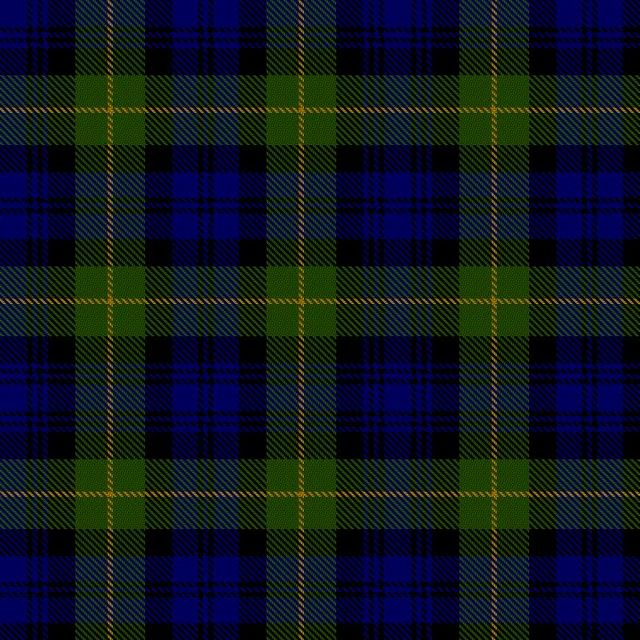
Campbell is the closest, since it uses the same thirteen-band pattern in lighter shades. Gordon is described by House of Gordon USA as derived from three patterns made from Black Watch in 1793, with a single yellow stripe added; the Register dates the Gordon tartan to 1794. Grant, Munro and Sutherland versions of the same cloth appear in the Cockburn Collection.
"Ancient", "modern" and "weathered" Black Watch are colour treatments of the same sett by weavers. No separate registry entries for them were found.
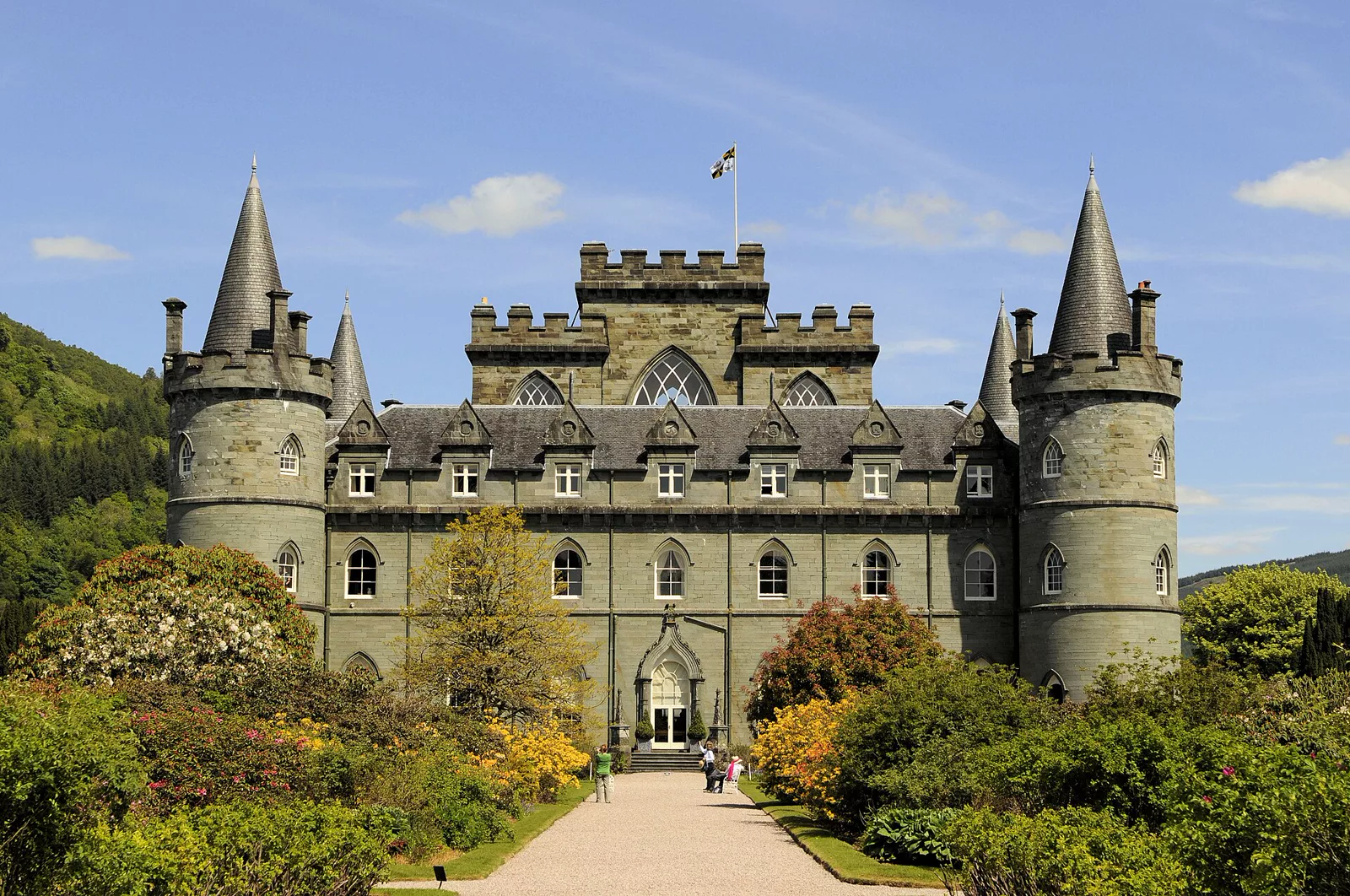
A clan of Argyll whose chief is the Duke of Argyll, with the principal seat at Inveraray Castle on Loch Fyne. The chief's Gaelic style is Mac Cailein Mòr, from Cailean Mòr (Colin the Great), killed in the 1290s. The Campbell tartan is the Black Watch sett in lighter shades, but the Black Watch sett itself is shared with other clans and its origin is not credited to the Campbells.
Photo: Son of Groucho from Scotland, CC BY 2.0
An association between a tartan and a clan is a claim with its own sources. It does not mean every bearer of the clan name has a right to the tartan, or the reverse.