Foundations
Tartan vs plaid
In Scotland, tartan is the pattern and plaid was originally a garment. In North America, plaid is the common word for the pattern. Both uses are established.

Tartan and plaid overlap in everyday speech but did not start as the same thing. Tartan is a pattern: two or more alternating coloured stripes crossing at right angles to make a repeating check. Plaid, in older Scottish use, was a piece of cloth worn as a garment. In North America plaid now names the pattern, and that usage is in the dictionaries.
Tartan
The Scottish Register of Tartans Act 2008 defines a tartan as a design capable of being woven, made of two or more alternating coloured stripes that combine vertically and horizontally into a repeated chequered pattern. A given tartan has a name and a recorded stripe sequence, its sett, written as a thread count. See what is tartan.
The word named a kind of cloth before it named a pattern. The Online Etymology Dictionary dates English tartan to the mid-15th century as a woollen fabric, probably from French tiretaine, a coarse strong cloth, with the Scottish sense of a woollen cloth with crossing coloured stripes from about 1500. The origin is uncertain, and other derivations have been proposed.
Plaid
The Dictionary of the Older Scottish Tongue describes a plaid as a length of cloth in a certain weave, in single or double width, used chiefly as a garment: worn as a shawl by women throughout Scotland, as a mantle by men, and, apparently in the Highlands only, as the belted plaid that served as the main article of dress. It was also a bedcovering, and it came in plain colours, marls or patterns. The dictionary mentions white, grey and tartan plaids, and some made of silk. The earliest quotation it gives is from 1510, and it records the word’s origin as uncertain.
The same entry shows how the garment was seen. It quotes a description, published in 1741 and referring to observations of 1661, of Highland women wearing “a party coloured blanket which they call a plad over their heads and shoulders”. It also records church regulations of the 1630s that treated plaids as unseemly dress in certain public places. The word, in other words, meant a blanket-like wrap, and what mattered was the garment, not its pattern.
So a Scottish plaid might be tartan, but it might also be plain grey or white. And a tartan is not a plaid unless it is being used as one, for instance as a shawl or wrap.
Where the word came from
The Online Etymology Dictionary traces plaid into English in the 1510s from Scottish Gaelic plaide, “blanket, mantle”, and floats peallaid, “sheepskin”, as a possible source. The Scots dictionary is more cautious and calls the origin uncertain. That is a real difference between sources, and neither is a primary record of the Gaelic word’s history. The Wikipedia article on the belted plaid repeats the gloss of Gaelic plaide as blanket and gives the Gaelic names fèileadh-mòr, “large wrap”, and breacan an fhèilidh, “tartan wrap of the kilt”. In Gaelic, then, the garment and its cloth had their own words, and “tartan wrap” was one way to name a plaid that happened to be tartan.
The earliest clear reference to the belted plaid that Wikipedia cites is from 1594, describing Highlanders of the Western Isles with belts over their loins outside their cloaks. Estimates of its length and width differ between sources, so none is given here. For the garment and the later tailored kilt, see what is a kilt.
Plaid in the law of 1746
The Dress Act of 1746 is a useful test, because Parliament had to name what it was banning. As Wikipedia summarises the text, the Act listed “the Plaid, Philabeg, or little Kilt, Trowse, Shoulder-belts” and also tartan or party-coloured plaid for coats. The plaid was one named garment, and tartan cloth was something else that could be used for coats. That is the older distinction in statute language: plaid for the wrap, tartan for a striped cloth.
How the words are used now
| Term | Original sense | Common use today |
|---|---|---|
| Tartan | A woven pattern of crossing coloured stripes with a recorded sett | The same, usually with a specific name attached |
| Plaid | A length of cloth worn as a mantle, shawl or bedcovering | In North America, any checked or crossed-stripe pattern, tartan or not |
The Online Etymology Dictionary records the pattern sense of plaid, “a pattern of bars crossing each other at right angles”, by 1890. When and how it moved from the garment to the pattern, and why it did so in North America in particular, is not established in the sources used here, so any story that gives a precise cause or date should be treated as a guess. Wikipedia’s disambiguation page lists the senses side by side: tartan cloth, mainly in North American usage; Scottish garments such as the belted plaid; and modern flannel shirts and jackets in a plaid pattern.
In Britain a shop selling “plaid” fabric is likely to mean a shawl or blanket, or a check that is not a named tartan. In North America plaid is commonly used for tartan patterns as well as other checks. Neither group is mistaken; they are using a word whose meaning has moved. If you are describing a specific design with a recorded name, tartan is the accurate word. For a generic check, either is understood.
Other checks
Several checks are often called plaid but are not tartans in the sense that matters for a named pattern. The descriptions below are from Wikipedia, a level D pointer, and are only as good as its references.
- Gingham. A medium-weight, balanced plain-woven cotton, usually one bright colour with white, made from dyed yarns. Its etymology is uncertain; Guingamp in Brittany, Dutch and Malay origins have all been suggested. Wikipedia places mills producing checked and tartan-style gingham in Manchester from the mid-18th century. It is a plain weave, not a twill, and has one colour pair.
- Buffalo check. Black on red in a large square. Wikipedia reports that it got its name around 1850 when a designer at the Woolrich mill in Pennsylvania copied a Scottish pattern called “Rob Roy”, after Rob Roy MacGregor. That origin story rests on journalism, not on a mill record we have seen, so it is a claim and not established history.
- Madras. A lightweight cotton cloth from the Chennai region of India, with tartan-style designs. Authentic pieces are handwoven from short-staple cotton that is carded, not combed, which leaves the small slubs that give the cloth its texture. The cloth is named for a place and a hand technique, not a pattern.
The statutory test for a tartan is alternating coloured stripes that cross to form a repeated chequered pattern, which a plain two-colour square may technically meet. In practice the name tartan is kept for designs with a documented or registered sett, because the Register works from a threadcount, and this site uses it that way. “Tartan plaid”, a phrase common in online listings, usually means a checked pattern in the manner of tartan, and it does not tell you whether a real named tartan is involved.
Which word to use
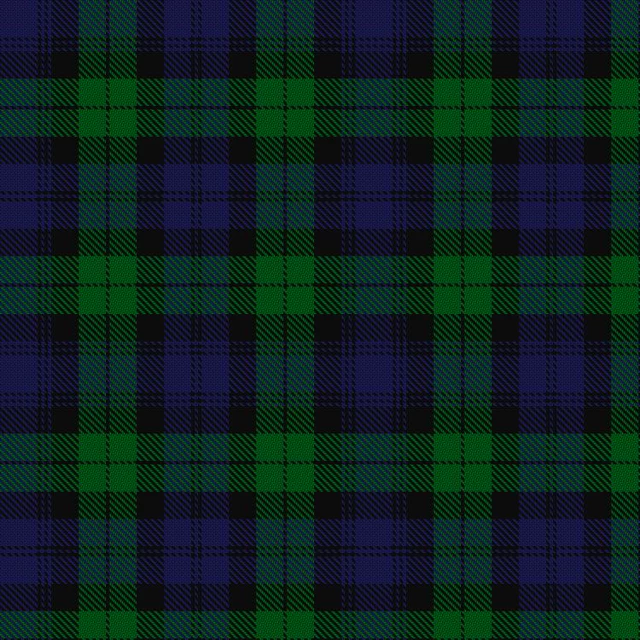
- Describing a named design (Black Watch, Royal Stewart): tartan. A named design has a threadcount you can look up.
- Describing a Scottish garment of cloth, such as a shawl, wrap or the belted plaid: plaid is the older and more precise word.
- Describing a check with no recorded sett, such as a flannel shirt or a printed fabric: plaid in North America, check or tartan-style elsewhere. Neither claims a Scottish connection.
- Searching to buy: use “tartan” with a name or threadcount if you want a specific pattern, and expect “plaid” listings to be broad.
- Writing for readers in both places: say tartan for the pattern and name the garment, and the meaning is clear to both.
Related
The belted plaid, the garment form, is covered in what is a kilt. The Black Watch tartan is documented in its own Black Watch tartan entry.
Continue learning

Related guides
Sources & further reading
- Plaid (Dictionary of the Older Scottish Tongue entry)
- Scottish Register of Tartans Act 2008, section 2: the Scottish Register of Tartans
- Tartan
- Plaid (Online Etymology Dictionary)
- Tartan (Online Etymology Dictionary)
- Belted plaid
- Dress Act 1746
- Gingham
- Buffalo check
- Madras (cloth)
- Plaid (disambiguation)
- Scottish Register of Tartans: frequently asked questions