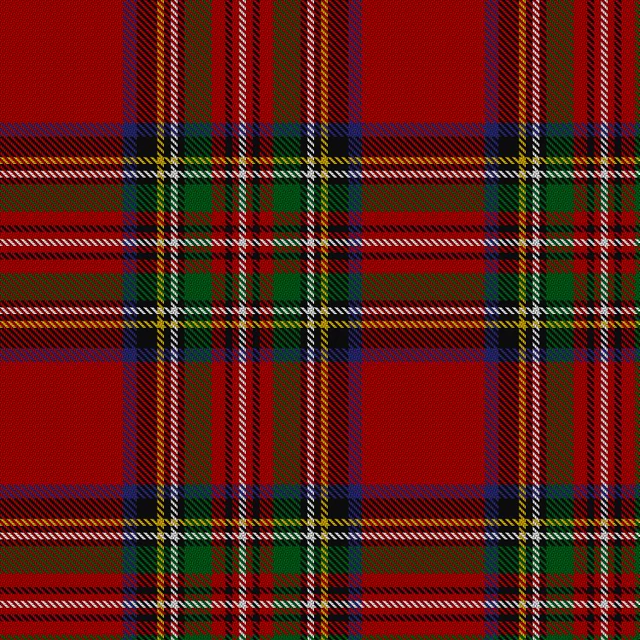
A red tartan with blue, black, yellow, white and green lines, listed in the Scottish Register of Tartans in the Royal category. It appears in Wilsons of Bannockburn records from about 1800 and is the personal tartan of the monarch.
Royal tartan (Scottish Register of Tartans category: Royal)
Universal
Evidence level A
Image: Scottish Register of Tartans, rendered from the registered threadcount. Crown copyright, National Records of Scotland.Image source: the record this swatch comes from. Licence: Crown copyright, National Records of Scotland (Scottish Register of Tartans). Re-use beyond fair dealing needs NRS permission.
Type
Tartan
Classification
Royal tartan (Scottish Register of Tartans category: Royal)
Earliest known date
1800
Registered
Not recorded
Associated clan
Stewart
Who can wear it
Universal
Evidence level
A
Also known as
Stewart, Royal
Royal Stuart
Overview
Royal Stewart is a red tartan with blue, black, yellow, white and green lines. The Scottish Register of Tartans classes it as Royal and lists it as SRT 1370, dated 1800. It is the personal tartan of the monarch, and it is also associated with the Stewart family.
It is not a clan tartan in the restricted sense. No law or registry rule limits who may wear it.
The Scottish Register of Tartans records Stewart, Royal (SRT 1370, category Royal, 1800, designer not specified) as listed in Wilsons of Bannockburn records from around 1800 under the name Royal Stewart.
From the historical notes. Evidence level A. Sources: [1]
Pattern
The record gives red as the ground, with dark blue, black, yellow, white and green. A threadcount appears on this record from the Tartan Dictionary, R/36 DB4 K6 Y1 K1 W1 K1 G8 R4 K1 R2 W/1, and the page draws the sett from it. The register's own count is behind a login and was not read, so the dictionary is the source for the sett shown.
The register adds that early samples show interchangeable use of blue shades, so the blue is not as fixed as the other colours in the early record.
Origins
The register says the sett appears in Wilsons of Bannockburn records from around 1800 under the name Royal Stewart. How it came about is unclear, and the register treats stories of a late eighteenth-century origin or of use at the 1745 rising as unproven and probably myth.
Wikipedia, as a pointer, says the sett was first published in 1831 in James Logan's The Scottish Gaël. If that is right, it would be the earliest printed record, though it is secondary and not checked here against the book.
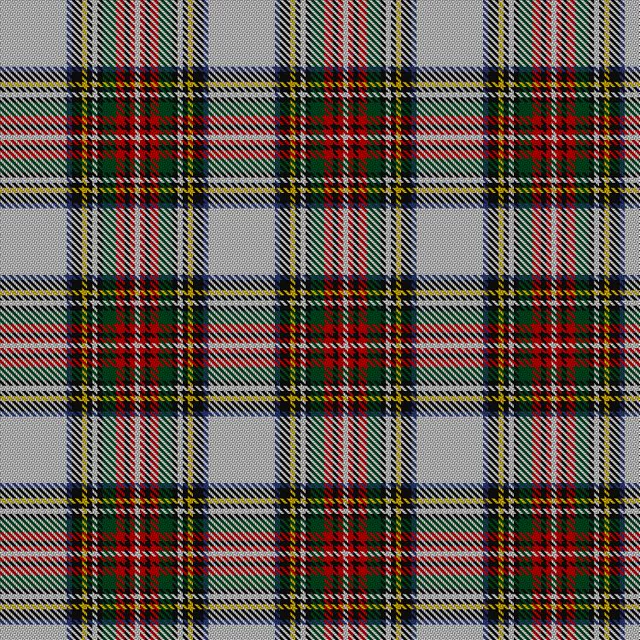
The register lists Stewart, Dress #1 (SRT 1765) as a dress version of Royal Stewart with equal yellow and white stripes, estimated c. 1850 and believed to derive from the Vestiarium Scoticum of 1842.
From the historical notes. Evidence level A. Sources: [3]
Development
The royal link comes from 1822. The register says George IV wore the tartan during his visit to Scotland that year and that Queen Victoria then adopted it for the royal family. The register's c. 1800 date for the Wilsons record is earlier than that visit.
Later, according to the register, George V tried to restrict the tartan to royalty but gave up because it had become a popular fashion tartan, and the Balmoral pattern was reserved for royal use instead. The register does not give dates for those steps.
The dress version, Stewart Dress, is dated by the register to about 1850 and linked to the 1842 Vestiarium Scoticum.
Name and variants
The register's name is Stewart, Royal, and Royal Stuart is the alternative spelling. The register and its sources use both Stewart and Stuart.
Balmoral is a different tartan. The register's note and the kiltmaker Kinloch Anderson both say it, not Royal Stewart, is the royal-only one.
Clan relationship
The Stewarts' association is a family one and a royal one. Royal Stewart is the best-known Stewart tartan, but the Stewart Society notes that clan members have others, including dress versions, so this tartan is not the only Stewart pattern. A Stewart surname does not make it yours, and wearing it does not require one.
Check before repeating
Misconceptions
The 1745 story is unproven. The register treats a late eighteenth-century origin and use at the rising as probably myth, and the earliest solid record is the Wilsons' catalogue from around 1800.
Royal Stewart is not royalty-only. The register says George V tried that and dropped it. Balmoral is the royal one.
It is not the tartan of every Stewart. The Stewart Society lists others.
Modern uses
The register notes the tartan became popular as a fashion tartan, which is why George V's restriction failed. Wikipedia, as a pointer, adds that the pipers of the Black Watch, Royal Scots Dragoon Guards and Scots Guards wear it, that Jackie Stewart wore a band of it on his racing helmet in the 1960s, and that punk fashion adopted it in the late 1970s. Those uses are secondary claims and not checked here.
Not established
What the record does not show
The register does not say who designed Royal Stewart or why it was named that in c. 1800. The sources read do not give the dates of George V's attempt to restrict it or of the Balmoral reservation, and the 1831 first-publication claim is a secondary pointer. The register's own threadcount is unread.
Dating and sources
Three sources date this tartan in three ways, and they do not strictly agree.
The Scottish Register of Tartans gives about 1800, from Wilsons of Bannockburn records under the name Royal Stewart.
The Stewart Society says the pattern was "known at the end of the 18th century" and first appeared in print in James Logan's The Scottish Gael of 1831, and that early samples show the blue as a light azure.
Wikipedia, as a pointer, gives 1831 as the first formal documentation and attaches the Stewart name to the sett retrospectively.
These can all be true together. A weaver's record of about 1800 and a printed plate of 1831 are different events, and neither shows that the Stewarts used the pattern before a weaver sold it. What none of them supplies is a Stewart chief or the royal household choosing it before 1822. The Stewart Society and Wikipedia both name the 1822 visit of George IV as the moment the tartan became royal.
One wording difference is worth knowing. The Stewart Society's page speaks of the personal tartan of Her Majesty the Queen, which reflects when it was written. Wikipedia now names King Charles III. The tartan belongs to the monarch of the day and the title on the page changes with the reign.
Restricted or universal
Wikipedia, as a pointer, says permission from the monarch is theoretically required to wear Royal Stewart, and quotes the Scottish Register of Tartans as saying that in practice, because of its popularity, it has become a universal tartan that anyone without a clan tartan of their own may wear. The register's own record, read for this page, gives the George V episode instead: an attempt to restrict the tartan to royalty that was dropped because the tartan had become a fashion cloth.
The two accounts agree on the result. There is no enforced rule, the tartan sold widely, and the one pattern that was reserved for royal use is Balmoral. The older theory that permission is still formally needed is a tradition, not a law, and the register says no law governs what tartan a person wears.
Other register entries
Two register entries show how far the Stewart name travels beyond the clan.
Racing Stewart (SRT 2306, Corporate) was designed by Kinloch Anderson Ltd on 1 August 1995 "for Jackie Stewart's Formula One motor racing team". The register marks it as restricted to that corporate use and records that a woven sample is held by the National Records of Scotland. This is the only Stewart pattern read for this page that is formally restricted, and the restriction is by a company, not by any royal rule.
Hay Stewart (SRT 1850, Name) was designed by Wilsons of Bannockburn and dated 1838. The register describes it as like the Victoria Stewart pattern with a double red overcheck on the white, and notes a letter of 1938 saying it was probably designed by or for the Sobieski Stuart brothers.
Both are separate setts with their own numbers. A cloth labelled with a Stewart-sounding name should be matched by register number before anyone assumes it is Royal Stewart.
Colours
red#C80000Approximate
dark blue#2C2C80Approximate
black#101010Approximate
yellow#E8C000Approximate
white#F0F0F0Approximate
green#006818Approximate
Approximate hex values estimate the thread colour; they are not specified by a registry.
Rendered sett (threadcount from Stewart Royal)
Dates in the record
The dates this record holds, and the opening sentence of each historical note that names a single year. A year is the one the source gives; it has not been checked independently here.
Earliest known date held in this record.
The register says King George IV wore the tartan during his 1822 visit to Scotland, and that Queen Victoria then adopted it for the royal family.
The Stewart Society says Royal Stewart was known at the end of the eighteenth century, first appeared in print in James Logan's The Scottish Gael in 1831, and that early samples show the blue as a light azure.
The register lists Racing Stewart (SRT 2306, Corporate) as designed by Kinloch Anderson Ltd on 1 August 1995 for Jackie Stewart's racing team, restricted to that corporate use, with a woven sample held by the National Records of Scotland.
The Scottish Register of Tartans records Stewart, Royal (SRT 1370, category Royal, 1800, designer not specified) as listed in Wilsons of Bannockburn records from around 1800 under the name Royal Stewart. It says early samples show interchangeable use of blue shades.
The register says King George IV wore the tartan during his 1822 visit to Scotland, and that Queen Victoria then adopted it for the royal family. It also says George V tried to restrict its use to royalty, abandoned the attempt because of its popularity as a fashion tartan, and reserved the Balmoral pattern for royal use.
The Stewart Society states that the tartan is the personal tartan of the monarch and quotes registry guidance that it is appropriate for all subjects of the Sovereign to wear it.
The register lists Stewart, Dress #1 (SRT 1765) as a dress version of Royal Stewart with equal yellow and white stripes, estimated c. 1850 and believed to derive from the Vestiarium Scoticum of 1842.
Wikipedia, as a pointer, says the sett was first published in 1831 in James Logan's The Scottish Gaël, that David Wilkie's painting of the 1822 visit shows George IV in Highland dress, that the pipers of the Black Watch, Royal Scots Dragoon Guards and Scots Guards wear it, and that Jackie Stewart wore a band of it on his helmet and punk fashion adopted it in the late 1970s. These claims are secondary and were not checked against the cited works.
The Stewart Society says Royal Stewart was known at the end of the eighteenth century, first appeared in print in James Logan's The Scottish Gael in 1831, and that early samples show the blue as a light azure.
The register lists Racing Stewart (SRT 2306, Corporate) as designed by Kinloch Anderson Ltd on 1 August 1995 for Jackie Stewart's racing team, restricted to that corporate use, with a woven sample held by the National Records of Scotland.
The register lists Hay Stewart (SRT 1850, Wilsons of Bannockburn, 1838), a pattern like Victoria Stewart with a double red overcheck on the white, and says a letter of 1938 suggests it was probably designed by or for the Sobieski Stuart brothers.
No restriction is recorded for this tartan. It is recorded as a universal tartan, open to anyone.
No legal restriction. The Stewart Society quotes registry guidance that, as clansmen wear their chief's tartan, it is appropriate for all subjects of the Sovereign to wear Royal Stewart.
Registry guidance quoted by the Stewart Society says that, as clansmen wear their chief's tartan, it is appropriate for all subjects of the Sovereign to wear Royal Stewart. The Scottish Register of Tartans also states there are no laws about which tartan a person may wear.
Kinloch Anderson, a kiltmaker, says the monarch-only royal tartan is Balmoral, and that Royal Stewart has no such restriction. That is a commercial source and is recorded at a low evidence level.
Royal Stewart is also called the Stewart tartan, but a Stewart surname is not required, and Stewart clan members have other tartans as well, including dress versions.
Stewart Dress is the dress version, with yellow and white of equal size. Balmoral is the pattern the register says George V reserved for royalty. Other Stewart tartans exist and are separate setts; the Stewart Society lists them.
A family descended from the hereditary High Stewards of Scotland, one branch of which became the royal House of Stewart in 1371. The royal house, the Stewart clan and the Royal Stewart tartan are three separate things: secondary sources report that the name has no chief recognised by the Lord Lyon, and the registry says Royal Stewart is the personal tartan of the monarch.
An association between a tartan and a clan is a claim with its own sources. It does not mean every bearer of the clan name has a right to the tartan, or the reverse.