Scottish clan
Clan Stewart
Gaelic name Stiùbhart
A family descended from the hereditary High Stewards of Scotland, one branch of which became the royal House of Stewart in 1371. The royal house, the Stewart clan and the Royal Stewart tartan are three separate things: secondary sources report that the name has no chief recognised by the Lord Lyon, and the registry says Royal Stewart is the personal tartan of the monarch.
No photograph is held for this record. Shown: register swatches of its linked tartans.
- Region
- Renfrewshire, Teviotdale, Lauderdale
- Historic seat
- Not recorded
- Motto
- Virescit vulnere virtus
- Linked tartans
- 2
- Linked surnames
- 1
- Evidence level
- D
Overview
Three different things carry the name Stewart. The first is the royal House of Stewart, the line of kings that began with Robert II in 1371. The second is the Stewart family and its branches, which descend from the hereditary High Stewards of Scotland. The third is a set of tartans, of which Royal Stewart is the best known. They are linked, but each link needs its own evidence.
The name has an unusual position among Scottish families. Secondary sources report that the Lord Lyon recognises no chief of the name Stewart, and the Stewart Society says the Earls of Galloway have been regarded as the senior representatives of the High Stewards' line. Appin and Bute are described as separate clans with their own chiefs. No seat is assigned on this page because the sources read do not give one for the name as a whole.
The Scottish Register of Tartans says Royal Stewart appears in Wilsons of Bannockburn records of about 1800 under that name, that the origin of the name is unclear, and that stories of an eighteenth-century or 1745 origin are unproven and likely a myth.
Origins
Secondary sources trace the family to Breton stewards of Dol. Wikipedia says Walter fitz Alan came to Scotland when David I claimed the throne, became High Steward, and received land in Renfrewshire and East Lothian in the twelfth century.
The Clan Stewart Society traces the later branches to Sir John Stewart of Bonkyl, who died in 1298, and to his sons. It names Appin, Atholl, Bute and Galloway as lines descended through them. These accounts rest on a clan society and on Wikipedia, and they have not been checked here against Way and Squire or a printed Stewart history.
Development
Wikipedia says the sixth High Steward, Walter, married Marjory, daughter of Robert the Bruce, and that their son became Robert II in 1371. On that account the House of Stewart held the Scottish crown, and later the English crown, until Queen Anne's death in 1714.
The branches continued separately. The Clan Stewart Society says Lord Garlies became Earl of Galloway in 1623 and that, since the Lennox branch ended, the Earls of Galloway have been regarded as the senior representatives of the High Stewards' line. It says the Earl of Galloway is honorary president of the Stewart Society, founded in 1899. Wikipedia says the Lord Lyon recognises no chief of Clan Stewart itself, and that Stewart of Appin and Stuart of Bute are separate clans with chiefs of their own. The spelling Stuart, which is among the aliases here, is the form associated with the later royal house.
The register dates Stewart, Dress #1 to about 1850, based on the sett that the Sobieski Stuarts gave as Royal Stewart in their Vestiarium Scoticum of 1842, with equal yellow and white stripes.
Tartan relationships
Royal Stewart is the best-known of the Stewart tartans. The Scottish Register of Tartans lists it in its Royal category, with an entry in Wilsons of Bannockburn records of about 1800 under the name Royal Stewart. The register says the origin of the name is unclear and that stories of an eighteenth-century or 1745 origin are unproven and likely a myth. It says George IV wore the tartan on his visit of 1822, that Queen Victoria adopted it for the royal family, and that George V gave up an attempt to restrict it to royal use because it was already a widely worn fashion tartan.
The Stewart Society says James Logan published Royal Stewart in 1831, calls it the personal tartan of the monarch and says all subjects of the Sovereign may appropriately wear it. That is a society's statement of custom, not a legal rule. So Royal Stewart is a royal tartan, available in practice to anyone, and it is not a clan tartan limited to people named Stewart.
Stewart, Dress #1 is a different tartan. The register dates it to about 1850 and says it is based on the sett that the Sobieski Stuarts gave as Royal Stewart in their Vestiarium Scoticum of 1842, with equal yellow and white stripes. The society lists many other Stewart tartans, including Stuart of Bute, Stewart of Appin, Stewart of Atholl and Stewart of Galloway, which are not covered on this site yet.
Not established
What the record does not show
The sources read for this page do not establish a chief of the name Stewart, a sourced list of septs, or a seat for the name as a whole. Most of the descent from Walter fitz Alan to Robert II comes from Wikipedia, which is a level D source here, and the Stewart Society's longer history pages sit behind membership. The register keeps its threadcounts behind a login that was not read.
None of this shows that a person named Stewart or Stuart descends from the royal house, or that the name implies any one of the tartans. Both are claims that would need a record of their own.
Check before repeating
Misconceptions
Royal Stewart is not restricted to people named Stewart. The Stewart Society says all subjects of the Sovereign may appropriately wear it, and the register says an attempt to restrict it to royal use was abandoned.
The story that Royal Stewart was worn in the 1745 rising is described by the register as unproven and likely a myth.
Surnames and septs
There is no Stewart surname page on this site yet, so there is nothing to link to. Stewart and Stuart are spellings of one name derived from the hereditary High Stewards, and the clan page explains why the name, the royal house and the Royal Stewart tartan are three separate things. The sources read do not establish a chief of the name or a sourced list of septs, so none is recorded.
Historical notes
Secondary sources say the Stewarts descend from the hereditary stewards of Dol in Brittany, that Walter fitz Alan became the first hereditary High Steward of Scotland under David I, and that the name has no chief recognised by the Lord Lyon. These were not checked against Way and Squire or another book.
Evidence level D. Sources: [1]
The Stewart Society quotes registry guidance that Royal Stewart is the personal tartan of the monarch and appropriate for all subjects of the Sovereign to wear.
Evidence level C. Sources: [2]
Wikipedia says Walter fitz Alan, descended from the stewards of Dol in Brittany, came to Scotland under David I and became High Steward with estates in Renfrewshire and East Lothian, and that the 6th High Steward, Walter, married Marjory, daughter of Robert the Bruce. Their son became Robert II in 1371, and the House of Stewart held the Scottish crown, and later the English one, until Queen Anne's death in 1714.
Evidence level D. Sources: [3]
Wikipedia says the Lord Lyon recognises no chief of Clan Stewart as such, that the Earls of Galloway are regarded as the principal branch, and that Stewart of Appin and Stuart of Bute are separate clans with their own chiefs. This was not checked against a Lyon Court record.
Evidence level D. Sources: [3]
The Clan Stewart Society names Appin, Atholl, Bute and Galloway as branches descended from the sons of Sir John Stewart of Bonkyl, who died in 1298. It says Lord Garlies was made Earl of Galloway in 1623 and that, since the Lennox branch ended, the Earls of Galloway have been regarded as the senior representatives of the line of the High Stewards. It also says the Earl of Galloway is honorary president of the Stewart Society, founded in 1899.
Evidence level C. Sources: [4]
The Scottish Register of Tartans says Royal Stewart appears in Wilsons of Bannockburn records of about 1800 under that name, that the origin of the name is unclear, and that stories of an eighteenth-century or 1745 origin are unproven and likely a myth. It says George IV wore it on his visit of 1822, Queen Victoria adopted it for the royal family, and George V gave up an attempt to restrict it to royal use because it was already a widely worn fashion tartan.
Evidence level A. Sources: [5]
The register dates Stewart, Dress #1 to about 1850, based on the sett that the Sobieski Stuarts gave as Royal Stewart in their Vestiarium Scoticum of 1842, with equal yellow and white stripes.
Evidence level A. Sources: [6]
The Stewart Society says James Logan published Royal Stewart in his 1831 book The Scottish Gael, and lists several other Stewart tartans, among them Prince Charles Edward Stewart, Stuart of Bute, Stewart of Appin, Stewart of Ardshiel, Stewart of Atholl, Stewart of Galloway and Racing Stewart.
Evidence level C. Sources: [2]
Dates named in the notes
Each line is the opening sentence of a historical note above that names a single year. The year is the one the source gives; it has not been checked independently here.
The Clan Stewart Society names Appin, Atholl, Bute and Galloway as branches descended from the sons of Sir John Stewart of Bonkyl, who died in 1298.
Evidence level C. Sources: [4]
The Stewart Society says James Logan published Royal Stewart in his 1831 book The Scottish Gael, and lists several other Stewart tartans, among them Prince Charles Edward Stewart, Stuart of Bute, Stewart of Appin, Stewart of Ardshiel, Stewart of Atholl, Stewart of Galloway and Racing Stewart.
Evidence level C. Sources: [2]
Tartans linked to Stewart
A clan and a tartan are linked by a sourced claim, not by the name alone. Open a tartan to see the evidence for the link.
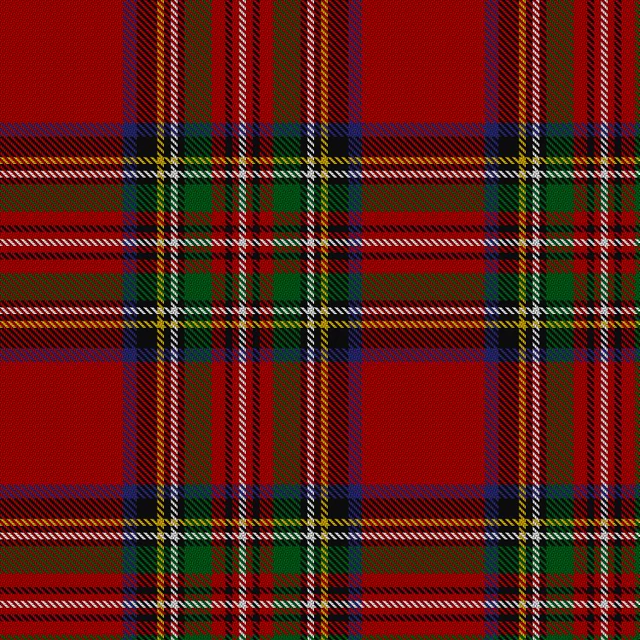
- TartanRoyal StewartEarliest known record A red tartan with blue, black, yellow, white and green lines, listed in the Scottish Register of Tartans in the Royal category. It appears in Wilsons of Bannockburn records from about 1800 and is the personal tartan of the monarch.
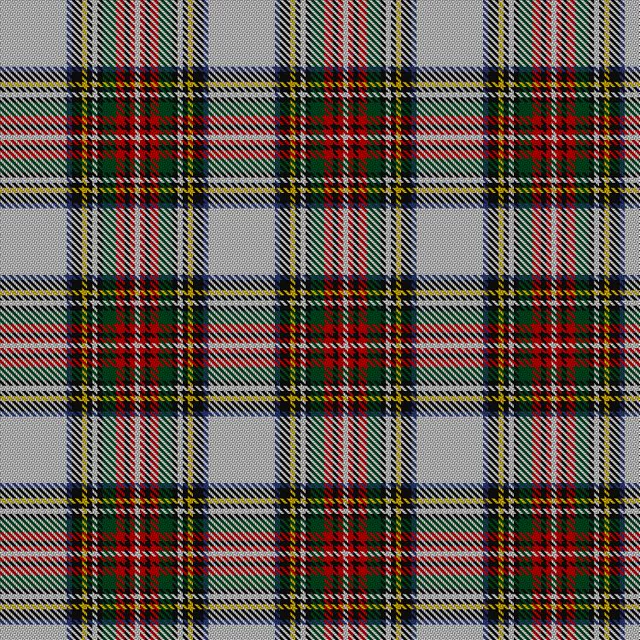
- Clan tartanStewart DressNo date recordedThe dress version of the Stewart tartan, with equal yellow and white stripes. The Scottish Register of Tartans estimates its date as about 1850 and links it to the Vestiarium Scoticum of 1842.
Image: Scottish Register of Tartans, rendered from the registered threadcount. Crown copyright, National Records of Scotland.
Surnames linked to this clan
A surname's link to a clan is a claim about history, not a statement about any person's ancestry.
- Uncertain
- Reported, but the sources are weak or disagree.
Fields missing from this record
Lowlands and Borders
Other clans recorded in the same area
Chosen only because their records name regions in the same part of Scotland. It is not a claim of kinship or alliance.