Surname
Stewart surname
Also spelled Stuart, Steuart, Steward
Stewart is an occupational name.
- Places
- Renfrewshire, Appin, Atholl, Bute, Galloway
- Linked clan
- Clan Stewart
- Linked tartans
- Royal Stewart, Stewart Dress
- Evidence claims
- 21
- Sources
- 22
- Entry status
- Partial
Origin of the name
Stewart is an occupational name.
The secondary sources read derive it from Old English stigweard, made of stig, "house" or "household", and weard, "guardian", and describe the steward as the official who ran the domestic affairs of a household, especially a royal one, before the Norman Conquest, and as the equivalent of a seneschal, the manager of a manor or estate, afterwards. Wikipedia also offers the Gaelic Stiùbhart, "steward", as an alternative source, without saying how the two relate. Because the name began as a job title, people in different places could take it up independently, so a person called Stewart is not shown to belong to one family. In Scotland the name is tied above all to the hereditary office of High Steward, held by the family descended from Walter fitz Alan, whose line became the royal House of Stewart in 1371. Three things carry the name and need separate evidence: a surname held by a very large number of unrelated people, the descendants of the High Stewards and their branches, and the royal house. The spelling Stuart is the French form associated with Mary, Queen of Scots, and the Stewart societies accept Stewart, Stuart, Steuart and Steward as the one name. George Black's Surnames of Scotland, the standard reference for Scottish surnames, is on archive.org only as a lending copy, so it was not read for this page. The etymology and first bearers below rest on Wikipedia pointers (level D) and on clan society pages (level C), and the position of the name with the Lord Lyon rests on a clan council's summary of Scots law, not on a Lyon Court record.
Places associated with the name
- Renfrewshire
- Appin
- Atholl
- Bute
- Galloway
Clan
A surname and a clan can share a name without every bearer of the name belonging to the clan. This is the link the sources support.
Linked clan · Renfrewshire, Teviotdale, Lauderdale
Clan Stewart
Uncertain Reported, but the sources are weak or disagree.
The clan page treats Stewart as the name of a family descended from the High Stewards, with branches at Appin, Atholl, Bute and Galloway. The Clan Stewart Society says there is no hereditary chief to whom Stewarts offer allegiance, and Wikipedia says the Lord Lyon recognises no chief of the clan as such. The Stewart Society takes in all who bear the name or descend from Stewarts, but that is a society's membership rule. It does not show that any one Stewart descends from the High Stewards, because the name began as an occupation. Appin and Bute are described as separate clans with chiefs of their own, so a Stewart from those areas may belong to a different clan from a Stewart of Galloway.
Tartan
Tartans linked to the name, each with the strength of the link. The link is to the name's history, not to any individual's family.
Tartan
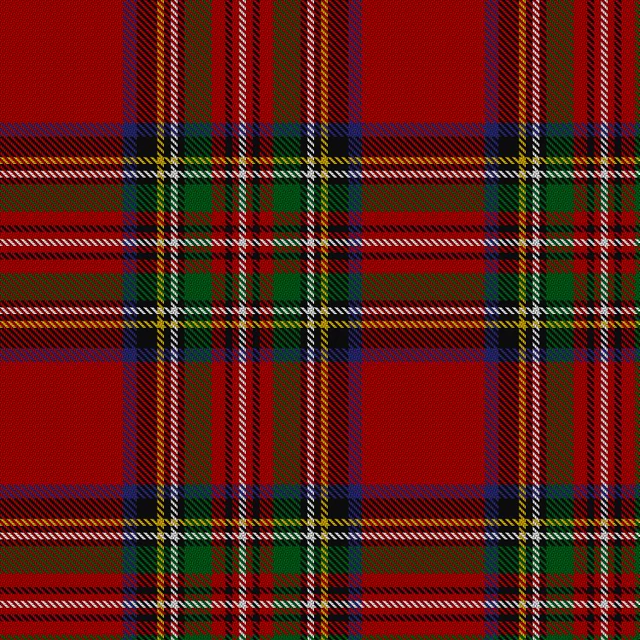
Royal Stewart
Probable Supported by a credible source, not independently confirmed.
The Scottish Register of Tartans lists Stewart, Royal in the Royal category with a date of 1 January 1800, and says Wilsons of Bannockburn records of about 1800 call it Royal Stewart, for a reason it calls unknown. The record page does not itself call it the monarch's personal tartan. The Stewart Society does, in wording that still names the late Queen, and the same society says it is appropriate for all subjects of the Sovereign to wear. The register says George V tried to restrict it to the Royal Family and could not, because it was already widely worn as a fashion tartan, and that he restricted the Balmoral tartan instead. Bearing the name Stewart neither entitles a person to Royal Stewart nor bars anyone else from it.
Clan tartan
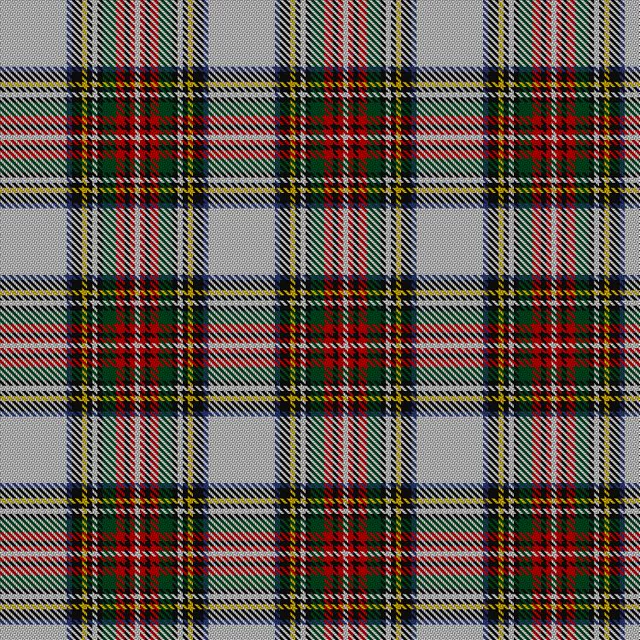
Stewart Dress
Probable Supported by a credible source, not independently confirmed.
The register records Stewart, Dress #1 as a dress version of Royal Stewart with equal yellow and white stripes, dated about 1850 and based on the sett that the Sobieski Stuarts gave as Royal Stewart in their Vestiarium Scoticum of 1842. It is a later pattern linked to the name by title, not a record of a Stewart family sett. The Stewart Society lists further tartans for the name, among them Stuart of Bute, Stewart of Appin, Stewart of Ardshiel, Stewart of Atholl, Stewart of Galloway and Racing Stewart, which are not yet covered on this site.
Image: Scottish Register of Tartans, rendered from the registered threadcount. Crown copyright, National Records of Scotland.
From the evidence
Where the sources disagree
Sentences from the evidence below in which the record says its sources do not agree. Each is quoted as written; follow the claim number for the context.
The two accounts differ on when the spelling became general, and neither source read gives a document for either date.
That is a different parent from the one in the Wikipedia article on Sir John Stewart, which puts Atholl under James of Pearston, so the sources disagree on how Atholl joins the family tree.
Evidence
21 claims, numbered in the order the record lists them. Consecutive claims that cite the same source are set together under that source. Each claim carries its own evidence level.
- APrimary or official3 claims
- CSpecialist secondary8 claims
- DCommercial10 claims
Claims 1 to 2
- DCommercial
Wikipedia says Stewart is possibly derived from the Old English stigweard, a compound of stig, meaning household, and weard, a guardian, or from the Gaelic Stiùbhart, meaning steward. The wording is hedged, and the two derivations are given as alternatives. Black's Surnames of Scotland, the Dictionary of American Family Names and the Oxford Dictionary of Surnames were not opened, so how those works weigh the options is not reported here.
Evidence level D. Sources: [8]
- DCommercial
Wikipedia calls Stewart an occupational name for the administrative official of an estate, from Middle English stiward and Old English stigweard. It says that in England before the Conquest a steward controlled the domestic affairs of a household, especially a royal one, and that after the Conquest the word was used as the equivalent of seneschal, the steward of a manor or estate. It attributes this account to the standard name dictionaries.
Evidence level D. Sources: [9]
Claims 3 to 4
All cite Walter FitzAlan, High Steward of Scotland [10]
- DCommercial
Wikipedia says Walter fitz Alan, son of Alan fitz Flaad, a Breton knight given lands in Shropshire by Henry I, appears to have arrived in Scotland about 1136 in the reign of David I. It says he became the king's dapifer, or steward, about 1150 and served three kings in turn: David, Malcolm IV and William I. It names Mearns, Strathgryfe, Renfrew and North Kyle among his western lordships, says the dates of the grants are uncertain, and says Malcolm IV confirmed them in 1161 or 1162.
Evidence level D. Sources: [10]
- DCommercial
The same Wikipedia article says Walter's family came from Dol in Brittany, where its members were stewards to the bishops, that he founded Paisley Priory about 1163, first at Renfrew and then at Paisley, and that he died in 1177 at Melrose Abbey and was buried at Paisley. The date of his arrival is not settled across the sources read: the Clan Stewart Society's Bute page says the stewards of Dol came to Scotland by way of England when David I returned in 1124, which is earlier than the c. 1136 given for Walter himself.
The National Records of Scotland counts the surname of each child in the year's birth register, both parties in the marriage register and the deceased in the death register.
- DCommercial
The Clan Stewart Society says Robert II was the son of Robert I's daughter Marjorie and her husband Walter the Steward, took Stewart as his surname, and so became the first monarch of the royal House of Stewart. It dates his reign from 1371. Wikipedia's article on the house gives the same start date and says the family held the thrones of Scotland, and after 1603 of England and Ireland, until the death of Queen Anne in 1714. On that account the royal house took its surname from the office of steward, not the other way round.
- DCommercial
Wikipedia says Mary, Queen of Scots, brought up in France, adopted the French spelling Stuart, and the Wikipedia article on the name adds that she formalised it to preserve the correct pronunciation. The Clan Stewart Society dates the change of spelling to the accession of a Stewart to the English throne in 1603. The two accounts differ on when the spelling became general, and neither source read gives a document for either date. Stewart and Stuart are the same name, and the spelling does not mark a branch: the Wikipedia article on the clan says both forms are used for different branches, and the society's sept list includes Stewart, Stuart, Steuart, Steward and Steuard together.
Claims 7 to 8
All cite John Stewart (knight, died 1298) [15]
- DCommercial
Wikipedia says Sir John Stewart, second son of Alexander Stewart, 4th High Steward, who died in 1283, was killed at the Battle of Falkirk on 22 July 1298. It says his seal on the Ragman Rolls of 1296 is the strongest evidence for his arms, which differ from the High Stewards' by a bend gules. It also says that the later style of Bonkyll is not supported by contemporary evidence: he married Margaret de Bonkyll, but no territorial designation for John himself appears in medieval texts. The branches of the name are usually traced back to him, so that doubt about his style is a detail the clan accounts gloss over.
Evidence level D. Sources: [15]
- DCommercial
Wikipedia lists John's children as including Alexander of Bonkyll, whose line is said to lead to the Earls of Angus, Alan of Dreghorn, from whom it traces the Stewarts of Darnley, the Earls of Lennox and the later House of Stuart, James of Pearston, said to be ancestor of the Lords of Lorne, the Earls of Atholl, Buchan and Traquair and the Stewarts of Appin, and Robert of Daldowie, ancestor of the Steuart baronets. The Stewart Society's public family-lines index names Charles Stuart, 1st Earl of Lennox, who died in 1576, and Esme Stuart, 1st Duke of Lennox, who died in 1583, but the descent itself is behind its member login.
Claims 9 to 12
- CSpecialist secondary
The Stewarts of Appin, according to the Clan Stewart Society, descend from Sir John Stewart of Bonkyll through the Lorne line. Dougal Stewart, son of the murdered Sir John Stewart of Lorn, became the first of Appin, and Duncan, the second, built Castle Stalker on the Cormorant's Rock in Loch Linnhe. The society says the clan fought at Flodden in 1513 and Pinkie in 1547 and supported the Jacobites in 1715 and 1745. It says the estate was sold by the ninth chief in 1765 and that the tenth of Appin obtained the restoration of Ardshiel in 1782. The Appin line has chiefs of its own, which is why it is described as a clan separate from the Stewart name at large.
Evidence level C. Sources: [17]
- CSpecialist secondary
The Atholl line is traced by the Clan Stewart Society to Alexander Stewart, Earl of Buchan, known as the Wolf of Badenoch and a second son of Robert II, said to have built Garth Castle after 1390. That is a different parent from the one in the Wikipedia article on Sir John Stewart, which puts Atholl under James of Pearston, so the sources disagree on how Atholl joins the family tree. The society adds that General David Stewart of Garth recorded 1,937 persons of the name Stewart in Atholl in 1822 as male-line descendants of Alexander, that the earldom passed to the Murrays, with William Murray created Earl of Atholl in his own right in 1627, and that Athollmen followed the Murray earls.
- CSpecialist secondary
For Bute, the Clan Stewart Society says Robert II gave his younger son John the lands of Bute, Arran and Cumbrae, and that James IV made Ninian hereditary captain and keeper of Rothesay Castle in 1498. It says the family took the Stuart spelling introduced by Mary, Queen of Scots, was created Earl of Bute in 1703 and was raised to Marquess in 1796. The page also gives a baronetcy date of 1727 that does not fit its own 1703 earldom, so only the dates that agree with each other are used here. Wikipedia describes Stuart of Bute as a separate clan with a chief of its own.
- CSpecialist secondary
The Clan Stewart Society names Appin, Atholl, Bute and Galloway as branches descended from the sons of Sir John Stewart of Bonkyll, says Lord Garlies was made Earl of Galloway in 1623, and says that since the Lennox branch ended the Earls of Galloway have been regarded as the senior representatives of the line of the High Stewards. The Earl is described as honorary president of the Stewart Society, which was founded in 1899. Seniority of descent is a different thing from chiefship: the society page does not claim that the Earl is a chief of the name.
Evidence level C. Sources: [19]
The Scottish Register of Tartans gives Stewart, Royal a date of 1 January 1800 and says Wilsons of Bannockburn listed the pattern from about 1800 as Royal Stewart, for a reason it says is unknown, adding that surviving specimens show it was a popular fashion tartan.
Claims 13 to 14
All cite Clan Stewart [3]
- CSpecialist secondary
On who leads the name, the sources agree more than they usually do. The Clan Stewart Society says there is no hereditary chief to whom Stewarts offer allegiance. Wikipedia says the clan does not have a chief recognised by the Lord Lyon, regards the Earls of Galloway as the principal branch, and treats Stuart of Bute and Stewart of Appin as separate clans. The Council of Scottish Clans and Associations adds the legal context: the Lord Lyon has no jurisdiction to decide a disputed chiefship, and membership of a clan depends on recognition by the clan itself. The Lyon Court's own register and its guidance note on the succession of chiefs were not readable here, so the statement that no chief is recognised is a secondary report. A reader who needs it for a legal purpose should ask the Court of the Lord Lyon directly.
- CSpecialist secondary
The Clan Stewart Society's sept list reads Balquidder, Boyd, Carmichael, Caw, Chaple, Chappel, Cleghorn, Cook, Crookshank, Cruickshank, Dennison, France, Frances, Francis, Garrow, Heron, Jameson, Jamieson, Lennox, Lile, Lillie, Lyle, MacGara, MacLyall, MacLyle, MacMahel, MacMail, MacMichael, MacMichan, MacMichen, MacMichel, Michael, Michaels, Menteith, Monteith, Moody, Mudie, Ochiltree, Ogletree, Steuard, Steuart, Steward, Stewart and Stuart. It defines a sept as a family that followed another family's chief, whether through marriage or by living on a powerful laird's land. Wikipedia's shorter list differs, for example by including Lombard and Young, so the lists are not an agreed record. A name on a sept list is a convention, and holding it does not prove descent from, or loyalty to, any Stewart.
Claims 15 to 18
- APrimary or official
The National Records of Scotland counts the surname of each child in the year's birth register, both parties in the marriage register and the deceased in the death register. On that count Stewart was the fifth most common surname in Scotland in 2023 with 1,055 occurrences, behind Smith, Brown, Wilson and Campbell, and sixth in 2025 with 991, behind Smith, Brown, Wilson, Thomson and Campbell. The text read does not report Stuart separately, so the figures say nothing about how the two spellings divide. They also describe present-day registrations, not the medieval spread of the name.
- DCommercial
Wikipedia says Stewart was the 66th most common surname in the United Kingdom in 2014 and that it has large concentrations in the United States, mainly in the southern states, in the United Kingdom, mainly in Scotland, Northern Ireland, the north-east and south-west of England, Cumbria, Lancashire and Yorkshire, and in Canada, Jamaica, New Zealand and Australia. The article does not name its counting source in the text read. The figure and the spread are given as level D pointers, and the reasons for the spread, such as emigration or naming, are not established here.
Evidence level D. Sources: [8]
- CSpecialist secondary
The Stewart Society says membership is open to all who bear the name Stewart, Stuart, Steuart or Steward, or who are Stewarts by birth or descent, as well as the septs or families associated with the Stewarts. Its stated aims include genealogical work. That is an invitation, and the Society does not require proof of descent from the High Stewards. Its public pages list sections on battles, castles, famous Stewarts, tartans, historical objects and family lines, and the family-lines section is available in full only to members.
- APrimary or official
The Scottish Register of Tartans gives Stewart, Royal a date of 1 January 1800 and says Wilsons of Bannockburn listed the pattern from about 1800 as Royal Stewart, for a reason it says is unknown, adding that surviving specimens show it was a popular fashion tartan. It says George IV wore it on his 1822 visit to Scotland, that Queen Victoria adopted it for the Royal Family, and that George V tried to restrict it to the Royal Family and failed because of its wide use. The Stewart Society calls it the tartan of the Royal House of Stewart and the personal tartan of the monarch, and says it is appropriate for all subjects to wear. The register page itself says nothing about a personal tartan, so that claim is the Society's and is level C.
Claim 19
- CSpecialist secondary
A common belief is that the Stewart name implies descent from the kings, and a second is that a Stewart is by default a Jacobite. The sources read do not support either as a rule. The name is occupational, so many Stewarts have no connection to the royal line, and the Clan Stewart Society's account of Atholl describes divided allegiances between 1689 and 1745, with one Murray earl backing William of Orange in 1689, the Marquess of Tullibardine a Jacobite in 1715, and many Athollmen joining Charles Edward Stuart in 1745. The society says Appin supported the Jacobites in 1715 and 1745, which shows that some branches did, not that the name did.
Claims 20 to 21
All cite Clan Stewart Society [1]
- APrimary or official
To research a particular Stewart line, start with a known ancestor and work back through documents. ScotlandsPeople holds the statutory registers of births, marriages and deaths, church court records and 17th and 18th century tax rolls, among other series. Because Stewart is so common, a surname search alone returns many unrelated families, so a place and a date are needed. The Stewart Society states genealogical aims and the Clan Stewart Society says it studies genealogical, cultural and historical background, though the Stewart Society keeps its family-lines section for members. DNA matches were not covered by any source read, so they are left out rather than summarised.
- DCommercial
The name does not prove royal descent, High Steward descent, membership of a clan with a recognised chief, a right to any single tartan, or Jacobite sympathies. The surname arose from an occupation, the clan has no chief that the sources read can name, the branches at Appin and Bute are described as clans of their own, and the tartans are registered patterns, not family records. What the surname does allow is a starting point: a Stewart whose ancestors lived in Appin, Atholl, Bute or Galloway has a documented branch to compare against, while one from elsewhere may belong to none of them.
What this page does not say
Sources
- Clan Stewart Society
- The Stewart Society
- Clan Stewart
- Scottish Law Regarding Clans and Chiefs
- Scottish Register of Tartans: Stewart, Royal
- Tartans of the Stewarts
- Scottish Register of Tartans: Stewart, Dress #1
- Stewart (name)
- Stuart (name)
- Walter FitzAlan, High Steward of Scotland
- Stewarts of Bute
- Stewart History
- House of Stuart
- Stewart Branches and Septs
- John Stewart (knight, died 1298)
- Family Lines
- Stewarts of Appin
- Stewarts of Atholl
- Stewart of Galloway
- Most common surnames in Scotland, 2023
- Most common surnames in Scotland, 2025
- ScotlandsPeople