Surname
Mackenzie surname
Also spelled MacKenzie, McKenzie, Macenzie, Kenzie, MacKinzie
Mackenzie is the anglicised form of the Gaelic Mac Coinnich, "son of Coinneach".
- Places
- Kintail, Ross-shire, Wester Ross
- Linked clan
- Clan Mackenzie
- Linked tartan
- Mackenzie
- Evidence claims
- 31
- Sources
- 29
- Entry status
- Partial
Origin of the name
Mackenzie is the anglicised form of the Gaelic Mac Coinnich, "son of Coinneach".
Wikipedia glosses Coinneach as "comely" or "handsome", while British Surnames says the meaning is given in different ways. Coinneach is now usually rendered Kenneth, although Kenneth first stood for a different Gaelic name, Cionaodh, so an English-speaking Kenneth and a Gaelic Coinneach are not always the same name. Gaelic builds patronymics with Mac, "son", and Mac and Mc are one prefix written two ways, so Mackenzie and McKenzie are the same surname and not two families. The z is not a z. In Middle Scots writing the letter yogh, which sounded like the y in "yes", was confused with a cursive z, and early printers who had no yogh in their type used z instead. The name was therefore first written MacKenȝie and said roughly "ma-KEN-yee"; Wikipedia gives Menzies, Dalziel and Culzean as other names altered the same way. The modern spelling with a hard z hides the original sound, and the pronunciation followed the spelling. The surname gave Clan Mackenzie its name. The clan's lands lay in Kintail and Wester Ross, and by the seventeenth century, according to Wikipedia, its territory ran from the Black Isle in the east to the Outer Hebrides in the west. How far back the family can be traced is less certain than clan histories suggest. Tradition makes the chiefs descendants of Gilleoin of the Aird, a Gaelic dynast of the early twelfth century, and Wikipedia says the Mathesons are believed to share that ancestry. An older claim, set down by John Mackenzie of Applecross (died about 1684) and by George Mackenzie, 1st Earl of Cromartie (died 1714), gave the family a Fitzgerald ancestor; Wikipedia reports that it rests on one manuscript of 1576, now lost, and that the historian Alexander Mackenzie dropped it in 1894. The Clan Mackenzie Society still gives a grant of Kintail to Colin Fitzgerald in 1263 as tradition, which shows how long the story has lasted without a surviving document behind it. The documented record starts later. Wikipedia calls Alexander Mackenzie of Kintail (before 1436 to after 1471) the first chief of whom indisputable contemporary evidence survives: papal dispensations of 1465 and 1466 and his appearance as a witness at Dingwall in 1471. A page of older Mackenzie history held by the National Library of Scotland quotes a charter of David II in 1362 to "Murdo filio Kennethi de Kintail" and one of 1380 to his son, but the work is not named on the page, so those charters are treated here as reported and not as seen. The Clan Mackenzie Society says Alexander the Upright was the first chief in the full sense, because before him the Kintail line was "but a narrow thread" with few chiefs who left several sons. Early surname bearers outside the chiefly line are harder still to find, and the earliest chiefs cannot be treated as settled fact. Because Mackenzie is a patronymic, anyone whose forefather was a man called Coinneach could take it, in any glen, and Gaelic naming did not require descent from the Kintail chiefs. The clan's own membership rule, explained by the Standing Council of Scottish Chiefs, counts everyone who shares the chief's surname, and the society's list of related names runs to more than forty, including Kenneth, Kennethson, Murchison and MacIver. None of this shows that a given Mackenzie descends from Kintail. It shows that the name was widely borne and that the clan has long treated it generously.
Places associated with the name
- Kintail
- Ross-shire
- Wester Ross
Clan
A surname and a clan can share a name without every bearer of the name belonging to the clan. This is the link the sources support.
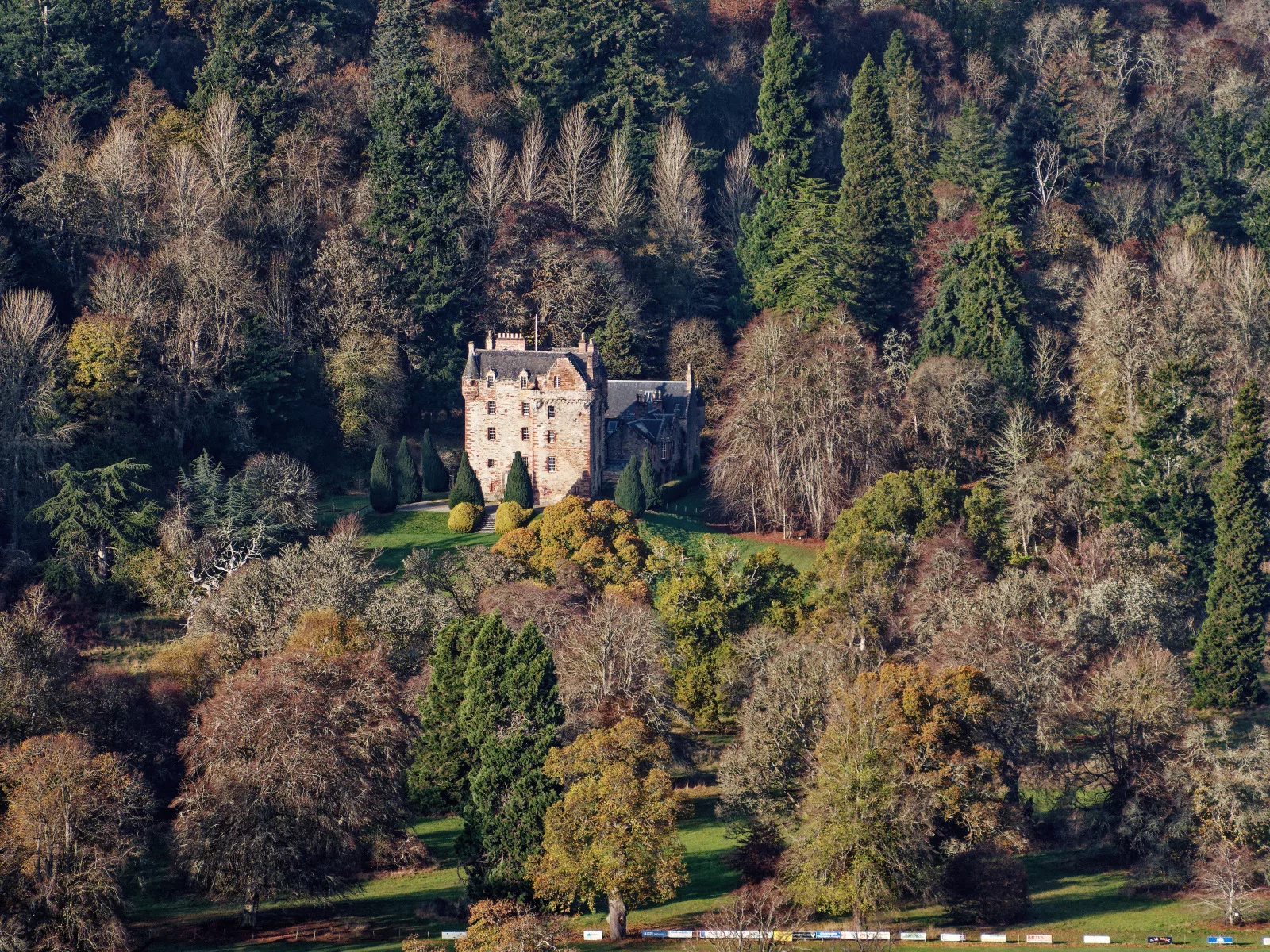
Castle Leod near Strathpeffer, the seat of the Mackenzie chiefs according to the Clan Mackenzie Society. The photo shows the castle, not the clan.Photo: Julian Paren, CC BY-SA 2.0 (source) Linked clan · Kintail, Ross-shire, Wester Ross
Clan Mackenzie
Probable Supported by a credible source, not independently confirmed.
The clan takes its name from the surname, and Kintail and Ross-shire are its historic region according to the clan society and Wikipedia. The link is probable and not verified for an individual bearer, for three reasons. First, the Standing Council of Scottish Chiefs counts holders of the chief's surname as clan members, which is a membership rule and not a record of descent. Second, the chiefly line is only documented in the fifteenth century, and Wikipedia says the account of the 8th chief, Kenneth, rests on such sparse references that his very existence is doubted. Third, the clan grew by absorbing branches under other names: the society says the descendants of Murdoch Riach at first styled themselves MhicVurchie, a separate group, and only by the seventeenth century used the name Mackenzie, while the Gairloch Mackenzies disputed the Kintail chiefs' leadership. Through the female line the Gairloch estate also passed to a chief who took the name, which is another way the surname and the blood diverge. The clan society itself advises against the word sept and says the related surnames are "surnames of the family and of allied or dependent families", not separate sub-clans.

Tartan
Tartans linked to the name, each with the strength of the link. The link is to the name's history, not to any individual's family.
Clan tartan
Mackenzie
Probable Supported by a credible source, not independently confirmed.
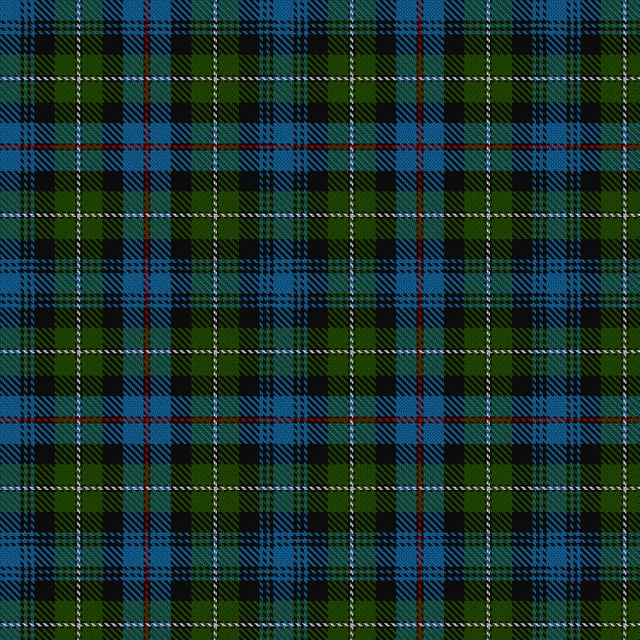
The Scottish Register of Tartans classes Mackenzie (reference 267) as Clan/Family, dated 1778 and recorded as the Seaforth Highlanders' regimental tartan. It has the same pattern as the MacLeod tartans, so the pattern is not exclusive to Mackenzies. Wikipedia says the 72nd and 78th regiments, from which the Seaforth Highlanders descend, were raised by members of the Mackenzie family and wore the Mackenzie tartan, so the sett is tied to a Mackenzie family regiment from the late eighteenth century. The association is probable for people of the name, not a rule: the register entry does not say that every bearer of the surname belongs to the tartan, and nothing in the sources read here ties an individual Mackenzie to it.
Image: Scottish Register of Tartans, rendered from the registered threadcount. Crown copyright, National Records of Scotland.
From the evidence
Where the sources disagree
Sentences from the evidence below in which the record says its sources do not agree. Each is quoted as written; follow the claim number for the context.
Evidence
31 claims, numbered in the order the record lists them. Consecutive claims that cite the same source are set together under that source. Each claim carries its own evidence level.
- BInstitutional3 claims
- CSpecialist secondary9 claims
- DCommercial18 claims
- EUnverified1 claim
Claim 1
- DCommercial
British Surnames derives Mackenzie from the Gaelic MacCoinnich, son of Coinneach, and notes that the meaning of Coinneach is glossed in more than one way.
Evidence level D. Sources: [10]
Claims 2 to 3
All cite Mackenzie (surname) [11]
- DCommercial
Wikipedia's surname article gives the Gaelic form as Mac Coinnich, glosses Coinneach as comely or handsome, and says Kenneth is the usual anglicisation although it first rendered a different Gaelic name, Cionaodh.
Evidence level D. Sources: [11]
- DCommercial
Wikipedia says the z in Mackenzie represents the Middle Scots letter yogh, as in the older spelling MacKenzie written with a yogh, and that Menzies was altered in the same way.
Evidence level D. Sources: [11]
The Standing Council of Scottish Chiefs says everyone who shares the chief's surname is deemed a member of the clan, that sharing a surname creates a presumption and not a guarantee, and that each chief decides which families the clan accepts.
Claims 4 to 6
- DCommercial
Wikipedia's article on yogh says yogh became confused with a cursive z in Middle Scots and that early printers often used z when their fonts lacked yogh. It gives the older pronunciation of MacKenzie as "makenyie", of Menzies as "mingis", of Dalziel as "deeyel" and of Culzean as "culain".
Evidence level D. Sources: [12]
- BInstitutional
The Standing Council of Scottish Chiefs says everyone who shares the chief's surname is deemed a member of the clan, that sharing a surname creates a presumption and not a guarantee, and that each chief decides which families the clan accepts.
Evidence level B. Sources: [2]
- DCommercial
Wikipedia's article on Scottish Gaelic personal names says Mac and Mc are the same prefix spelled two ways and that patronymics are built on mac, "son", so McKenzie and Mackenzie are one surname in origin.
Evidence level D. Sources: [13]
Claims 7 to 8
All cite Clan Mackenzie [5]
- DCommercial
Wikipedia reports that tradition derives the Mackenzie chiefs from Gilleoin of the Aird, an early twelfth-century Gaelic dynast, that the Mathesons and Anrias are believed to share that ancestry, and that an alternative theory names a thirteenth-century Kermac Macmaghan.
Evidence level D. Sources: [5]
- DCommercial
Wikipedia reports that early clan histories by John Mackenzie of Applecross and George Mackenzie, 1st Earl of Cromartie, claimed a Fitzgerald ancestor, that this goes back to a single lost manuscript made by William MacQueen, parson of Assynt, in 1576, and that Alexander Mackenzie gave the theory up in his 1894 edition.
Evidence level D. Sources: [5]
Claims 9 to 12
- CSpecialist secondary
The Clan Mackenzie Society gives a grant of Kintail to Colin Fitzgerald in 1263, after the Battle of Largs, as traditional and calls Kintail the Mackenzies' "Giftland".
Evidence level C. Sources: [7]
- CSpecialist secondary
The Clan Mackenzie Society calls Alexander the Upright, in the fifteenth century, the first Mackenzie chief in the true sense, and quotes the historian Alexander Mackenzie that before him "the line of Kintail is but a narrow thread".
Evidence level C. Sources: [1]
- DCommercial
Wikipedia calls Alexander Mackenzie of Kintail (before 1436 to after 1471) the first chief for whom indisputable contemporary documentary evidence survives: a papal dispensation of 13 September 1465, a further dispensation in 1466 and a charter witnessed at Dingwall in 1471. It says two charters of 1463 and 1477 cited for him were questioned because they appear only in inventories, and that clan histories before the seventeenth century are often unreliable.
- DCommercial
Wikipedia says Kenneth Mackenzie, 8th of Kintail, was killed by the Laird of Buchanan, left no legitimate issue and was succeeded by a half-brother, John. It adds that Kenneth appears never to have been served heir and that there is doubt over his very existence.
Evidence level D. Sources: [6]
The Dictionary of Canadian Biography says Sir Alexander Mackenzie was born in 1764 at Stornoway on Lewis, son of Kenneth Mackenzie and Isabella Maciver, and in 1774 travelled to New York with his father because of economic depression on Lewis.
Claims 13 to 16
- EUnverified
A digitised page held by the National Library of Scotland, from a work it does not name, quotes a charter of David II in 1362 to "Murdo filio Kennethi de Kintail" and one of 1380 to his son Murdoch Nidroit. The charters themselves were not seen.
Evidence level E. Sources: [15]
- DCommercial
Stirnet's genealogy gives Kenneth (Coinneach) of Kintail as dying in 1304 and Murdoch Dubh as dying in 1375, says the numbering of the early chiefs varies between writers, and states that an Irish Geraldine descent is unsupported by evidence.
Evidence level D. Sources: [16]
- CSpecialist secondary
The Clan Mackenzie Society says Murdoch Riach's descendants, the Clan Vurchie, began as a separate group, fought against Alexander the Upright, and by the seventeenth century called themselves Mackenzie and not MhicVurchie. It says the Gairloch Mackenzies also disputed the leadership of the Kintail line.
Evidence level C. Sources: [1]
- CSpecialist secondary
The Clan Mackenzie Society says Gairloch came to the family in the fifteenth century through Hector Roy Mackenzie, Coigach through the marriage of Dame Margaret MacLeod to Roderick Mackenzie, Tutor of Kintail, and Lewis around 1597 when Torquil Cononach gave up his claim. The Earl of Seaforth took his title from Loch Sithphort on Lewis in 1623.
Evidence level C. Sources: [7]
Claims 17 to 20
- DCommercial
Wikipedia reports that the earldom of Seaforth was created on 3 December 1623 and that William, 5th Earl, was declared forfeit on 7 May 1716. Francis Humberston Mackenzie became Baron Seaforth in 1797 and died in 1815 without surviving sons.
Evidence level D. Sources: [17]
- DCommercial
Wikipedia reports that the earldom of Cromartie was created in 1703 for Sir George Mackenzie, was forfeited after the Jacobite rising of 1745, and was recreated on 21 October 1861 for the Duchess of Sutherland, passing by special remainder. The 5th Earl has held it since 1989.
Evidence level D. Sources: [18]
- CSpecialist secondary
The Clan Mackenzie Society says the chiefship was effectively dormant after the death of James Fowler Mackenzie in 1907 and that the Lord Lyon recognised the Earl of Cromartie as chief on 12 June 1980. It adds that Sir Walter Scott wrote of the Kintail line ending when Lord Seaforth died in 1815. The Lyon Court record itself was not seen.
Evidence level C. Sources: [1]
- CSpecialist secondary
Claims 21 to 24
- CSpecialist secondary
The Clan Mackenzie Society's list of related surnames has more than forty names, among them Kenneth, Kennethson, Kynoch, Murchison, MacIver, MacKinney and MacKinnie. It says these "do not represent separate and definable sub-clans" and records Mackenzie itself as spelled with Mac, Mc or M' and as Macenzie, Kenzie or MacKinzie. MacKinnon is not on the list.
Evidence level C. Sources: [4]
- DCommercial
Wikipedia derives MacKinnon from the Gaelic Mac Fhionghuin, "fair born" or "fair son", or alternatively from Mac Ionmhuinn, and places that clan on Skye and Mull. The article does not link it to Mackenzie, so the two names have different Gaelic roots and share only some letters in English.
Evidence level D. Sources: [21]
- DCommercial
Wikipedia says the Seaforth Highlanders were formed in 1881 from the 72nd (Duke of Albany's Own Highlanders) and the 78th (Ross-shire Buffs), both raised by members of the Mackenzie family. The 78th earned the honours Assaye (1803) and Maida (1806), the regiment's full title was approved on 22 November 1881, and its first battalion merged into the Queen's Own Highlanders on 7 February 1961. The Clan Mackenzie article and the Seaforth article differ on which Mackenzie raised which regiment and in which year.
- CSpecialist secondary
The Clan Mackenzie Society says Sir Hector Mackenzie of Gairloch and his sons refused to evict a single tenant during the Clearances, and that in 1852 to 1853 the women of Coigach disarmed officers and burned eviction summonses. These are the society's statements, and tenants who left other Mackenzie estates are not covered by them.
Evidence level C. Sources: [7]
Claims 25 to 28
- DCommercial
Wikipedia dates the Highland Clearances mostly to two phases between 1750 and 1860, notes that historians dispute what the term covers, and lists Nova Scotia, Cape Breton, Prince Edward Island, Glengarry in Ontario and the Carolinas among Gaelic emigrant settlements. It says the kelp trade collapsed by 1820, which removed seasonal work for tens of thousands of crofters.
Evidence level D. Sources: [22]
- BInstitutional
The Dictionary of Canadian Biography says Sir Alexander Mackenzie was born in 1764 at Stornoway on Lewis, son of Kenneth Mackenzie and Isabella Maciver, and in 1774 travelled to New York with his father because of economic depression on Lewis. He entered the fur trade in 1779 and was knighted on 10 February 1802, and the river he followed to the Arctic now bears his name.
Evidence level B. Sources: [23]
- DCommercial
Wikipedia gives 3 July 1789 as the day Alexander Mackenzie left Fort Chipewyan for the river that now bears his name, and 20 July 1793 as the day he reached the Pacific at Bella Coola. It says he died on 12 March 1820 and was buried at Avoch.
Evidence level D. Sources: [24]
- DCommercial
Forebears counts about 101,080 people named MacKenzie: 21,393 in Canada, 20,345 in the United States, 15,242 in Scotland, 13,653 in England and 12,513 in Australia. Scotland has the highest density, 1 in 351. Its separate McKenzie figure is about 138,502, led by the United States (77,734), Australia (27,305), Canada (15,930), England (15,733) and Jamaica (14,429), with the Bahamas the densest at 1 in 175. The site does not state its method, so these are rough comparisons.
Claims 29 to 31
- DCommercial
Wikipedia says Mackenzie is used as a given name, more often for girls than boys in North America, and credits the 1975 television series One Day at a Time and the actress Mackenzie Phillips with raising it from obscurity as a girls' name. It gives no popularity figures.
Evidence level D. Sources: [27]
- BInstitutional
ScotlandsPeople says registration of births, deaths and marriages became compulsory in Scotland on 1 January 1855. Old Parish Registers run from 1553 but are incomplete and thin, census returns are available for 1841 to 1921, and valuation rolls exist for the mid-point between censuses from 1855 to 1905 and every five years from 1915 to 1940. It warns that records before 1855 show more spelling variations and difficult handwriting.
Evidence level B. Sources: [28]
- CSpecialist secondary
George F. Black's The Surnames of Scotland (1946) is held by the Internet Archive as a lending copy. Its Mackenzie entry could not be read for this page, so it is named only as a reference to check, not as a source for any claim here.
Evidence level C. Sources: [29]
What this page does not say
Sources
- Clan Mackenzie chief
- Who is a member of a Clan?
- Clan Mackenzie
- Septs (Clan MacKenzie Society)
- Clan Mackenzie
- Kenneth Mackenzie, 8th of Kintail
- The lands (Clan Mackenzie Society)
- Scottish Register of Tartans: Mackenzie
- Seaforth Highlanders
- Last name: Mackenzie
- Mackenzie (surname)
- Yogh
- Scottish Gaelic personal names
- Alexander Mackenzie of Kintail
- The Mackenzies (pp. 88-90, digitised text)
- Mackenzie of Kintail (Stirnet genealogies)
- Earl of Seaforth
- Earl of Cromartie
- The castle (Castle Leod)
- MHG45098 - Castle Leod - Strathpeffer
- Clan MacKinnon
- Highland Clearances
- MACKENZIE, Sir ALEXANDER
- Alexander Mackenzie (explorer)
- MacKenzie surname distribution
- McKenzie surname distribution
- Mackenzie (given name)
- Family history guide
- The surnames of Scotland, their origin meaning and history (George F. Black, 1946)