Surname
Macdonald surname
Also spelled MacDonald, McDonald, MacDonnell, McDonnell, Mac Dhòmhnaill
Macdonald is the anglicised form of the Gaelic Mac Dhòmhnaill, "son of Dòmhnall".
- Places
- Hebrides, West Highlands, Lochaber, Skye, Glencoe
- Linked clan
- Clan MacDonald
- Linked tartan
- MacDonald
- Evidence claims
- 29
- Sources
- 27
- Entry status
- Partial
Origin of the name
Macdonald is the anglicised form of the Gaelic Mac Dhòmhnaill, "son of Dòmhnall".
Wikipedia's surname article gives the Gaelic forms as MacDhòmhnaill and Dòmhnallach, and the dictionary entry in the Scottish National Dictionary defines the Gaelic prefix Mac, also written Mc and M', as forming a patronymic equal to the English suffix -son. The name is therefore a description of a father, not of a place or a trade, and any family with a forefather called Dòmhnall could have produced it. The final d in the English spelling has no counterpart in the Gaelic; Wikipedia's page on MacDonnell notes that it arrived in the anglicised forms Macdonald, MacDonald and McDonald. Dòmhnall itself is a Celtic name, and the sources agree on its meaning but not on how to write the reconstructed root. Wikipedia's article on the given name derives it from Proto-Celtic *dumno-ualos, "world ruler". The Online Etymology Dictionary reaches the same sense, "world-mighty, ruler of the world", from Old Irish Domnall and a root written *dubno-valos. A 2024 post on Omniglot's Celtic blog explains the discrepancy: the Proto-Celtic word *dubnos was an adjective meaning "deep" and a noun meaning "world", and the name Dubnowalos meant "world prince" or "chief". Nothing in these sources suggests the name meant anything other than a ruler of the world; the variation is in the spelling of the reconstructed form. All three are level D web sources, so the etymology is a standard reference gloss and not a finding from a specialist study. The clan name is the more precise story. The High Council of Clan Donald calls Donald of Islay, the grandson of Somerled, the progenitor of Clan Donald, in Gaelic Clann Dhòmhnaill. Wikipedia places the eponymous ancestor one generation earlier: Dòmhnall mac Raghnaill, son of Raghnall mac Somhairle, who was himself a son of Somerled, killed in 1164. That article notes that there is almost no contemporary evidence for his life, that a charter naming him "Douenaldus filius Reginaldi filii Sumerledi" is questioned on authenticity, and that historians doubt he was prominent in his own lifetime. The Clan Donald sources and Wikipedia therefore disagree on which Donald gave the name, and the question cannot be settled from the pages read here. The Wikipedia surname article instead calls Aonghus Mòr, who died about 1293, the first MacDonald in the sense of a bearer of the surname. Read together, the sources show a name that took shape in the thirteenth century around Somerled's descendants in the Isles, and that spread far beyond them. Macdonald is among the most common surnames in Scotland. The Wikipedia surname article gives the rank as 2nd in 1855 to 1858 with 1.23 per cent of the population, 10th in 1976 at 0.59 per cent and 10th in 2014 at 0.51 per cent. Its page on Scottish surnames lists Macdonald 11th at 0.52 per cent without giving the year, so the sources differ by one place on a recent count. The same article says Scottish statistics do not distinguish Macdonald from MacDonald. In England in 1891, it says, the surname clustered in Lancashire and Yorkshire, and in the United States in 1840 McDonald was far more common than Macdonald, particularly in the Ohio, Pennsylvania and New York corridor. Those are secondary figures; the primary counts sit in the censuses listed below. The page cannot answer whether a given Macdonald descends from the Lords of the Isles. The sources used here show that people took clan names for reasons other than descent, and that the clan itself split into independent branches centuries ago.
Places associated with the name
- Hebrides
- West Highlands
- Lochaber
- Skye
- Glencoe
Clan
A surname and a clan can share a name without every bearer of the name belonging to the clan. This is the link the sources support.
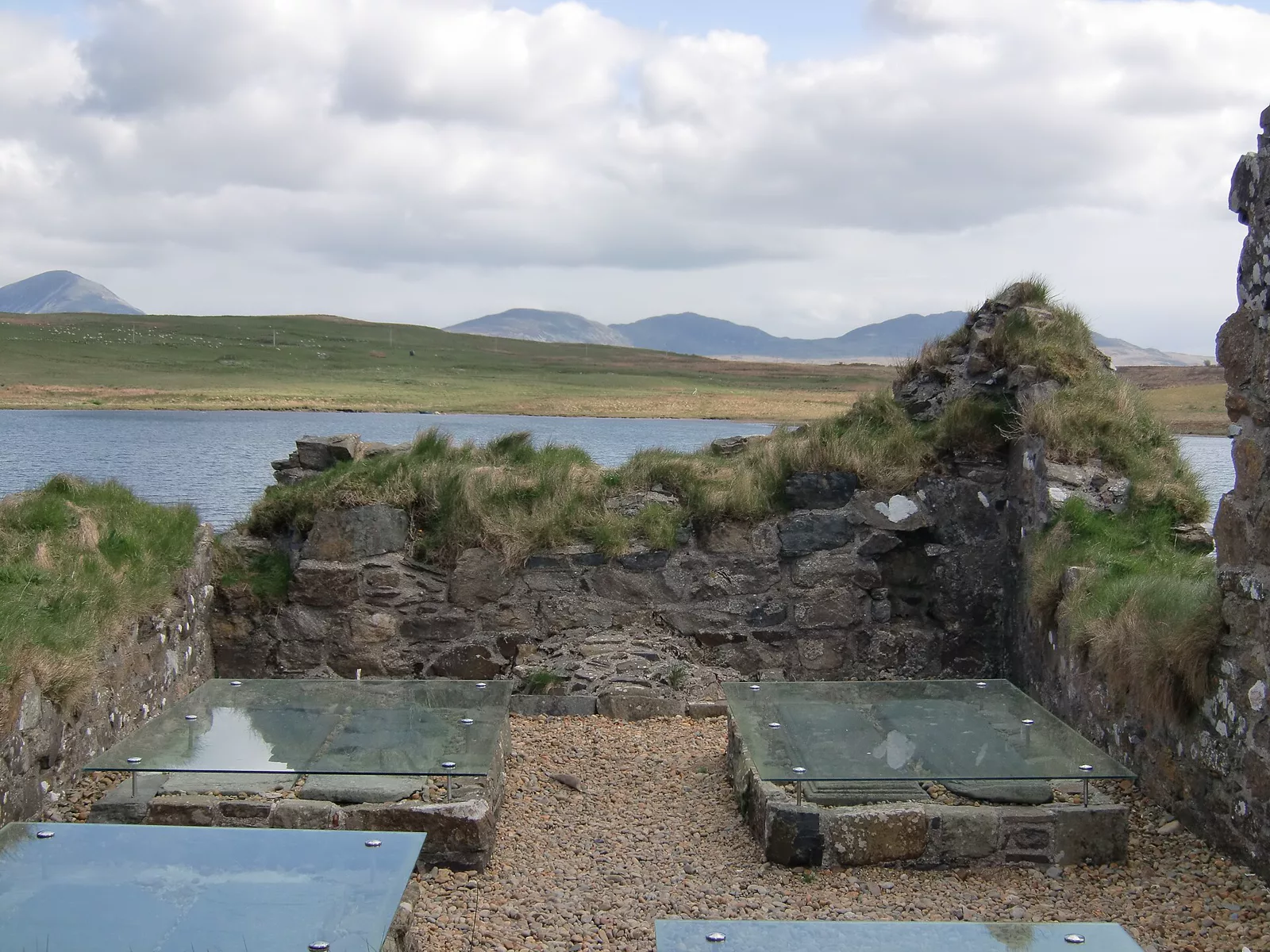
Eilean Mòr at Finlaggan on Islay, which secondary sources give as the traditional seat of the Lords of the Isles. The photo shows the site, not any one branch of the clan.Photo: W. L. Tarbert, CC BY-SA 3.0 (source) Linked clan · Hebrides, West Highlands
Clan MacDonald
Probable Supported by a credible source, not independently confirmed.
The clan takes its name from the same Gaelic patronymic, and Clan Donald traces its name to a Donald in the line from Somerled. The link is strong for the name as a whole and weak for any one person. The Standing Council of Scottish Chiefs deems everyone who shares a chief's surname a member of the clan, but that is a membership rule and not proof of descent, and ScotlandsPeople says clan surnames were also taken by followers, tenants and others for reasons other than blood. The clan itself is a group of branches. By the seventeenth century Sleat, Clanranald, Glengarry, Keppoch and Glencoe had their own chiefs, and the Macdonalds of Dunnyveg and the Antrim MacDonnells have their own lines. A Macdonald could belong to any of these, to none, or to a family that took the name by allegiance. Nothing about the surname alone says which branch, if any, applies.

Tartan
Tartans linked to the name, each with the strength of the link. The link is to the name's history, not to any individual's family.
Clan tartan
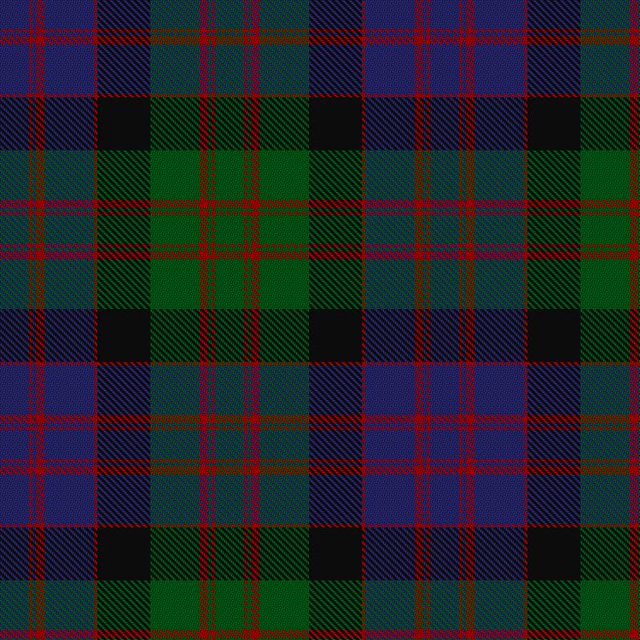
MacDonald
Probable Supported by a credible source, not independently confirmed.
The Scottish Register of Tartans dates the main MacDonald record to 1819, calls it the oldest recorded version of the clan sett, and says there are at least 27 versions across nine branches. The register adds that the chief has traditional authority over clan tartans. For a Macdonald with no known branch this is the usual starting point, but the register's own count of versions shows that the name does not fix one sett. The register says MacDonald of Sleat was manufactured in the eighteenth century from an old MacDonald tartan shown in a painting at Armadale Castle, and that the reconstruction appears to differ somewhat from the original. It is a branch tartan, so it belongs to the Sleat line and not to every Macdonald, and it is the same sett as Middleton. The register holds two MacDonald of Clanranald records dated 1819. One rests on a count in the Lord Lyon's register recorded in 1946 and is distinguished by two white lines. A Macdonald is linked to this sett only if the family connects to the Clanranald branch, which the surname does not show. The register dates MacDonald, Lord of the Isles Hunting to 1950 from a portrait of about 1765 at Armadale Castle, and says the blue-green version is worn by the High Chief. This is a portrait-based record, not evidence of cloth worn by the medieval Lords of the Isles. The separate MacDonald of the Isles record of 1842 comes from the Vestiarium Scoticum and the register says it is not generally regarded as a clan tartan.
Image: Scottish Register of Tartans, rendered from the registered threadcount. Crown copyright, National Records of Scotland.
From the evidence
Where the sources disagree
Sentences from the evidence below in which the record says its sources do not agree. Each is quoted as written; follow the claim number for the context.
Evidence
29 claims, numbered in the order the record lists them. Consecutive claims that cite the same source are set together under that source. Each claim carries its own evidence level.
- BInstitutional5 claims
- CSpecialist secondary6 claims
- DCommercial17 claims
- EUnverified1 claim
Claims 1 to 4
- DCommercial
Wikipedia's surname article gives the Gaelic forms MacDhòmhnaill and Dòmhnallach, both meaning "son of Dòmhnall", and lists McDonnell, MacDonnell, McDonell, Donaldson and McConnell among related variants.
Evidence level D. Sources: [14]
- BInstitutional
The Scottish National Dictionary entry defines Mac as the Gaelic prefix, also written Mc and M', forming a patronymic equal to the English suffix -son. It adds that in colloquial English it is applied to anyone believed to be Scottish.
Evidence level B. Sources: [15]
- DCommercial
Wikipedia's article on the given name derives Dòmhnall from Proto-Celtic *dumno-ualos, "world ruler" or "world wielder", with cognates Dónal in Irish, Dyfnwal in Welsh and Dumnagual in Cumbric, and says the d in Donald came partly from English speakers' misreading of the Gaelic sound.
Evidence level D. Sources: [16]
- DCommercial
The Online Etymology Dictionary traces Donald to Gaelic Domhnall and Old Irish Domnall, glossed as "world-mighty, ruler of the world", and dates the Scottish forms Dofnald and Dufenald to the thirteenth century.
Evidence level D. Sources: [17]
Claims 5 to 8
- DCommercial
A 2024 post on Omniglot's Celtic blog gives Proto-Celtic *dubnos as an adjective meaning "deep" and a noun meaning "world", and *Dubnowalos as a male given name meaning "world prince" or "chief". Sources therefore write the reconstructed first element differently (dumno- or dubno-) while agreeing on the sense.
Evidence level D. Sources: [18]
- CSpecialist secondary
The High Council of Clan Donald calls Donald of Islay, grandson of Somerled, the progenitor of Clan Donald, rendered in Gaelic as Clann Dhòmhnaill. It describes Somerled as a twelfth-century Lord of Argyll proclaimed King of the Isles after defeating the Norse.
Evidence level C. Sources: [1]
- DCommercial
Wikipedia calls Dòmhnall mac Raghnaill, son of Raghnall mac Somhairle, the eponymous progenitor of Clan Donald, whose descendants bore the patronymic Mac Dhòmhnaill. It says there is almost no contemporary evidence for his life and that a charter naming him, held to be issued to Paisley Abbey, is questioned because its witness list and wording resemble a verified charter of his son Aonghus Mòr.
Evidence level D. Sources: [19]
- DCommercial
Wikipedia gives Somerled's death as 1164 at the Battle of Renfrew and names four sons by Ragnhild: Dugall, Ranald, Angus and Olaf. Clan MacDougall and the Lords of Argyll descend from Dugall, Clan Donald from Ranald's son Donald, and Clan MacRory and Clan MacAlister from other descendants of Ranald.
Evidence level D. Sources: [20]
The Scottish National Dictionary entry defines Mac as the Gaelic prefix, also written Mc and M', forming a patronymic equal to the English suffix -son.
Claims 9 to 10
- DCommercial
Wikipedia's surname article names Aonghus Mòr, who died about 1293, as the first MacDonald among the early members of Clan Donald. This differs from the Clan Donald account that treats Donald of Islay, and from Wikipedia's own clan account that treats Dòmhnall mac Raghnaill, as the name-giving ancestor, so the sources are not consistent about who first carried the surname.
- DCommercial
Wikipedia dates the rule of Donald of Islay, Lord of the Isles, to 1386 to 1423, calls him son of John of Islay and grandson of King Robert II, and says he pressed his wife Mariota's claim to the earldom of Ross after 1402 and led about 10,000 men at Harlaw in 1411.
Evidence level D. Sources: [21]
Claims 11 to 13
All cite Clan Donald: an introductory history [1]
- CSpecialist secondary
The High Council of Clan Donald says John of Isla was the first to take the title Lord of the Isles, that the earldom of Ross was annexed to the Crown in 1475, and that John, fourth Lord of the Isles, suffered final forfeiture by the Crown in 1493.
Evidence level C. Sources: [1]
- CSpecialist secondary
The High Council of Clan Donald traces the main branches to separate sons of the Lords: Clanranald from Ranald, eldest son of John of Isla's first marriage, with Castle Tioram on Loch Moidart as its principal seat; Sleat from Uisdean, third son of Alexander, second Lord of the Isles; Glengarry from Ranald's second son Donald; Keppoch from Alasdair Carrach, Alexander's natural son; and Glencoe from Iain Fraoch, natural son of Angus Og, whose chiefs were styled MacIain.
Evidence level C. Sources: [1]
- CSpecialist secondary
The High Council of Clan Donald says that by the dawn of the seventeenth century Sleat, Clanranald, Glengarry, Keppoch and Glencoe had become independent clans, each with its own chief, none of whom could claim to be Mac Dhòmhnaill, a style reserved for the High Chief, which stayed vacant until 1947.
Evidence level C. Sources: [1]
Claims 14 to 15
- DCommercial
Wikipedia lists Clan Macdonald of Sleat, Clanranald, Keppoch, Glencoe, Clan MacDonell of Glengarry and Clan MacAlister as branches with recognised chiefs, and Dunnyveg, Lochalsh and Ardnamurchan as historic branches without one. It says the MacDonnells of Antrim are a cadet branch of the Dunnyveg MacDonalds with a chief recognised in Ireland and do not belong to the Scottish associations.
Evidence level D. Sources: [4]
- DCommercial
Wikipedia's page on the surname MacDonnell says it is an anglicised form of Mac Dhòmhnaill found in Scotland and Ireland, with Glengarry and Antrim among the connected branches. A search result summary of MacLysaght's Surnames of Ireland, not read at source, gives McDonnell three Irish origins: a galloglass family in the Glens of Antrim, a Thomond sept and a west Ulster sept. The Gaelic name is the same on both sides of the North Channel, so spelling alone does not show a Scottish or an Irish family.
Evidence level D. Sources: [22]
ScotlandsPeople says Mac surnames were also written Mc, Mhic or M', that the same person's surname is often registered as Mc in one record and Mac in another, and that searching M*CDONALD with the asterisk wildcard returns both MCDONALD and MACDONALD entries.
Claims 16 to 17
All cite Surnames [2]
- BInstitutional
ScotlandsPeople says Mac surnames were also written Mc, Mhic or M', that the same person's surname is often registered as Mc in one record and Mac in another, and that searching M*CDONALD with the asterisk wildcard returns both MCDONALD and MACDONALD entries.
Evidence level B. Sources: [2]
- EUnverified
A popular 2014 article states that Mc is an abbreviation of Mac and that the idea of Mac as Scottish and Mc as Irish is a myth; it cites no archival example, and a commenter on it disputes the abbreviation point. The two stronger sources above, the Scottish National Dictionary and ScotlandsPeople, show Mc as a written form of Mac and give no ethnic or religious split.
Claims 18 to 20
- DCommercial
Wikipedia's surname article says Scottish surname statistics make no distinction between Macdonald and MacDonald, and that in the United States in 1840 McDonald was far more prevalent than Macdonald, particularly across Ohio, Pennsylvania and New York.
Evidence level D. Sources: [14]
- DCommercial
Wikipedia's article on Scottish surnames lists Macdonald as the 11th most common surname in Scotland at 0.52 per cent, a patronym, and says families living on lands acquired by powerful clans adopted the names of their new lords, naming Campbells, Gordons, Macdonalds and Mackenzies among the clans concerned.
Evidence level D. Sources: [5]
- BInstitutional
ScotlandsPeople says bearers of a clan surname were not necessarily descended from the clan's leaders, and that followers might adopt the clan name to curry favour with the laird, to show solidarity, for protection, or because their lands were taken. It says patronymic naming persisted in the Highlands and Islands well into the eighteenth century.
Evidence level B. Sources: [2]
Claims 21 to 22
All cite Who is a member of a Clan? [3]
- BInstitutional
The Standing Council of Scottish Chiefs says every person who has the same surname as the chief is deemed a member of the clan, that allegiance to the chief is another route to membership, and that there is no official list of recognised septs, which is a matter for each chief. This is a membership rule, not a finding about ancestry.
Evidence level B. Sources: [3]
- DCommercial
Claims 23 to 24
All cite Massacre of Glencoe [24]
- DCommercial
Wikipedia dates the Massacre of Glencoe to 13 February 1692 and says modern research estimates around 30 deaths among the MacDonalds of Glencoe and their associates. Hamilton's men reported 38 dead and the MacDonalds said about 25 were known to be slain, so the figure is disputed. The troops were from the Earl of Argyll's Regiment under Robert Campbell of Glenlyon, about 120 men, who had been billeted among the MacDonalds for 12 days.
Evidence level D. Sources: [24]
- DCommercial
Wikipedia says a proclamation of 26 August 1691 offered pardon to those who swore allegiance to William and Mary before 1 January 1692, that MacIain of Glencoe reached Inveraray on 6 January, five days late, and that the Secretary of State, Lord Stair, wrote on 11 January that he rejoiced that Glencoe had not taken the oaths. It says the 1695 commission concluded Stair and Hamilton had a case to answer.
Evidence level D. Sources: [24]
Claims 25 to 28
- DCommercial
Wikipedia gives Flora MacDonald's birth as 1722 at Milton, South Uist, and her death as 5 March 1790 at Kingsburgh on Skye. It says she obtained permits for a party including Prince Charles Edward Stuart, disguised as Betty Burke, who landed near Uig on 27 June 1746; that she was held in the Tower of London and released in June 1747; and that she married Allan MacDonald in 1750 and emigrated to Anson County, North Carolina, in 1774.
Evidence level D. Sources: [25]
- DCommercial
Wikipedia reports a Y-chromosome study in which, of a sample of 164 men bearing the surname MacDonald, 23 per cent carried the same marker, which belongs to haplogroup R1a, described as extremely rare in Celtic-speaking areas of Scotland but common in Norway. If the figure is right, about three quarters of the sampled MacDonalds did not share that line, and the finding bears on Somerled's male line, not on every bearer of the name. The study itself was not read.
Evidence level D. Sources: [20]
- CSpecialist secondary
The High Council of Clan Donald says that in 1947 Alexander Godfrey Macdonald received the undifferenced arms of Macdonald of Macdonald and that Clan Donald again had a High Chief.
Evidence level C. Sources: [1]
- BInstitutional
ScotlandsPeople lists the records most useful for a Scottish line: statutory registers of births, deaths and marriages from 1 January 1855; census returns from 1841 to 1921; Old Parish Registers from 1553; valuation rolls from 1855 to 1940 at the mid-points between censuses and then every five years; and wills and testaments from 1513 to 1925. It warns that before 1855 spelling variation and handwriting are the main difficulty.
Evidence level B. Sources: [26]
Claim 29
- CSpecialist secondary
Internet Archive holds George F. Black's The Surnames of Scotland (1946; the record read is the 1962 sixth reprint, 918 pages) as a borrow-only title. Its Macdonald entry was not read for this page, so no claim here rests on it.
Evidence level C. Sources: [27]
What this page does not say
Sources
- Clan Donald: an introductory history
- Surnames
- Who is a member of a Clan?
- Clan Donald
- Scottish surnames
- Scottish Register of Tartans: MacDonald
- Scottish Register of Tartans: MacDonald of the Isles
- Scottish Register of Tartans: MacDonald of Clanranald (ref 2354)
- Scottish Register of Tartans: MacDonald of Clanranald (ref 661, Wilsons of Bannockburn)
- Scottish Register of Tartans: MacDonald, Lord of the Isles Hunting
- Scottish Register of Tartans: MacDonald, Lord of The Isles (1750 portrait)
- Scottish Register of Tartans: MacDonald (full record)
- Scottish Register of Tartans: MacDonald of Sleat
- MacDonald (surname)
- Mac, prefix (Scottish National Dictionary)
- Donald (name)
- Donald
- Deeply Profound
- Domhnall mac Raghnaill
- Somerled
- Donald of Islay, Lord of the Isles
- MacDonnell (surname)
- Why Mac and Mc Surnames Often Contain a Second Capital Letter
- Massacre of Glencoe
- Flora MacDonald
- Family history
- The surnames of Scotland, their origin meaning and history