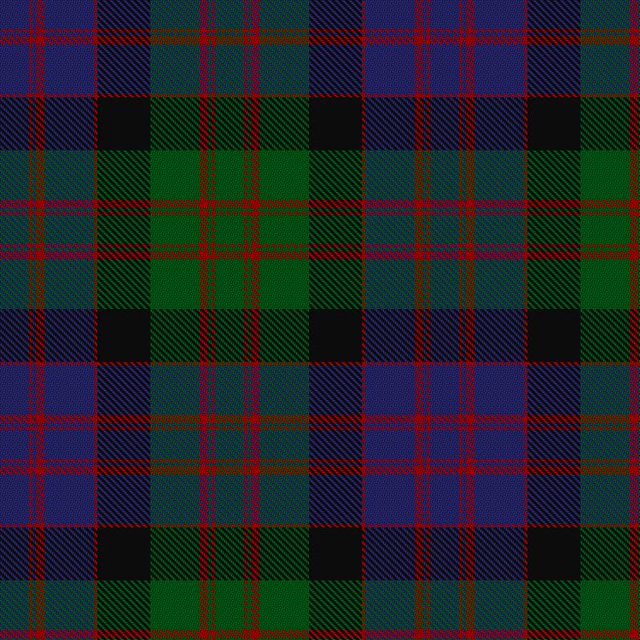
The Scottish Register of Tartans dates the main MacDonald tartan to 1819 and calls it the oldest recorded version of the clan sett. It notes at least 27 versions across nine branches, and that MacDonald of the Isles (1842) comes from the Vestiarium Scoticum and is not generally regarded as a clan tartan.
Clan/Family
No restriction recorded
Evidence level A
Image: Scottish Register of Tartans, rendered from the registered threadcount. Crown copyright, National Records of Scotland.Image source: the record this swatch comes from. Licence: Crown copyright, National Records of Scotland (Scottish Register of Tartans). Re-use beyond fair dealing needs NRS permission.
Type
Clan tartan
Classification
Clan/Family
Earliest known date
1819
Registered
Not recorded
Associated clan
MacDonald
Who can wear it
No restriction recorded
Evidence level
A
Also known as
Macdonald
Clan Donald
Overview
MacDonald is a family of tartans, not one. The Scottish Register of Tartans describes at least 27 versions across the nine branches of Clan Donald. Its main MacDonald record is dated 1819 and described as the oldest recorded version of the clan sett.
Other dates found in secondary sources (1810, 1815) were not reconciled with the register's 1819 and are not used here.
The register dates the main MacDonald record to 1819, calls it the oldest recorded version of the clan sett, and says there are at least 27 versions across nine branches.
From the historical notes. Evidence level A. Sources: [1]
Pattern
The register holds the threadcount behind a login, so this page gives no count. It says the green was lightened to show the sett, and that the pattern differs slightly from versions documented by Logan, Smibert and Grant while keeping the same motifs. The colours listed on this page are approximate and are not read from the registered sett.
Origins
The main record is dated 1819 and has no named designer. The register says it matches the version in the 1880 Clans Originaux and cites the Scottish Tartans Society's note that it is the oldest recorded version of the clan sett. A woven sample is held in the Scottish Tartans Authority's Scarlett Collection.
The register does not say who first wove or wore the sett, or whether 1819 is the year of the earliest surviving record or of the cloth itself. What it describes is a record, not a founding.
The register's notes on the main record say it differs slightly from the setts documented by Logan, Smibert and Grant, and that its green was lightened to show the sett.
From the historical notes. Evidence level A. Sources: [2]
Development
The register shows the sett spreading into many versions. It lists MacDonald Dress, several branch setts, and separate records for Clanranald, Sleat, Glencoe, Kingsburgh and Staffa. Several come from published collections of the 19th century, from paintings, or from museum cloth, so the branch names often record where a sett was found, not a grant made by a chief.
The clan's own account is that a high chief was recognised again in 1947, and the register's notes say authority over clan tartans rests with the chief. The High Council of Clan Donald is the source for that recognition, not a record of any tartan ruling.
Name and variants
The register spells the name MacDonald and lists related records under MacDonald of, MacDonell of and Macdonald, so searching one spelling misses others. Three branch records are described in the sections below: Clanranald, Sleat, and Lord of the Isles Hunting. The register also holds MacDonald Dress (1880), MacDonald of Glengarry (Full Dress), Kingsburgh and Staffa, which this site does not yet cover.
Clan relationship
The register ties the tartan to Clan Donald, which it describes as nine independent branches. Each branch has its own chief and its own sett or setts. The main MacDonald record is the clan-wide one, and branch tartans are separate records with separate sources. Sharing the MacDonald name does not by itself show descent from any one branch.
Check before repeating
Misconceptions
MacDonald of the Isles is not a medieval Lords of the Isles tartan. The register says it first appeared in the Vestiarium Scoticum of 1842, differs from earlier setts attributed to the Lord of the Isles, and is not generally regarded as a clan tartan. Registered Lord of the Isles tartans that do have a source rest on 18th-century portraits.
MacDonald of Glencoe is another case. The cloth fragment dates to about 1740 and has a Glencoe provenance, but the register says its attribution to the MacDonalds has no proof beyond the place.
What the record does not show: the origin of the 1819 sett before the record, a threadcount on this page, and any rule limiting who may wear a branch tartan.
Modern uses
The register's records mention weavers: modern weavers use the blue-tramline form of MacDonald Dress, and D. C. Dalgliesh reproduced the Glencoe fragment in the 1980s. No sourced sales or usage figures are held for the MacDonald tartans.
Clanranald sett
Clanranald is one of the nine branches of Clan Donald, and the register holds two Clanranald records, both dated 1819. They are separate records, and the register does not say they are the same sett.
The better documented one (STA reference 427) is based on a count in the Register of the Court of the Lord Lyon, recorded in 1946. It corresponds to the setts given by A. and W. Smith in 1850 and by J. Grant in 1886, is distinguished by two white lines, and a certified example is held in the Highland Society of London collection. The second (STA reference 4521) names Wilsons of Bannockburn as designer and gives only a count for the 24 reed with 5 half setts.
The register does not explain how a count recorded in 1946 carries an 1819 date, and this page does not guess. A Lyon count recorded in 1946 shows what was fixed in that year, not what was woven in 1819. The Wilsons attribution names a weaving firm, so it describes a source of cloth, not a chief's choice.
What the record does not show: who designed the Lord Lyon version, why two 1819 records exist, and what the Wilsons record looks like beyond a reed count. For wearing, the register lists no restriction and the records say nothing about who by tradition wears it, so ask Clanranald's chief or the clan society before treating it as limited to one family.
Sleat sett
Sleat, on Skye, is one of the nine branches of Clan Donald. The register's MacDonald of Sleat record has no tartan date and no designer. Its note says the tartan was manufactured in the 18th century as MacDonald of Sleat, Lord of the Isles, and was devised from an old MacDonald tartan shown in a painting at Armadale Castle.
The note then qualifies its own claim: the reconstruction appears to differ somewhat from the original, and whether that was intended or a mistake is open to conjecture. A tartan copied from a painting is a reading of the painter's colours and the weaver's interpretation, so the surviving sett may differ from both. The register also says the sett is the same as Middleton, and a sample is held in the Scottish Tartans Authority's Dalgety Collection. A sett shared with a surname tartan means the Sleat name may be a later label, and the name alone does not show a Sleat connection.
The alternative name Lord of the Isles in the note does not describe a medieval tartan. The only documented source is an old painting, the register does not give its date, and no sources read describe cloth from the period of the medieval lords.
What the record does not show: the painting's date, when the Sleat name became attached, and the threadcount. The register lists no restriction and says nothing about wearers.
Isles hunting sett
MacDonald, Lord of the Isles Hunting is dated 1950 on the register (STA reference 2209), and its source is a portrait at Armadale Castle, Skye, dating from about 1765. The register says it matches D. W. Stewart's woven silk sample in Tartans Old and Rare, and that the blue-green version is worn by Godfrey Macdonald, High Chief of the Macdonalds. The 1950 date is a recording date for the record and cannot be read as the year the pattern was first worn.
Two points keep the title in proportion. A portrait of about 1765 is separated by centuries from the medieval Lords of the Isles, so the name describes the title the pattern is associated with, not a cloth from their time. And the register's separate Lord of The Isles record (STA reference 873, category Other) is dated 1750 and taken from the portrait of the MacDonald Boys by Jeramiah Davidson in the National Portrait Gallery, Edinburgh. These are different records and different cloths. Neither is the Vestiarium design, MacDonald of the Isles (1842).
The register's notes also say the tartan was worn by Edward VIII and his father as Lord of the Isles, and by Prince Charles in 1997, citing the Scottish Tartans Society archive. That is the society's statement and has not been checked elsewhere.
For wearing, the register lists no restriction, but its note ties the blue-green version to the High Chief, so ask Clan Donald before wearing it as a chief's or family tartan. The sitter in the portrait and the threadcount are not established here.
Colours
dark blue#2C2C80Approximate
green#006818Approximate
red#C80000Approximate
black#101010Approximate
white#F0F0F0Approximate
Approximate hex values estimate the thread colour; they are not specified by a registry.
Dates in the record
The dates this record holds, and the opening sentence of each historical note that names a single year. A year is the one the source gives; it has not been checked independently here.
The register lists MacDonald of Glencoe (about 1740) from a cloth fragment in the West Highland Museum.
The register dates the main MacDonald record to 1819, calls it the oldest recorded version of the clan sett, and says there are at least 27 versions across nine branches.
The register says MacDonald of the Isles (SRT 2374, 1842) is from the Vestiarium Scoticum, differs from earlier setts attributed to the Lord of the Isles or to any Clan Donald branch, and is not generally regarded as a clan tartan.
The High Council of Clan Donald says that in 1947 the Lord Lyon recognised Alexander Godfrey, 7th Lord Macdonald, as High Chief of Clan Donald, which is the restoration of a high chief that the register's notes refer to.
The register dates the main MacDonald record to 1819, calls it the oldest recorded version of the clan sett, and says there are at least 27 versions across nine branches. It adds that the chief has traditional authority over clan tartans.
The register's notes on the main record say it differs slightly from the setts documented by Logan, Smibert and Grant, and that its green was lightened to show the sett. It matches the version published in the 1880 Clans Originaux, and a sample is held in the Scottish Tartans Authority's Scarlett Collection. The register holds the record under STA reference 419.
The register says MacDonald of the Isles (SRT 2374, 1842) is from the Vestiarium Scoticum, differs from earlier setts attributed to the Lord of the Isles or to any Clan Donald branch, and is not generally regarded as a clan tartan. It warns that the Sobieski Stuarts never produced their manuscript and mixed fact and fiction. It is therefore not evidence of a tartan worn by the medieval Lords of the Isles.
The register's MacDonald Dress record (1880) is taken from Clans Originaux. Its notes say the original Johnston sett used black for the two wide tramlines on white, and that modern weavers use blue instead.
Registered Lord of the Isles tartans rest on portraits. One is dated 1750 and taken from a portrait of the MacDonald Boys in the National Portrait Gallery, Edinburgh. Another is the Lord of the Isles Hunting, taken from a portrait at Armadale Castle of about 1765, dated 1950 in the register.
The register lists MacDonald of Glencoe (about 1740) from a cloth fragment in the West Highland Museum. It says that when D. C. Dalgliesh reproduced it in the 1980s the firm attributed it to the MacDonalds with no proof other than the Glencoe connection.
A register search for 'macdonald' returns 34 records, among them three MacDonald Dress versions, two MacDonald of Clanranald, MacDonald of Sleat, MacDonald of Glengarry (Full Dress), Kingsburgh, Staffa and two Lord of the Isles Hunting records.
The High Council of Clan Donald says that in 1947 the Lord Lyon recognised Alexander Godfrey, 7th Lord Macdonald, as High Chief of Clan Donald, which is the restoration of a high chief that the register's notes refer to.
No restriction is recorded for this tartan. It is not recorded as a universal tartan.
The Scottish Register of Tartans lists no restrictions on this record, and says there are no laws about which tartan a person may wear, only traditions. By clan tradition the MacDonald tartans are worn by members of Clan Donald and their families. Because the clan has nine branches with their own setts, a branch tartan is the usual choice for someone who knows their line.
The register lists no restrictions on the MacDonald record and states there are no laws about which tartan a person may wear. Clan tradition links the MacDonald tartans to Clan Donald and its families, with the chief holding traditional authority over clan tartans. The sources read here do not set out a rule for the branch tartans, so choose by the branch you can name and ask the relevant clan society.
The register holds MacDonald Dress (1880) as a distinct record, and separate setts for Clanranald and Sleat. This page does not compare patterns because no threadcounts were read.
A west Highland and Hebridean clan whose chiefs were Lords of the Isles until the forfeiture of 1493. Clan Donald has several branches, each with its own chief, and in 1947 the Lord Lyon recognised the Lord Macdonald as High Chief of Clan Donald. The Scottish Register of Tartans records at least 27 MacDonald setts across nine branches, so the name does not point to a single tartan.
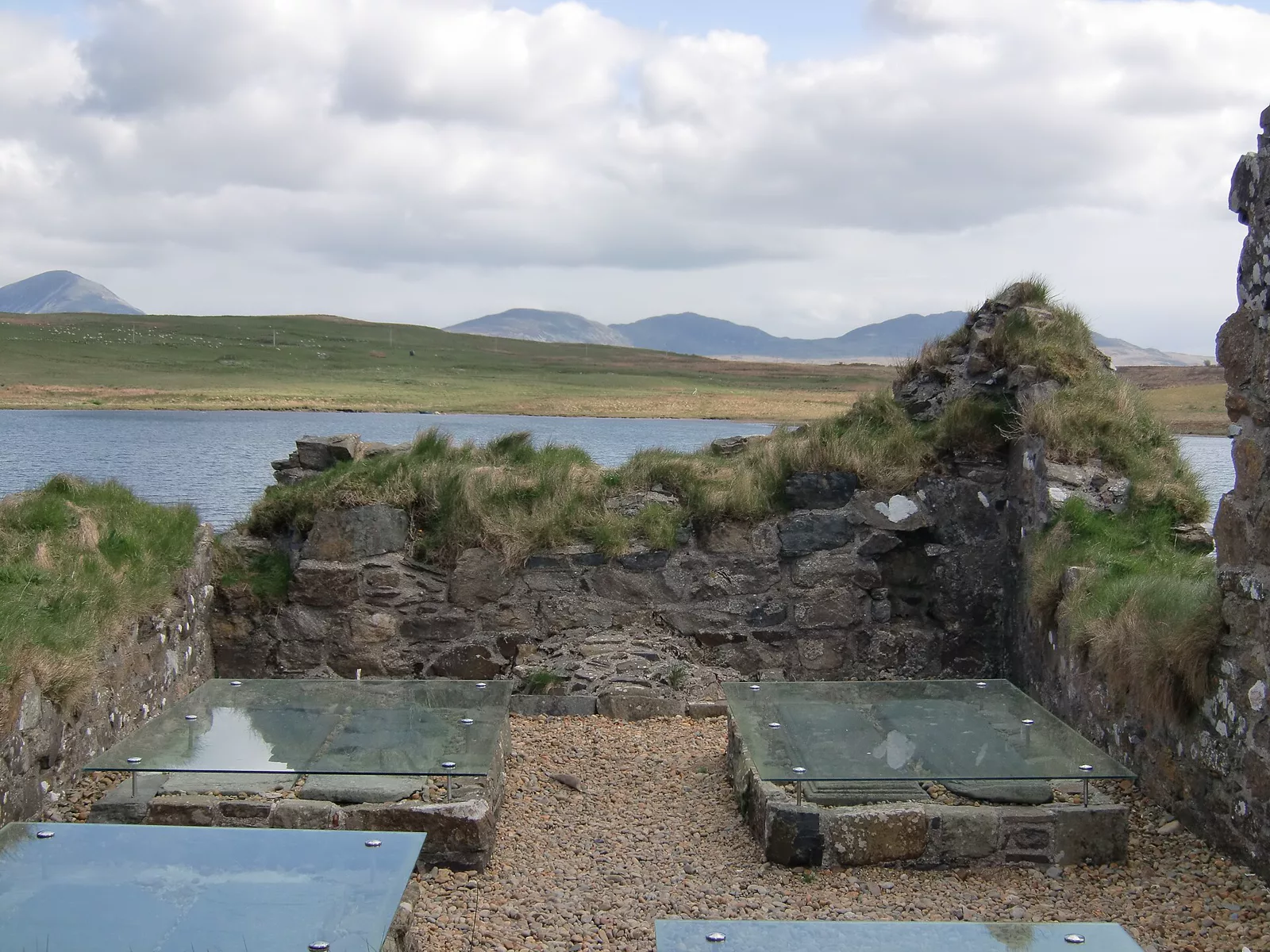
Photo: W. L. Tarbert, CC BY-SA 3.0
An association between a tartan and a clan is a claim with its own sources. It does not mean every bearer of the clan name has a right to the tartan, or the reverse.