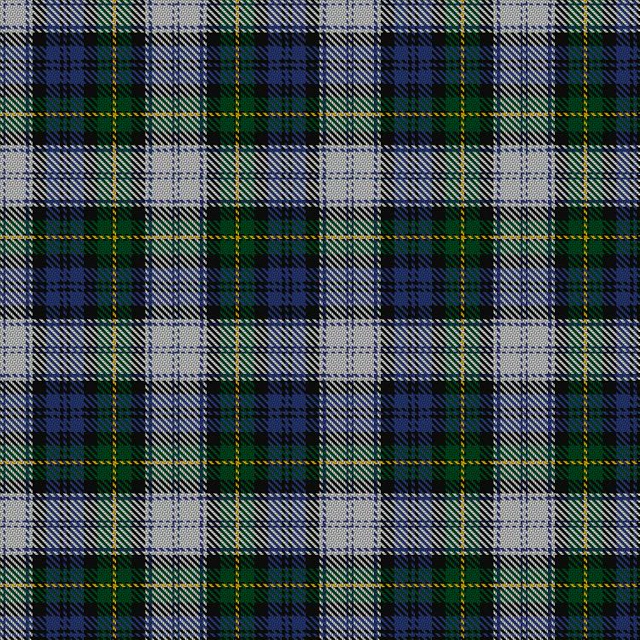
The oldest of the Gordon Dress tartans in the Scottish Register of Tartans, first printed in W. and A.K. Johnston's The Tartans of the Clans and Septs of Scotland in 1906.
Clan/Family, dress
No restriction recorded
Evidence level A
Image: Scottish Register of Tartans, rendered from the registered threadcount. Crown copyright, National Records of Scotland.Image source: the record this swatch comes from. Licence: Crown copyright, National Records of Scotland (Scottish Register of Tartans). Re-use beyond fair dealing needs NRS permission.
Type
Clan tartan
Classification
Clan/Family, dress
Earliest known date
1906
Registered
Not recorded
Associated clan
Gordon
Who can wear it
No restriction recorded
Evidence level
A
Also known as
Gordon Dress
Overview
Gordon Dress is a group of related setts, not one tartan. The Scottish Register of Tartans lists Gordon Dress #1 to #5, Gordon Dress (Original), and a fashion entry, Gordon Dress (F.Schumacher). This page is about the Original, which the register calls the oldest version of the Dress Gordon tartan.
The register records the Original as SRT 1782, first appearing in W. and A.K. Johnston's The Tartans of the Clans and Septs of Scotland in 1906. It names no designer.
The register lists Gordon Dress (Original) (SRT 1782) as first appearing in W. and A.K. Johnston, The Tartans of the Clans and Septs of Scotland (1906), and calls it the oldest version of the Dress Gordon tartan.
From the historical notes. Evidence level A. Sources: [1]
Pattern
The record gives dark blue, green, black and yellow, the same four colours as the main Gordon tartan, and the clan society describes Gordon Dress as based on the 92nd regimental pattern. The register's threadcount for the Original is not shown without a login, so this site has not read it and does not draw the sett.
The sources read do not say how this sett differs line by line from Gordon, so no difference is claimed here.
Origins
The register's note is the whole documented origin: it is the oldest version of the Dress Gordon tartan and first appeared in the 1906 Johnston book. That sets a latest-known date of 1906. It does not show where Johnston found the pattern, and the register names no earlier source.
That makes it a published pattern, not a documented historic cloth. The register does not say it was worn by a chief, a regiment or a family before 1906.
A register search for "gordon dress" returns seven entries: Gordon Dress #1 to #5, Gordon Dress (Original), and Gordon Dress (F.Schumacher), the last classed as Fashion.
From the historical notes. Evidence level A. Sources: [2]
Development
Other Dress Gordon setts are recorded separately, each with a different source.
Gordon Dress #2 is dated 1985 and noted as details from a Johnston's of Elgin specimen. Gordon Dress #3 was found in the notes of James MacKinlay, who counted it from a sample in the stock book of Garrie and Deas. Gordon Dress #4 is credited to the Scottish Tartans Society archive. Gordon Dress #5 comes from a collection the register assumes dates between 1930 and 1950. Gordon Dress #1 has no notes.
So the group was assembled from specimens, notebooks and archive samples over decades, not from one design decision. The register does not rank them beyond calling the 1906 one the oldest.
Name and variants
"Gordon Dress" is a loose label. Each sett in the register has its own number and none is the sole dress Gordon. If you are matching a piece of cloth, the numbered name or source collection is the safer identifier than the general term. The register's notes read here do not define what makes each sett a dress version.
Clan relationship
The register classes Gordon Dress (Original) as Clan/Family. It does not say the chief approved it, and none of the sources read gives a Gordon chief's statement on dress setts. The relationship to the clan is therefore the register's classification, not a documented grant.
Not established
What the record does not show
The register holds no designer, no pre-1906 use and no explanation of what the Original does differently from Gordon. It does not rank the five numbered dress setts against the Original, and the Schumacher entry is a fashion fabric, so it is not a clan pattern. The threadcounts are behind a login and unread.
Gordon entries in the register
A search on "gordon" returns 32 results over two pages. Excluding personal tartans, the clan and place entries on the first page show how many patterns carry the name and how differently they are documented:
Gordon (SRT 214, Military, designer unknown). The regimental sett covered on the Gordon page.
Gordon #2 (SRT 223, Johnston, 1883). Its note calls it an incorrect version of the original, with black guards added to the yellow stripe, and says it first appeared in The Scottish Clans and Their Tartans of 1883. It also records that the Gordons of Hallhead and Esslemont chose the tartan with three yellow lines, and the Gordon-Cumming of Altyre and Gordonstoun chose the one with two.
Gordon of Esselmont (STA 215, designed by the Sobieski Stewarts, 1842). The note says the 4th Duke of Gordon asked Forsyth of Huntly for kilts and received designs with one, two and three yellow stripes, that the Duke took the single stripe and the Esselmont family the triple, and that the Vestiarium Scoticum prints it simply as "Gordon". The origin of the Esselmont label is not documented, and Esselmont is given as near Ellon in Aberdeenshire.
Gordon, Red (SRT 652, Wilsons of Bannockburn). Recorded in the firm's 1819 Key Pattern Book simply as "Gordon"; "Red" is a modern addition. Also called Old Huntly and often used as the Huntly district tartan.
Gordon of Abergeldie (dated 1723). Taken from a portrait of Rachael Gordon of Abergeldie painted that year. The note warns that Gordon/Old Huntly is sometimes wrongly called Abergeldie.
Gordon #3 (SRT 1958, Fashion, Pringles). A fashion variation of the Vestiarium version of Gordon, now called Gordon of Esslemont, in the James Pringle Weavers' collection, probably from the 1970s.
Gordon Cumming (STA 7643, category Other). Documented from an old framed print of a mutton-chopped Highland chief signed "Yours faithfully, Gordon Cumming", contributed in 2008. The register itself says the word "Gordon" is not clear and the cloth only resembles Gordon 1.
Gordon Miniature (SRT 205, category Other). A sample in the Glencoe and North Lorne Museum, recorded as plain weave at 45 threads per inch.
Gordonstoun (Corporate).
Against this list, the Dress group is one cluster among several, and it is the cluster with the thinnest paper trail.
The dress setts compared
The five numbered Dress setts and the Original differ in provenance, not in anything the register states about their stripes.
Original (SRT 1782): the 1906 Johnston publication.
Dress #1 (SRT 3594, STWR 294): no registration notes at all.
Dress #2 (STA 305): dated 1985, taken from a Johnston's of Elgin specimen.
Dress #3 (SRT 315): from the notes of James MacKinlay, counted from a sample in the stock book of Garrie and Deas.
Dress #4 (SRT 347): the Scottish Tartans Society archive, with no date or designer.
Dress #5 (SRT 1831): the MacGregor-Hastie collection that forms the basis of the Scottish Tartans Authority cloth archive, with a date the register assumes to be between 1930 and 1950.
The separate Gordon Dress (F. Schumacher) (SRT 3588, Fashion) is a different kind of record. The register's note says it was found in a December 1989 issue of Country Home magazine as a commercial fabric from F. Schumacher Fabrics of New York. It is a furnishing design named after the pattern, and it should not be counted among the clan setts.
The dates are therefore of different things. 1906 is a publication, 1985 is a specimen's recorded date, and the 1930 to 1950 range is the register's own assumption about a collection. No entry carries a date of weaving that could rank one dress sett as earlier in use than another, apart from the register's own statement that the Original is the oldest.
How to pick a gordon dress cloth
The register does not tell a buyer which dress sett is correct for Gordon family use, and no Gordon chief's statement on dress setts was found. So the choice is a matter of preference, and the useful steps are practical.
Decide first whether you want the regimental Gordon (SRT 214) or a dress sett. They are different registered patterns, and Gordon Dress is not simply the same cloth with a white ground.
If a weaver sells "Dress Gordon", ask for the register number or the source collection. The Original, Dress #1 to #5 and the Schumacher fabric are all sold or catalogued under similar names.
Treat "Gordon Dress (F. Schumacher)" as a fashion fabric. It does not carry a clan claim.
If the cloth is for a family occasion, check with the family or the clan society, since nothing read for this page records a chief's ruling either way.
None of this is a rule. The register states there are no laws about which tartan a person may wear.
Colours
dark blue#2C2C80Approximate
green#006818Approximate
black#101010Approximate
yellow#E8C000Approximate
Approximate hex values estimate the thread colour; they are not specified by a registry.
Dates in the record
The dates this record holds, and the opening sentence of each historical note that names a single year. A year is the one the source gives; it has not been checked independently here.
The register lists Gordon of Esselmont (STA 215, Sobieski Stewarts, 1842), noting the 4th Duke of Gordon asked Forsyth of Huntly for kilts and received designs with one, two and three yellow stripes, that the Duke chose the single stripe and the Esselmont family the triple, and that the Vestiarium Scoticum prints the tartan simply as Gordon.
The register notes on Gordon #2 that the Gordons of Hallhead and Esslemont selected the tartan with three yellow lines and the Gordon-Cumming of Altyre and Gordonstoun the one with two, and that Gordon #2 first appeared in The Scottish Clans and Their Tartans (1883).
The register lists Gordon Dress (Original) (SRT 1782) as first appearing in W. and A.K. Johnston, The Tartans of the Clans and Septs of Scotland (1906), and calls it the oldest version of the Dress Gordon tartan.
A register search for "gordon dress" returns seven entries: Gordon Dress #1 to #5, Gordon Dress (Original), and Gordon Dress (F.Schumacher), the last classed as Fashion.
Gordon Dress #2 (SRT 305) is dated 1985 and noted as details from a Johnston's of Elgin specimen. Gordon Dress #3 (SRT 315) was found in the notes of the late James MacKinlay, who made the count from a sample in the stock book of Messrs Garrie and Deas.
Gordon Dress #4 (SRT 347) is attributed only to the Scottish Tartans Society archive. Gordon Dress #5 (SRT 1831) comes from the MacGregor-Hastie collection that forms the basis of the Scottish Tartans Authority cloth archive, and the register assumes a date between 1930 and 1950. Gordon Dress #1 (SRT 3594) carries no registration notes.
The register lists Gordon of Esselmont (STA 215, Sobieski Stewarts, 1842), noting the 4th Duke of Gordon asked Forsyth of Huntly for kilts and received designs with one, two and three yellow stripes, that the Duke chose the single stripe and the Esselmont family the triple, and that the Vestiarium Scoticum prints the tartan simply as Gordon.
The register notes on Gordon #2 that the Gordons of Hallhead and Esslemont selected the tartan with three yellow lines and the Gordon-Cumming of Altyre and Gordonstoun the one with two, and that Gordon #2 first appeared in The Scottish Clans and Their Tartans (1883).
The register lists Gordon, Red (Wilsons of Bannockburn) as recorded in the firm's 1819 Key Pattern Book simply as Gordon, also called Old Huntly, and often used as the Huntly district tartan; and Gordon of Abergeldie as dated 1723 from a portrait of Rachael Gordon of Abergeldie.
The register lists Gordon Dress (F. Schumacher) (SRT 3588, Fashion) as a commercial fabric found in a December 1989 issue of Country Home, Gordon #3 (SRT 1958, Pringles) as a fashion variation of the Vestiarium version, and Gordon Miniature and Gordon Cumming as category Other entries from a museum sample and a framed print.
No restriction is recorded for this tartan. It is not recorded as a universal tartan.
No law restricts it. By custom it is worn by people connected to the Gordon family, often for dress occasions.
No law restricts Gordon Dress. The Scottish Register of Tartans states there are no laws about which tartan a person may wear, only traditions. By custom it is worn by people connected to the Gordon family.
The regimental Gordon tartan is the closest relative. The other Dress Gordon setts are listed separately in the register and are not covered on their own pages here.
Gordon Dress (Original) compared with related tartans
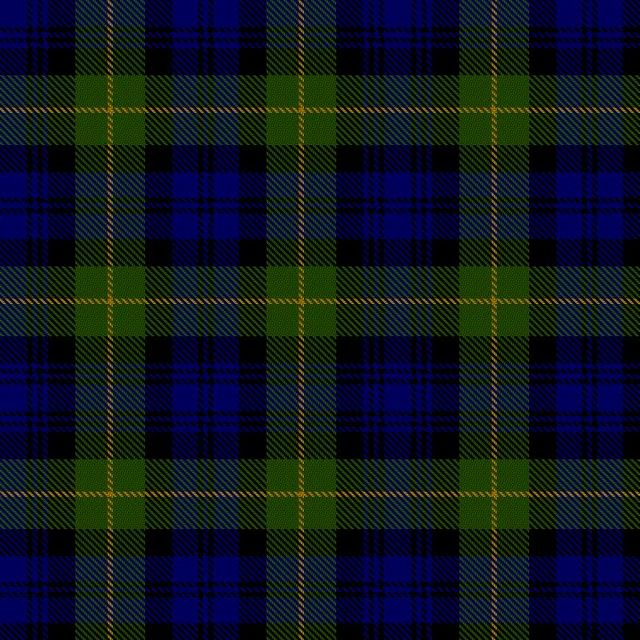
A clan of Aberdeenshire and the north-east, whose chief is the Marquess of Huntly. The family took its name from the barony of Gordon in Berwickshire and moved north when Robert the Bruce granted Strathbogie, later Huntly, to Sir Adam Gordon. The Gordon tartan is registered as a military tartan designed for the 92nd (Gordon) Highlanders in 1794 and later adopted by the clan.
Photo: Bill Harrison, CC BY-SA 2.0
An association between a tartan and a clan is a claim with its own sources. It does not mean every bearer of the clan name has a right to the tartan, or the reverse.