Scottish clothing
Scottish caps: Balmoral, Glengarry, Tam o' Shanter and flat cap
Five cap styles that get called a Scottish cap, how to tell them apart by shape and material, and where retailers and sources use the names loosely.
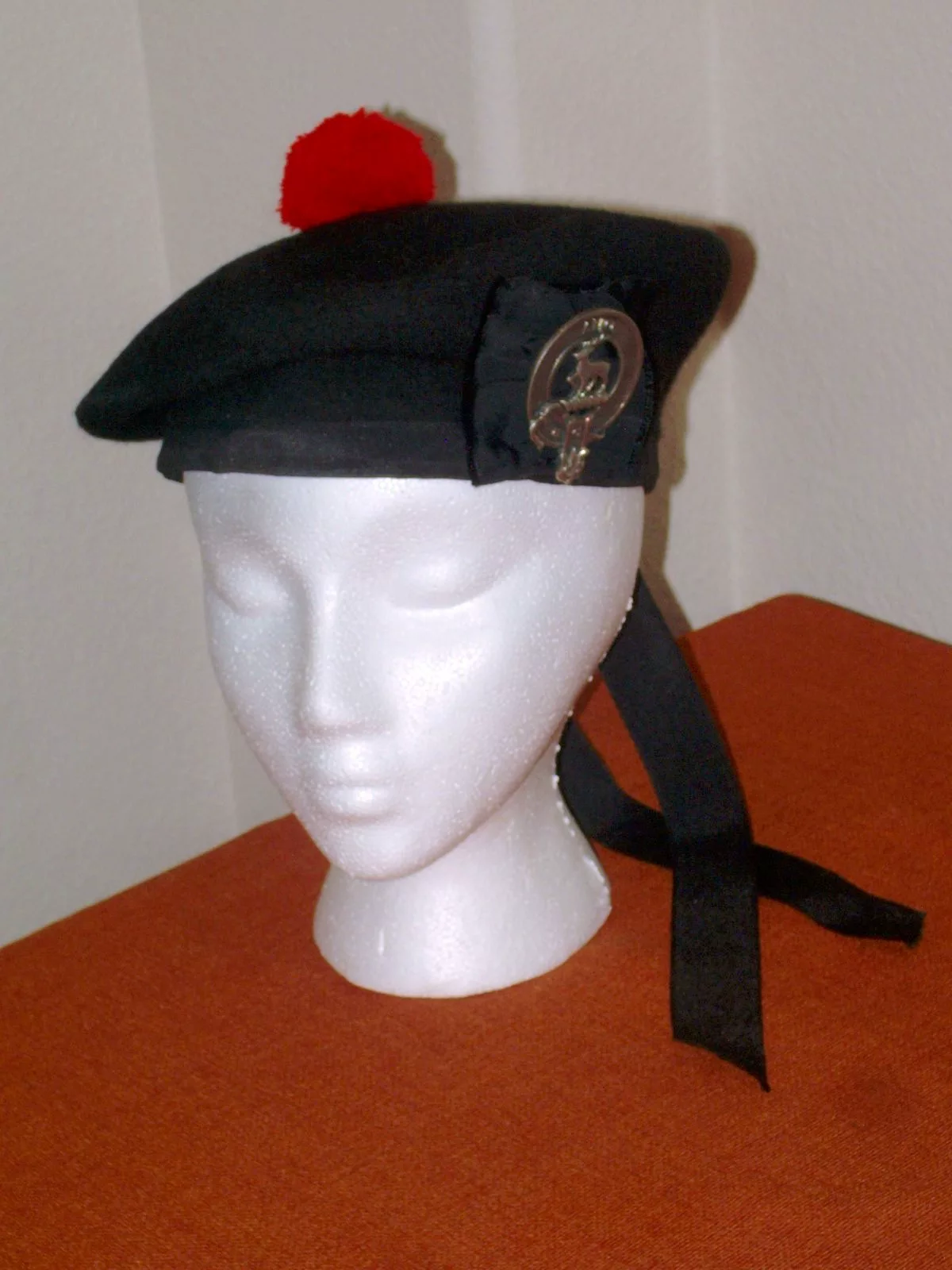

“Scottish cap” covers at least five different things. Three are bonnets worn with Highland dress (Balmoral, Glengarry and Tam o’ Shanter), one is an everyday tweed flat cap, and one, the “tartan cap”, is usually a fabric choice rather than a shape. This page sets them side by side so you can tell which is which.
The three bonnets
Balmoral. A knitted, soft wool cap with a flat crown, developed from the older blue bonnet. Descriptions give dark blue, black or Lovat green as the traditional colours, with a red toorie and sometimes a diced band round the edge. A regimental or clan badge is usually pinned to a ribbon cockade on the left, and ribbons at the back, once used to tighten the band, are sometimes left hanging. The name “Balmoral” for this headdress appears to date from the late nineteenth century. An 1842 description quoted in one reference says a bonnet of this kind was “worn pretty generally by ploughmen, carters and boys”, so it began as ordinary wear.
Glengarry. A side cap in thick-milled wool that folds along the crown, with a toorie, often a cockade on the left, and ribbons hanging behind. It is named for the Glengarry Fencibles, raised in 1794 by Alexander Ranaldson MacDonell of Glengarry, though who first made it is unclear. Military adoption is dated to around 1841 for pipers of the 79th Foot, and by the 1850s and 1860s it was standard undress headgear for Scottish regiments. The diced band can mark the regiment’s status. It is now worn in military, pipe band and civilian Highland dress.
Tam o’ Shanter. A flat bonnet, originally hand-knitted in one piece, stretched over a wooden disc to give the flat shape, then felted. It has a toorie at the centre. The name comes from Burns’s 1790 poem and, according to the same reference, only entered common use in the early nineteenth century. Before synthetic dyes in the mid-nineteenth century the bonnets were dyed with natural colours such as woad or indigo, which is why they were called blue bonnets. A khaki version introduced in 1915 became the military “bonnet, tam o’ shanter”, cut from separate pieces of serge.
How one knitted bonnet became three caps
All three bonnets descend from the same object: the knitted woollen bonnet that Scottish bonnetmakers produced for centuries. The Future Museum collection in East Ayrshire describes these as hand knitted on three wooden needles, which produced a circular garment without seams, then waulked or milled to raise the nap and sheared, which thickened the cloth and helped to waterproof it. The same page says local wool was dyed with woad or scabious plants, with indigo used later, and that blue bonnets were worn by servants, labourers and soldiers while black ones, more expensive, went to clerics, merchants and professional men. Its description of the shape is blunt: large, round, flat bonnets, “not neat little items of headgear”.
The trade was organised early. The same museum page gives a trade guild in Dundee by 1496 and incorporations at Stewarton in 1590 and Kilmarnock in 1646, and Helen Bennett’s 1981 Edinburgh thesis on the Scottish hand-knitting industry identifies bonnetmakers as the earliest identifiable knitters in Scotland, working in Dundee, Edinburgh, Glasgow, Kilmarnock and Stewarton mainly for domestic buyers. (We read only the thesis abstract, so the detail behind it is not checked here.) The museum page names Stewarton and Kilmarnock, both in Ayrshire, as the centres of the trade. A museum record for a bonnet probably knitted in Kilmarnock in the 1780s says it was common then for the yarn end at the centre of the crown to be decorated with a top knot; it does not say this particular bonnet has one, but the detail points to the ancestor of the toorie. The main museum page says Stewarton took over the lead in the nineteenth century by securing government orders for the armed forces, and a second museum record says that in more recent years it turned the work from a cottage industry into a mechanised, factory-based enterprise.
That sequence explains why the modern caps look related. Wikipedia’s summary of the blue bonnet, which is a secondary source, says the Victorian era brought more elaborate forms, the Kilmarnock or Balmoral bonnet with ribbons, a diced border and a toorie, and an informal toorie-topped variant that became known as the tam o’ shanter. A piper writing in 2018 makes a related point: in the old days the toorie was the finishing remnant of the knitted hat and matched the bonnet’s colour, and since modern caps are no longer knitted the red or black toorie is only a residual feature. Treat the flat, toorie-topped shape as the shared ancestor, and the three names as later labels for particular finishes and uses.
Where the Glengarry came from, and what is disputed
The usual account credits Alexander Ranaldson MacDonell of Glengarry with the cap when he raised the Glengarry Fencibles in 1794. Wikipedia’s Glengarry article says historians debate whether early depictions show true Glengarries or ordinary military bonnets shaped differently, and that the first documented military use of the classic form may be 1841, when it is said to have been introduced for the pipers of the 79th Foot by Lieutenant Colonel Lauderdale Maule. The same article dates its becoming characteristic undress headgear of the Scottish regiments to the 1850s, and says that by 1860 the Glengarry had been adopted by pipers in all regiments except the 42nd (Black Watch), whose pipers wore the full dress feather bonnet.
A January 2019 Inverness Courier report adds a competing idea, not a conclusion. An Oxford-based researcher, Robert Harbord, argued that a Glengarry-style bonnet in Inverness Museum, labelled as found in a peat bog near Fort Augustus and thought to have reached the museum before 1932, might be the oldest surviving example. His theory is that after the 1747 Act of Proscription clansmen pushed up the sides of the large, flat pre-Culloden bonnets and so created the new shape. The article says the museum’s only information is that label. The curator says no records contradict Harbord’s view and that confirmation of the bonnet’s age would be welcome, so the theory is open rather than settled. What the evidence does not show is who first made a Glengarry, or whether the 1794 Fencibles wore one.
What the army wears today
The military uses of these caps are the best-documented part of the topic, and they are a common source of confusion because army names and civilian names do not line up.
- Glengarry. According to the Glengarry article, the Royal Regiment of Scotland, formed in 2006, wears a blue Glengarry with red, green and white dicing, a red toorie, a black silk cockade and the regimental badge surmounted by a blackcock feather. The same article says diced bands indicated a regiment’s status: red, white and blue for royal regiments, red, white and green for others.
- Tam o’ Shanter. The “bonnet, tam o’ shanter”, abbreviated ToS, is a different cap from the civilian knitted bonnet. Wikipedia says it began as a khaki bonnet introduced in 1915 for the trenches, replaced the Glengarry as the field bonnet, and is now made of separate pieces of khaki serge. Battalions are told apart by hackles: the Black Watch battalion wears a red hackle in its ToS.
- Balmoral. The military Balmoral was dropped in the 2006 amalgamation; Wikipedia says all battalions now wear the Glengarry for that role. Before then the Black Watch wore a soft blue Balmoral as full dress after the Second World War.
An official 2010 Ministry of Defence news story shows how current these markers are. It reports that the two Territorial battalions, 6 SCOTS and 7 SCOTS, were given grey and purple hackles respectively for their Tam o’ Shanters, so that each had its own identity instead of borrowing the nearest regular battalion’s hackle. The story says some older hackles were granted as battle honours to soldiers in antecedent regiments, and the commanding officer of 6 SCOTS is quoted saying the grey hackle “deliberately bears no historical or antecedent significance”. The practical lesson for a civilian is that a hackle on a ToS is a regimental mark. A civilian cap with a hackle copied from a regiment would imply a connection the wearer may not have.
Wikipedia’s tam o’ shanter article, writing about Canadian regiments, also distinguishes the army ToS from the Balmoral by cloth: the ToS is generally rough khaki wool, the Balmoral a finer pale tan or grey doeskin. That comparison belongs to the older uniform tradition and should not be read as a rule for civilian caps.
Choosing a cap for civilian Highland dress
For a civilian outfit the most direct guidance we found comes from the Clan Buchanan Society dress guide. It names two bonnets and one casual cap. The Glengarry is worn two fingers above the right eye, and the Balmoral straight with the excess pulled down over the right side. A tweed flat cap is acceptable with casual daywear. Its general rule is to remove headwear indoors unless under arms. It lists a bonnet as optional at ceilidh and dressy informal dress, lists a Balmoral or Glengarry with crest badge under general daywear, and lists a Highland bonnet with crest badge as suitable outdoors with black-tie and white-tie dress. It says nothing about headwear for semi-formal dress. It does not mention the tam o’ shanter or feathers at all, so any claim that a tam o’ shanter is “informal” or “for ceilidhs” has to come from elsewhere, and the sources we read for this page do not settle it.
Three practical points follow from the sources.
- Badge. Wikipedia’s kilt accessories article describes both caps as taking a crest badge, and its Balmoral article says the bonnet is usually worn tilted to the right to display it. A badge marks an affiliation, so choose one you are entitled to (a clan crest if you belong to that clan, otherwise a plain Scottish emblem) and treat a feather or a hackle as a mark of rank or regiment.
- Shape and colour. The kilt accessories article says both caps come in a variety of colours, but black is most usual. Other sources give dark blue or Lovat green for the Balmoral, so dark blue and black are the safe options; the sources do not rank them.
- Tartan. The piper’s 2018 article advises that less is more and warns against making every accessory tartan. It also says the Balmoral tartan is reserved for the Sovereign and family, which matters if a listing sells a “Balmoral tartan” cap: the tartan named Balmoral is a separate matter from the Balmoral bonnet, and should be checked in the register before use.
Both the Glengarry and the Balmoral appear in the Buchanan guide as formal options and in pipe-band uniform descriptions, so the sources give no reason to rank one above the other. The tam o’ shanter’s civilian role is the least settled of the three.
Flat cap and tartan cap
The flat cap is a rounded cap with a small stiff brim at the front, in tweed, wool, cotton and other cloths. Wikipedia traces it to sixteenth-century northern England, where it was likely called a “bonnet” before “cap” replaced the word around 1700, except in Scotland, where “bunnet” survives. It also notes the English Parliament’s 1571 act requiring males over six, except the nobility, to wear woollen caps on Sundays and holidays, repealed in 1597 by which time the cap marked a commoner. In Scotland it is therefore an everyday cap, not a part of Highland dress, which is why the Buchanan guide files it under casual daywear.
Tartan cap is not a separate historical style that we could establish. Sources describe Balmorals and tam o’ shanters as made in solid colours or in tartan, so a tartan cap is best read as “a bonnet or flat cap cut from tartan cloth”. If a listing uses the phrase, check which shape it actually is, and whether the tartan is one you may wear.
Comparison
| Style | Shape | Material | Traditional use | Formality | Typical outfit |
|---|---|---|---|---|---|
| Balmoral | Flat crown, soft, with toorie, left badge, ribbons behind | Knitted wool; dark blue, black or Lovat green | Everyday wear in the 1800s; later Highland regiments (Black Watch full dress after the Second World War) | Formal or informal Highland dress; with a badge it is one of two bonnets the Buchanan guide accepts | Kilt outfit; worn straight with the excess pulled down over the right side (Buchanan guide) |
| Glengarry | Side cap folding along the crown; toorie, ribbons behind, often a left cockade | Thick-milled wool | Military from about 1841; pipe bands; civilian Highland dress | Formal or informal Highland dress | Kilt outfit; worn about two fingers above the right eye (Buchanan guide) |
| Tam o' Shanter | Wide, flat bonnet with toorie | Hand-knitted and felted wool originally; serge, solid colours or tartan now | Blue bonnet tradition; khaki military version from 1915 | Not established in the sources read | Not established in the sources read |
| Flat cap | Rounded body with short stiff front peak | Tweed, wool or cotton | Everyday cap, north of England in origin | Casual | Tweed flat cap with casual or day dress (Buchanan guide) |
| Tartan cap | Varies; a fabric choice, not one shape | Tartan cloth | Not established as a distinct historical style | Not established | Not established |
Where the names blur
The names are not always kept apart. One reference notes that the Balmoral was sometimes simply described as the same thing as the tam o’ shanter, and a piper’s personal reference site calls the Balmoral a smaller version of the Tam O’Shanter. The two do share a flat, toorie-topped bonnet shape, so a listing that says one when it means the other is easy to find.
Other points of confusion:
- A Balmoral and a Glengarry can both carry a ribbon cockade and tails, but the Glengarry is a side cap that folds, the Balmoral a flat-crowned bonnet.
- The same piper’s page says Highlanders knot the back ribbons and Lowlanders let them hang free. That is one practitioner’s remark, and we have not found it confirmed elsewhere.
- Military terms differ from civilian ones: the army “tam o’ shanter” is a khaki serge cap from 1915, not the knitted bonnet.
Related pages
To identify a hat from a photograph or tell the bonnet names apart, use types of Scottish hats. Caps are one part of a Highland outfit: see kilt types for the garment itself and what is a kilt for the basics. Wearing a clan tartan on a cap raises the same questions as anywhere else, covered in who can wear which tartan.
Sources
The shape and history of the three bonnets rest on a mix of museum records and secondary summaries. The Future Museum pages and the Edinburgh thesis abstract cover knitted bonnet making; the Ministry of Defence story covers the 2010 hackles; the Inverness Courier relays a researcher’s theory and is flagged as such. Wikipedia’s articles on the Balmoral, Glengarry, tam o’ shanter, blue bonnet, flat cap and kilt accessories supply most dates and military details and cite their own sources, so they are weaker than regimental museum or National Museums Scotland references. National Museums Scotland holds Glengarry and Balmoral bonnets, but its catalogue pages did not load for us. The wearing guidance comes from the Clan Buchanan Society dress guide and a piper’s blog, one organisation’s view and one practitioner’s opinion, not a universal rule.
Related guides
Sources & further reading
- Balmoral bonnet
- Glengarry (cap)
- Tam o' Shanter (cap)
- Flat cap
- Scottish headwear (Tam O'Shanter, Balmoral, Glengarry)
- Buchanan Highland Wear and Dress Code Guide
- Bonnet making
- Kilmarnock bonnet (object record)
- Stewarton Bonnets (object record)
- Origins and development of the Scottish hand-knitting industry
- New feathers for new Scottish troops
- Historic Highland clansman's bonnet could be first of its kind
- Thoughts on Recent Posts Regarding Highland Dress
- Blue bonnet
- Kilt accessories