Scottish clothing
Kilt pins: what they do, where they go and how styles differ
A kilt pin is a small weighted ornament on the outer apron. It does not hold the kilt closed, and it goes through one layer only.
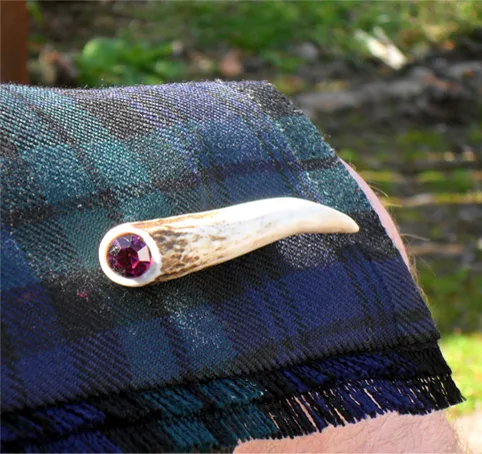

What the pin is for
Most guides give the pin two jobs: a little weight on the free corner of the outer apron, and decoration. Wikipedia says the weight stops the apron falling or blowing open (Wikipedia). Kilt Society says the same, and The Utility Kilt adds that it keeps the apron from moving up or down too much outdoors (Kilt Society).
One source disagrees on how much weight is involved. The Saint Andrew’s Society of the Middle South describes the pin as decorative and says it is not heavy enough to stop the apron blowing open in a breeze (Saint Andrew’s Society of the Middle South). So “it holds the kilt down” is a claim some sources make and one source qualifies. The practical reading is that the pin steadies the corner slightly and mostly finishes the outfit. If you need the apron to stay put in strong wind, the pin is the wrong tool to rely on.
The waist straps and buckles close the kilt, which is why none of the sources treat the pin as a fastener. A pin that does join the layers is the one error every guide here names, and the reasons given are specific. The Saint Andrew’s Society says it distorts the hang and action of the kilt and at worst can tear the cloth, and that thick-shanked pins have been known to damage kilts. Kilt Society says it restricts movement and can damage the kilt. Houston Kiltmakers’ guide, as published on Kilts for Hire, says the pin only goes through the outer apron and does not join the outer and inner aprons (Kilts for Hire).
Where it goes
The agreed points are simple. The pin sits on the outer apron only, low down, close to the free edge. On a man’s kilt the apron closes to the right and the pin sits near the fringed edge; for a kilted skirt, a clan society’s guidance says the skirt closes to the left and the pin goes on the left side (Clan Buchanan Society International). Kilt Society gives the bottom right-hand side for a standard kilt.
The distances are not standardised. The figures below are the ones the pages read actually print:
| Source | In from the fringed or side edge | Up from the hem |
|---|---|---|
| The Utility Kilt (retailer) | about 1.5 in | about 1.5 in (“from the bottom and side edge”) |
| Kilts for Hire / Houston Kiltmakers (retailer) | about 1.5 in | about 2 in |
| Kilt Society (retailer) | about 2 to 3 in | about 2 to 3 in |
| Saint Andrew’s Society; Wikipedia | two pattern squares | two pattern squares |
In metric terms the retailer figures run from roughly 3.8 cm to 7.6 cm in either direction, so the spread between the tightest and loosest advice is a factor of two. The first three rows agree on the area and differ by an inch or so.
The last row is a different kind of rule, and it does not sit comfortably beside the others. The Saint Andrew’s Society states the pin should go two pattern squares over and up from the edge of the cloth, and Wikipedia’s accessories article repeats the rule (Wikipedia: Kilt accessories). Wikipedia’s kilt pin article attributes a related passage on military fastenings to J. Charles Thompson, whose book So You’re Going to Wear the Kilt was published in Edinburgh in 1981, but the pages read do not say where the squares rule originates, and none defines the term. If a “pattern square” means one full repeat of the sett, the result depends entirely on the tartan: a repeat that measures several inches would put the pin two repeats in, which lands well outside the 1.5 to 3 inch range. For the rule to match the retailer figures, a “square” would have to be a block of roughly 0.75 to 1.5 inches. That arithmetic is only a consistency check, since no source gives a sett size, but it shows the two kinds of advice cannot both be read literally on every cloth.
A workable way to choose between them follows from what the sources agree on. Put the pin low and near the edge, inside the 1.5 to 3 inch band, on the outer apron only. Then nudge it so it sits against a stripe or colour block in the cloth, which Kilt Society suggests. Checking the position with the kilt on, standing, matters more than the figure, because the apron drapes differently from how it lies flat.
Styles and materials
Motifs named in the sources are clan crests, a sword shape (often called a claymore), thistles and other Celtic designs, with a plain safety-pin look at the minimal end. Materials named include pewter, chrome, sterling silver, wood and stag horn, in antique (matte) or polished finishes (Kilt Society). Houston Kiltmakers, as published on Kilts for Hire, calls the claymore its most popular design and says its pins range from plated options to solid silver, in shiny or antique finishes, with clan crest pins available. That is a statement about one maker’s range, not a survey of what people wear.
Wikipedia’s kilt pin article links style to occasion: a simple safety pin or blanket pin for sport, an ornate pin for formal day wear, and a silver pin with a stone setting for evening wear. Kilt Society does not mention occasions at all. The occasion pairing is therefore a single secondary source, and it fits the general logic of Highland dress, where formality is signalled by silver and stones. Treat it as a sensible default rather than a code.
| Style | How the sources describe it | Not established |
|---|---|---|
| Plain safety-pin look | Wikipedia: simple safety pins suit sport. Kilt Society lists a safety-pin style as a minimalist option. | Material |
| Sword (claymore) shape | Named as a common design by Kilt Society, The Utility Kilt and Houston Kiltmakers. | Which occasions it suits |
| Thistle and Celtic motifs | Named as common designs by both retailer guides. | Any rule on who wears which motif |
| Clan crest | Listed by Kilt Society and the Saint Andrew's Society; Wikipedia says pins often carry clan symbols or national emblems. | Any formal entitlement rule |
| Silver with set stones | Wikipedia: ornate silver pins with stones for evening wear. | Stone types |
| Stag horn or wood | Kilt Society names natural materials among the options. | Occasion |
Two practical cautions come from Wikipedia. Claw-style brooches, a historical type made from grouse feet, can snag the clothing of dancers, and a leather backing behind the apron or buttonhole stitching around the pin hole can reduce wear where the pin passes through.
How many pins is a question the sources barely touch. Kilt Society’s guide does not say how many to wear. An advice comment under a piping blog post says to limit the pin to one or none; that is a reader’s opinion and not an authority, but the guides read do not address the question, so it cannot be checked against them.
An older object: what museum records show
The retailer guides describe current practice. Museum records show that pins were objects of value well before the guides were written. Aberdeen’s collections include a kilt pin in silver, horn and glass, dated to the mid 19th century and 9.5 cm long, recorded as thought to have been worn by Sir James Gordon, the last Governor of Greenwich Hospital, and donated in 2012 (Aberdeen Archives, Gallery and Museums). At 9.5 cm it is longer than the 3.8 to 7.6 cm placement distances above, which is a reminder that a historical pin and a modern retailer pin are not the same size class, and that an old pin may not have been designed to sit within a couple of inches of a hem. The record does not say how it was worn.
Aberdeen’s catalogue also lists silver and citrine kilt pins, and the National Museums Scotland collection holds a mid 19th century silver plaid brooch from the Clanranald Collection, set with a cairngorm and a ring of sixteen carbuncles (National Museums Scotland). Those are the materials that Wikipedia’s evening-wear advice still points to: silver and set stones.
Pin, brooch and plaid brooch
The words overlap and the sources do not draw a firm line between a kilt pin and a brooch. The one clear distinction is the plaid brooch. The Saint Andrew’s Society describes a plaid brooch as fastening a fly plaid cast over the shoulder and pinned below it. Wikipedia’s Highland dress article lists a short belted plaid with a silver plaid brooch as an optional element of formal evening dress (Wikipedia: Highland dress). The Saint Andrew’s Society’s page lists the plaid brooch as usually worn with some formal ensembles, and describes the kilt pin as a decorative item for the outer apron.
The difference is function. A plaid brooch fastens cloth at the shoulder and carries the weight of the plaid. A kilt pin fastens nothing. That is why the two should not be treated as interchangeable ornaments. Clan Buchanan’s guide mentions a penannular brooch in connection with the great kilt, which is a third use of the word again.
Pins, ribbons and regimental practice
Wikipedia reports that the Black Watch used green ribbons in the same position as a pin, so as not to fasten the layers and spoil the uniform line. Museums Victoria’s record on kilt ribbons says the Black Watch and the Argyll and Sutherland Highlanders are the only Highland regiments to wear rosettes on their kilts, that the Black Watch has worn ribbons since the mid 18th century when the great kilt was worn, and that the Sutherland Highlanders began in the 19th century (Museums Victoria). The record gives a theory that the ribbons tied cloth together when men slept rough, calls the origin hazy and says that later only officers and sergeants kept the practice.
The two accounts differ in emphasis. Wikipedia places the ribbon where a pin would sit; the museum record talks about the ribbons as an older practice with its own origin. Neither establishes that the ribbon replaced a pin. Regimental dress also follows its own regulations, so the regimental ribbon is not a guide for civilian pin placement.
Where the Victoria story fits
A widely repeated account says the pin came in during Queen Victoria’s reign to keep the apron from flapping and showing more than the Queen liked. Wikipedia reports that J. Charles Thompson writes that Victoria brought in rules requiring military kilts to have a fastening, and that soldiers wore pins but did not pass them through both layers. Wikipedia also gives a version in which the Queen gave her own brooch to a struggling soldier, and treats that as allegation.
The sources read give no regulation text, order or archive reference for either version. The fair reading is that a Victorian origin is the commonly told one, that it is not documented in anything checked here, and that the more reliable fact is the modern custom: weight, decoration, one layer. Wikipedia’s Highland dress article does support the broader point that “proper” Highland dress for formal and semi-formal wear was codified during the Victorian era, which is the period the pin story sits in.
Related
The pin usually goes with a belt and sporran; see kilt belts and buckles for how those are sized and matched, and kilts for the garment itself.
Related guides
Sources & further reading
- Kilt pin
- The Essential Kilt Pin
- The Purpose and Placement of the Kilt Pin: Function and Style
- Choosing your basic attire
- Kilt Pin and Brooch
- Kilt accessories
- Highland dress
- Kilt pins: how to wear a kilt pin correctly
- Kilt pin (ABDMS082499)
- Kilt ribbons record (Black Watch and Argyll and Sutherland Highlanders)
- Plaid brooch, Clanranald Collection (H.MCR 25)