Pets
Tartan Dog Collars: Sizing, Materials and Hardware
How to measure a dog for a tartan or plaid collar, what the strap and hardware are made of, and what actually decides whether the collar is safe.
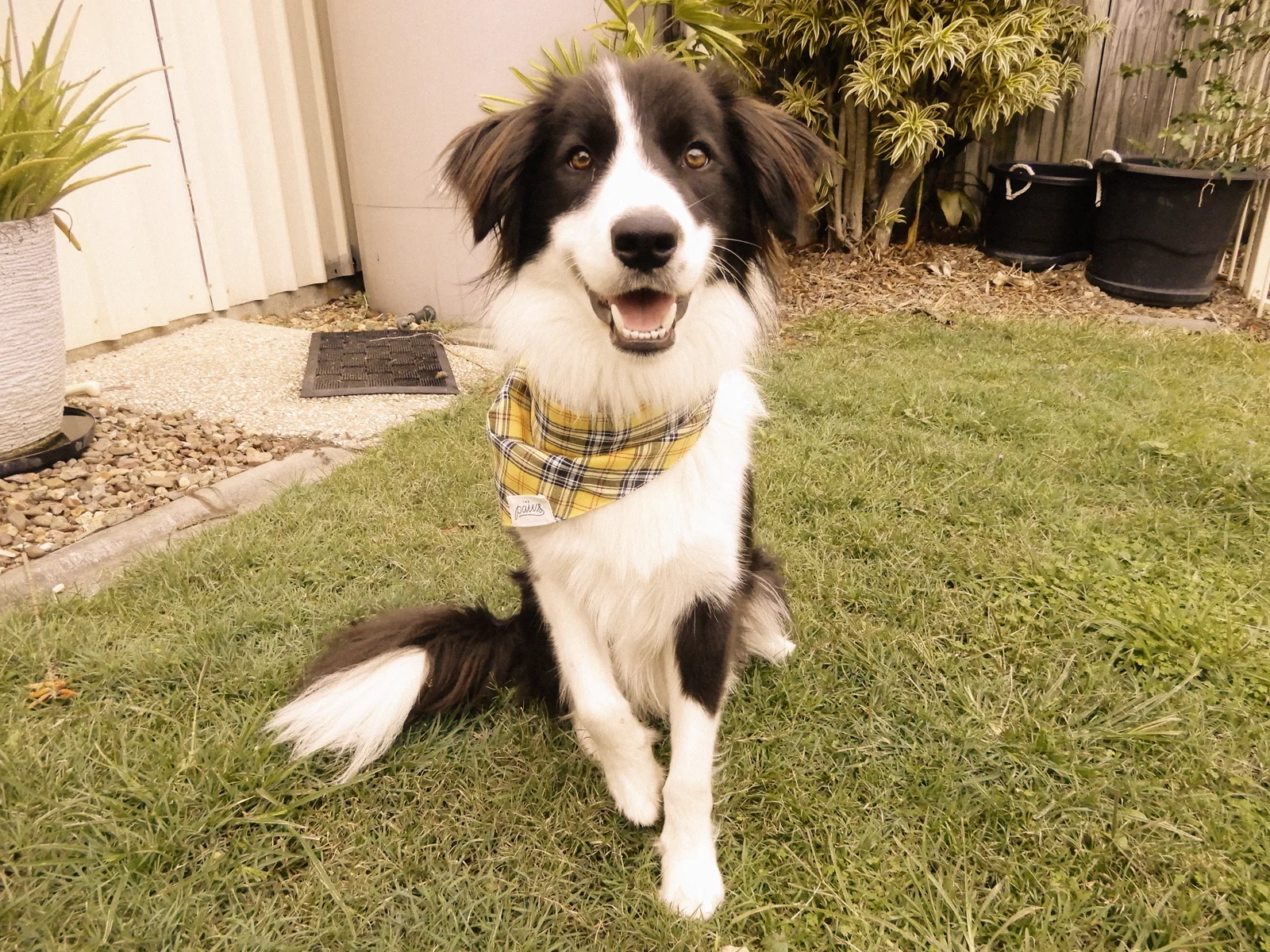
_showing_off_his_doggy_bandana.jpg)
On a tartan or plaid dog collar, the tartan is the print or weave on the strap or ribbon. It tells you nothing about strength, stitching or the buckle. A maker’s technical note on collar webbing says that in practice the stitching and hardware are often the weak point rather than the webbing, so judge the collar as a whole. This page gives a sizing method, then the materials and hardware that matter.
This is general equipment information, not veterinary advice. If a collar seems wrong for your dog, ask a vet or trainer.
Measure the neck
The American Kennel Club says to measure around the neck while the dog is standing naturally, to follow the two-finger rule so the collar is not too tight, and to take the larger size if the dog falls between two. It adds that for longer-necked breeds you should measure lower on the neck rather than near the head.
Purdue’s extension service describes a flat buckle collar as sitting just above where the neck meets the shoulder, and a properly fitted one as somewhat snug. It also says a collar that is too tight or dirty can irritate the skin, so remove it from time to time and check the coat and skin underneath. Purdue adds that dogs with a large neck and a small head, such as greyhounds and pugs, may slip their head through even a properly fitted flat buckle collar.
None of the sources read gives a schedule for rechecking a growing dog. The check takes seconds, so repeating it whenever the dog’s neck or coat changes is a reasonable habit rather than a sourced rule.
Width, dog size and hardware
Webbing width is matched to the dog and to the buckle. A webbing maker gives general guidance, explicitly not safety ratings, and notes that webbing must match buckle size: 25 mm webbing needs a 25 mm buckle. A leather-collar retailer, which is a seller rather than an authority, arranges width by weight and puts sighthounds on 4 cm or wider because of their narrow heads. The two sources broadly agree on the order of magnitude.
| Dog size | Width | Hardware notes |
|---|---|---|
| Small dog | 10 to 15 mm (maker); 1 to 2 cm under 10 kg (retailer) | Plastic quick-release buckles are lighter; match buckle width to the webbing |
| Medium dog | 20 to 25 mm (maker); 2 to 3 cm for 10 to 35 kg (retailer) | Check the D-ring area for rubbing and wear |
| Large or strong dog | 25 to 40 mm (maker); 3.5 cm and up from 35 kg (retailer) | A metal buckle may feel sturdier (a seller’s view); one seller says not to rely on the collar setup alone when a dog pulls hard |
| Sighthounds and similar | 4 cm or wider (retailer) | Narrow heads can slip a flat collar; Purdue suggests a martingale or harness for large-necked, small-headed dogs |
Quick-release buckles are a convenience fastening and are not the same as breakaway buckles. Sources agree that a breakaway collar is designed to release under pressure, so a dog that snags does not stay caught. They differ on leashes. One seller cautions that a dog may escape if the lead clips to hardware designed to release, while a pet blog says some premium models with double D-ring systems allow lead use while keeping the emergency release. Because of that disagreement, check the maker’s own instructions before clipping a lead to a breakaway collar.
Materials
A webbing maker names polyester as an everyday default, UV-stable, colour-fast and tough, and nylon as the choice where abrasion resistance matters. It lists cotton-feel and padded webbing as options for comfort lines, and says jacquard-woven or printed webbing can carry custom patterns, which is how a tartan appears on a strap.
Purdue describes leather and nylon as the two most common buckle collars.
- Nylon is less likely to break or stretch than leather and can be cleaned with soap and water.
- Leather may break under sustained pressure, which could free a snagged dog, but Purdue stresses that a leather collar is not a breakaway collar. Leather may stretch or crack with age, and washing with soap and water dries it out, so conditioner or a leather cleaner is advised.
Tartan ribbon sewn over a plain strap is a different construction from a tartan-woven strap. Whether a ribbon layer affects durability is not covered by any source consulted.
Martingale collars
A martingale is a two-loop collar: a main loop that fits the neck, and a smaller cinch loop that tightens when the lead is pulled. The Edmonton Humane Society, an animal shelter, describes its purpose as stopping a dog slipping out of its collar while on the lead, and calls it a good option for dogs whose heads are smaller than their necks (Edmonton Humane Society). That matches Purdue’s suggestion of a martingale or harness for large-necked, small-headed dogs, and the sighthound row in the table above.
The shelter’s fitting method differs from a flat collar’s. Adjust the main loop so it just slips over the head, then draw it up to the point right behind the ears, the narrowest part of the head, where the collar is tightest. You should still be able to slide two fingers under it. To check the fit, pull up on the ring: the cinch loop should close and the two metal pieces on each side of it should touch. When the loop is not being pulled, the collar should sit around the middle of the neck. The guide labels a tag ring for ID tags as a separate part from the ring the lead clips to.
Two cautions come with it. A martingale that is badly fitted can choke and harm the neck, and the guide says that for a dog that pulls a lot a martingale puts excessive pressure on the neck, so it recommends a harness instead. And like any collar, a martingale can catch or tangle, so the guide says to take it off when you are not watching the dog, or to use a breakaway style instead. Its maintenance tip is to check regularly for frayed fabric and to watch plastic buckles for cracks. The guide’s advice is to take a martingale off when you are not watching the dog, so it is not one to leave on an unsupervised dog. It is one shelter’s handout rather than a veterinary standard, and Purdue and the shelter agree only on the broad points.
Woven or printed pattern
Whether the tartan on a strap is woven in or printed on is a construction question that the listing may not answer. A hat retailer argues that woven tartan, with colour in each warp and weft yarn, wears more evenly than printed tartan, where ink sits on the surface and may fade or flake under rubbing and repeated washing, and suggests looking at a cut yarn end or the selvedge with a loupe (Christys’ Hats). That is a seller’s reasoning about cloth in general, with no test data, and it was not written about dog gear. A collar is rubbed by a coat, wetted and dragged through undergrowth, so the argument may be relevant, but no source read measures it. The practical step is to ask the seller whether the pattern is woven or printed. Tartan and plaid are used loosely on collar listings; the difference in meaning is explained in tartan vs plaid, and the cloth itself on the tartan fabric page.
Identification: what the law asks in Great Britain
A collar is also where a dog’s identification goes. The Control of Dogs Order 1992 says that every dog in a highway or a place of public resort must wear a collar with the name and address of its owner inscribed on the collar or on a plate or badge attached to it. It was made for England, Scotland and Wales, and lists exemptions including packs of hounds, dogs used for sporting purposes or for the capture or destruction of vermin, dogs used for driving or tending cattle or sheep, dogs used on official duties by the armed forces, customs or the police, dogs used in emergency rescue work, and dogs registered with the Guide Dogs for the Blind Association (legislation.gov.uk). The instrument was made on 19 March 1992 and came into force on 1 April 1992. The Explanatory Note, which is not part of the Order, says contravention is an offence against the Animal Health Act 1981, punishable on summary conviction by a fine not exceeding level 5 on the standard scale. The current penalty was not established. The site shows only the original version, so whether the Order has since been amended was not established from that source.
West Lothian Council, a Scottish local authority, states the Order’s collar requirement for the UK as the owner’s name and address including postcode engraved or written on the collar or engraved on a tag, with a telephone number optional but recommended. It lists microchipping as a separate requirement: all dogs in Scotland over eight weeks old must be microchipped under the Microchipping of Dogs (Scotland) Regulations 2016 (West Lothian Council). The council presents the two as separate requirements, which suggests that a chip does not replace the collar and tag. The practical consequence for a tartan collar is that the strap needs a way to carry the details. A tag ring does that on a martingale, as the shelter guide shows, and a printed or woven pattern on the strap does not satisfy the requirement on its own. Whether stitched or engraved details on the strap itself meet the wording of the Order was not researched. This page is not legal advice; check the current wording with your local authority.
Which collar for which job
| Type | What sources say it is for | Caution given |
|---|---|---|
| Flat buckle collar | Everyday wear and tags; Purdue describes it as the common type, in nylon or leather. | Too loose and the dog can slip out; too tight can irritate skin. |
| Breakaway collar | Designed to release under pressure for a dog that may snag. | Sources disagree on lead use; check the maker. |
| Martingale | Stops slipping out on the lead; suits heads narrower than necks. | Not for dogs that pull hard; remove when unsupervised; check for fraying and cracked buckles. |
| Harness | Recommended by the shelter instead of a martingale for strong pullers. | Not covered further by the sources read. |
None of this changes the earlier point: a tartan or plaid strap is a decorative surface on one of these designs. The questions that decide safety are the type, the fit, the hardware and the stitching, and they are answered by the product description, not by the pattern.
Washing
Purdue says nylon collars can be washed in soap and water and leather needs conditioner. For printed polyester or cotton-blend straps, no source consulted gives a washing method, so follow the care label and rinse out dirt, since a dirty collar is also named as a cause of skin irritation.
Related guides
Sources & further reading
- How to measure your dog for clothes and gear
- Choosing the Right Type of Collar for Your Dog (AS-564-W)
- How to choose dog collar webbing
- Dog collar width guide
- Quick-release buckle dog collars: buckle types, safe fit and when to use them
- How to choose the best dog breakaway safety collar
- The Control of Dogs Order 1992 (SI 1992/901)
- Microchipping
- Dog Resource Guide: martingale collars
- Inside the fabric: why woven tartan endures better than printed tartan