The Scottish Register of Tartans records Wallace (SRT 1208) as a Clan/Family tartan dated 1800, in red, black and yellow, with no designer named. Nothing links any tartan to Sir William Wallace, who died in 1305: the oldest known tartan fragment dates from about 1500 onward.
Clan/Family
No restriction recorded
Evidence level A
Image: Scottish Register of Tartans, rendered from the registered threadcount. Crown copyright, National Records of Scotland.Image source: the record this swatch comes from. Licence: Crown copyright, National Records of Scotland (Scottish Register of Tartans). Re-use beyond fair dealing needs NRS permission.
Type
Clan tartan
Classification
Clan/Family
Earliest known date
1800
Registered
Not recorded
Associated clan
Wallace
Who can wear it
No restriction recorded
Evidence level
A
Overview
The Wallace tartan is a clan and family tartan that the Scottish Register of Tartans dates to 1800. Its designer is not named. The pattern is built from broad red and black bands with a narrow yellow line.
Sir William Wallace was active in the 1290s and died in 1305. No evidence read for this record shows that he wore, or knew of, any tartan called Wallace. The earliest known tartan fragment in Scotland dates from about 1500 onward, and the earliest dated Wallace tartan evidence found here is the Register's 1800.
The register records Wallace (SRT 1208) as a Clan/Family tartan dated 1800, with a threadcount recorded by William A. Wallace in the Public Register of All Arms and Bearings in Scotland on 6 December 1951.
From the historical notes. Evidence level A. Sources: [1]
Pattern
The Register page gives the colours indirectly: its Wallace Hunting entry says that tartan is the same as Wallace (1208) with green replacing the red. The Register keeps threadcounts behind a login, so the count below comes from Tartan Dictionary, a derived database, and has not been checked against the Register.
The recorded count is K/4 R32 K32 Y/4. The slashes mark pivot points where the sett reverses, so the full sett is 136 threads: a red band of 32, a black band of 32, and a pivot stripe of 4 at each end, one black and one yellow. Treat these proportions as unverified; the hex colours on this site are approximate.
Origins
The Register's Wallace record carries the year 1800 but gives no designer and no document that fixes that date. Its note says only that the threadcount was recorded by William A Wallace in the Public Register of All Arms and Bearings in Scotland (38/123) on 6 December 1951. That tells us when a threadcount entered the Lyon Register, not when the pattern was first woven.
Tartan Dictionary quotes a 1962 note by Telford Dunbar placing a Wallace pattern in the stock list of William Wilson of Bannockburn around 1800, and calls the family connection unclear. The same database dates its own record 1842, which is the year of the Vestiarium Scoticum, a book the Register elsewhere describes as containing spurious documentation. Which of these dates describes the red, black and yellow sett is not settled by the sources read.
The Wallace Hunting entry (Scottish Tartans Authority reference 1101, dated 1980) is described as a Scottish Tartans Society sample from Lochcarron of about 1980, the same as Wallace (1208) with green replacing the red.
From the historical notes. Evidence level A. Sources: [2]
Development
The 1951 recording is the one firm point in the paper trail. After it, the pattern appears in the Scottish Tartans Society and Authority numbering as 1208. The Wallace Hunting variant is a sample from Lochcarron of about 1980 made by swapping green for the red, so it is a later commercial-style adaptation of 1208 and not an older tartan. Whether the 1800 date was inherited from an older pattern book or assigned by later cataloguers is not stated on the Register page.
Name and variants
The Register holds eleven entries when searched for Wallace. Five are tied to the name Wallace as a tartan: Wallace (Clan/Family, 1208), Wallace Hunting (Clan/Family, 1980 sample), Wallace Dress (Clan/Family, 1842, Sobieski Stewarts), Wallace Blue (Name category, 1966) and Dundee Wallace (Fashion, Wilsons of Bannockburn, 1819). Wallace Blue was taken from a 1966 Canadian enquiry to the Scottish Tartans Society, with a sample found at the Cluny Macpherson Company in Ontario.
The other entries are a school tartan, two personal tartans and the Wallace Memorial Centenary tartan. These designs share a name, not a common ancestor. The Wallace Dress entry is also known as Lendrum or Black and White MacFarlane, which shows how a name can be attached to a sett that began elsewhere.
Clan relationship
The Register reserves the Clan/Family category for clans and families recognised by the Court of the Lord Lyon. The Clan Wallace Society says Clan Wallace has a chief recognised by the Court of the Lord Lyon and that the society is the only organisation the chief acknowledges. The Register's own Wallace entry does not name the chief or a clan society. A surname, a clan and a tartan are three separate claims, and the Wallace surname has more than one origin.
Check before repeating
Misconceptions
The common claim is that Sir William Wallace wore the Wallace tartan. The sources read do not support it. He died in 1305, the oldest surviving tartan fragment from Glen Affric dates from 1500 to 1655, and the Wallace tartan's own Register date is 1800. Dye analysis of the Glen Affric cloth by National Museums Scotland found no synthetic dyes, and the cloth shows tartan was woven in the Highlands before the 1750s, but it carries no family name.
What the record does not show: a designer, a first weaving date, a document linking the pattern to the chiefly line, or a threadcount read from the Register itself.
Modern uses
The Wallace Memorial Centenary tartan was designed by the handloom weaver Christine MacLeod to mark one hundred years since the Wallace Memorial was installed at Elderslie, and the Register says members of The Society of William Wallace wear it. It was first worn at the Scottish Parliament and at the centenary celebration on Wallace Day. That tartan is a society design and not the clan tartan; the red, black and yellow Wallace remains the family pattern.
Hunting sett
Wallace Hunting is a twentieth-century colour variant, not a separate old sett. The register describes it as a Scottish Tartans Society sample woven by Lochcarron of about 1980, identical to Wallace (original STA reference 1208) with green replacing the red. Its own reference is 1101, its date is 1980 and no designer is named.
The word hunting in tartan naming usually points to a darker palette, but the register's note makes no such claim for this entry, so none is made here. The record does not say who chose the colours or why the variant was made. The practical consequence is narrow: the pattern is the Wallace sett, and the choice between the red and green versions is one of colour, with no source read tying either to a branch or purpose.
The register states no restriction and repeats that there are only traditions about who wears which tartan. Its threadcount is behind the login and was not read, so the colours here are the three the record names: dark green, black and yellow.
Dress sett
Wallace Dress is a different design from the red, black and yellow Wallace tartan. The register dates it to 1842, names the Sobieski Stewarts as designers, and lists two other names: Lendrum and Black and White MacFarlane (STA reference 1251).
Its note says the pattern is unnamed in the Highland Society of London Collection, whose original has a much smaller sett. That sequence means an older, unlabelled black and white cloth received the name Wallace in the Vestiarium era. The register lists samples at Inverness Museum, in the MacGregor Hastie Collection and in the Scottish Tartans Authority's Dalgety Collection. The sources read show no Wallace family use before 1842.
Two reasons to treat it cautiously. The register's Buchanan - 1842 record says the Sobieski Stuart claim to have copied a sixteenth-century manuscript was later proven fraudulent, so an 1842 attribution to the brothers is not evidence of an older family cloth. And the existence of three names for one sett shows that the label Wallace is one of several that attached to it. The register lists no restriction. Anyone wanting a Wallace tartan for family reasons has a better documented option in the main Wallace sett, whose threadcount was recorded in the Lyon Register on 6 December 1951.
Memorial centenary tartan
The Wallace Memorial Centenary tartan is a 2012 society design, not a clan tartan, and the register classes it as Corporate. It was designed by the handloom weaver Christine MacLeod and registered on 21 August 2012 for The Society of William Wallace, which marks a century since the Wallace Memorial was installed at Elderslie.
The colours are assigned meanings in the register's note: red for sacrifice, grey for the Wallace Sword and the memorial granite, brown for the Wallace Yew, rust for a commemorative walk, and blue and grey for the St Andrew's cross. The register records first wearing at the Scottish Parliament during ceremonies for the return of the Letter of Safe Conduct, and at the centenary celebration on Wallace Day. Bute Fabrics wove the cloth and a sample is held in the National Records of Scotland.
It is the one tartan on this page with a stated restriction: the register says use and production are controlled by The Society of William Wallace. Anyone who wants to wear or weave it should ask the society first. This differs from the clan and family tartans on the register, whose records state no such control.
Because the design commemorates a monument, wearing it does not claim Wallace descent, and it does not substitute for the Wallace clan tartan; the main record's clan sett is a separate pattern with its own sources.
Colours
black#101010Approximate
red#C80000Approximate
yellow#E8C000Approximate
Approximate hex values estimate the thread colour; they are not specified by a registry.
Rendered sett (threadcount from Wallace (clan))
Dates in the record
The dates this record holds, and the opening sentence of each historical note that names a single year. A year is the one the source gives; it has not been checked independently here.
Earliest known date held in this record.
The Register holds Dundee Wallace as a separate Fashion tartan by Wilsons of Bannockburn, recorded in Wilsons' 1819 key pattern book, and notes it uses nine colours where about six is normal.
The Register records Wallace Dress (1842, attributed to the Sobieski Stewarts) as a different, black and white design, also known as Lendrum or Black and White MacFarlane, so the name Wallace was attached to more than one unrelated pattern.
The Register lists Wallace Blue (Name category, 1966) as taken from the Scottish Tartans Society Archive from a Canadian enquiry in 1966, with the sample found at the Cluny Macpherson Company of Ontario.
The register records Wallace (SRT 1208) as a Clan/Family tartan dated 1800, with a threadcount recorded by William A. Wallace in the Public Register of All Arms and Bearings in Scotland on 6 December 1951.
The Wallace Hunting entry (Scottish Tartans Authority reference 1101, dated 1980) is described as a Scottish Tartans Society sample from Lochcarron of about 1980, the same as Wallace (1208) with green replacing the red.
The Register holds Dundee Wallace as a separate Fashion tartan by Wilsons of Bannockburn, recorded in Wilsons' 1819 key pattern book, and notes it uses nine colours where about six is normal. The Register does not say it is the Wallace clan tartan.
The Register records Wallace Dress (1842, attributed to the Sobieski Stewarts) as a different, black and white design, also known as Lendrum or Black and White MacFarlane, so the name Wallace was attached to more than one unrelated pattern.
Tartan Dictionary, a derived database, dates its Wallace record 1842 and quotes a note that Telford Dunbar (1962) placed a Wallace pattern in William Wilson's stock list around 1800 while the family connection remained unclear. This is a secondary pointer, not a primary record.
The oldest known Scottish tartan fragment, found in a Glen Affric peat bog, was radiocarbon dated by SUERC to 1500 to 1655 (most probably 1500 to 1600) and dye-tested by National Museums Scotland, centuries after Sir William Wallace died in 1305.
The Register lists Wallace Blue (Name category, 1966) as taken from the Scottish Tartans Society Archive from a Canadian enquiry in 1966, with the sample found at the Cluny Macpherson Company of Ontario.
No restriction is recorded for this tartan. Whether it counts as a universal tartan is not established.
The Scottish Register of Tartans says there are no laws about which tartan a person may wear, only traditions, and the Wallace record lists no restriction. By custom, people wear the tartan of their surname, and the Register keeps the Clan/Family category for clans and families recognised by the Court of the Lord Lyon. Wallace is a common surname with more than one origin, so a shared name does not by itself show descent from the Ayrshire chiefly line. The tartan is a pattern a person may choose to wear, not a record of membership.
No law restricts the Wallace tartan, and the Register's Wallace record lists no restriction. The Register says there are no laws about which tartan you may wear, only traditions. The usual tradition is to wear the tartan of your own surname. The Clan Wallace Society says the clan has a chief recognised by the Court of the Lord Lyon. The Wallace Memorial Centenary tartan is different: the Register records that its use and production are controlled by The Society of William Wallace.
Where a status is not established, treat it as unknown rather than as permission or prohibition. Clan societies and chiefs may state their own preferences.
Wallace Hunting is the closest pattern: the Register describes it as Wallace with green replacing red. Wallace Dress and the Wallace Memorial Centenary tartan share the name only. Dress is a black and white Vestiarium-era design, and the Centenary tartan is a 2012 society design in red, grey, brown, rust and blue.
A clan of Ayrshire and Renfrewshire with a chief recognised by the Lord Lyon and a society chartered in Texas in 1966. The family seat at Craigie Castle passed to the Wallaces by marriage about 1371. The family's link to Sir William Wallace is a descent claim from family sources, and no tartan can be tied to him: the register dates the Wallace tartan to 1800.
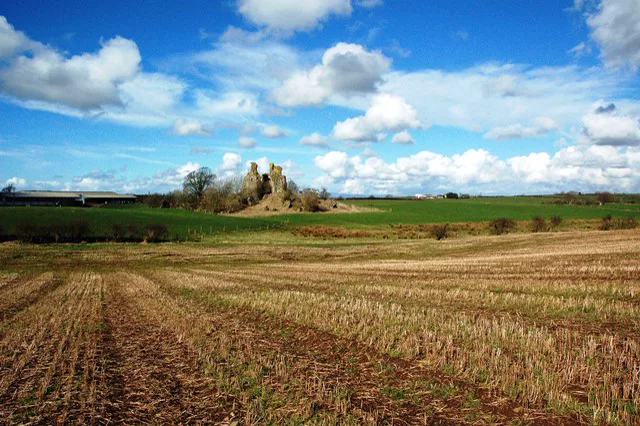
Photo: Mary and Angus Hogg, CC BY-SA 2.0
An association between a tartan and a clan is a claim with its own sources. It does not mean every bearer of the clan name has a right to the tartan, or the reverse.