Style
Tartan skirts: cuts, lengths and how a skirt differs from a kilt
Cut and length names for tartan and plaid skirts, what separates a skirt from a kilt, and why the size of the pattern repeat changes how a skirt looks and is cut.
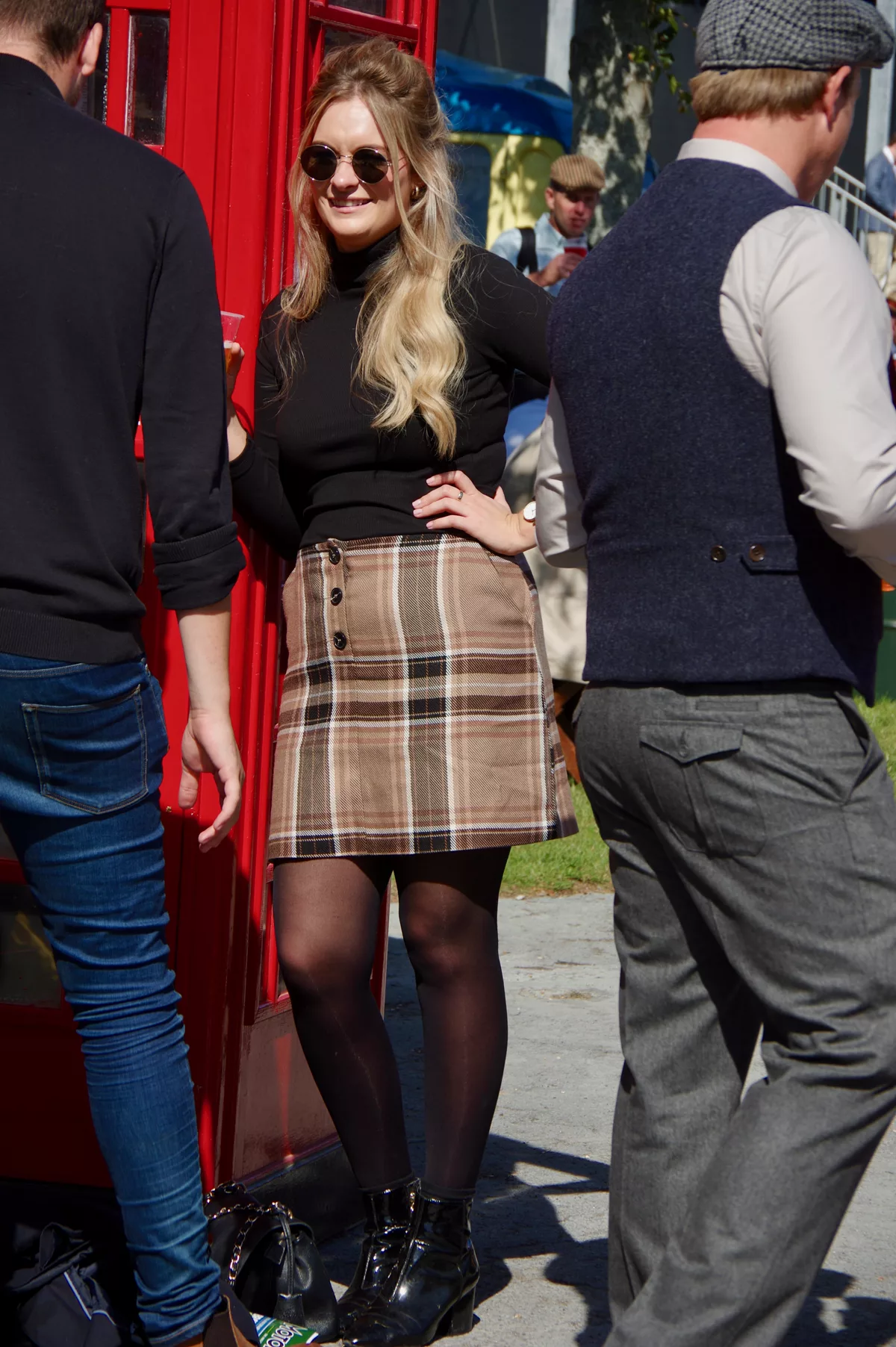
.jpg)
A tartan skirt is any skirt cut from tartan cloth, or from a plaid that imitates it. The cut decides its name (pleated, wrap, A-line, skort) and the hem decides its length (mini, knee, midi, maxi). A kilt is a narrower category with its own construction, covered below. Where the skirt is a kilt-style design, the next page to read is women’s kilts.
Cut vocabulary
The names below come from a general garment reference (Wikipedia: Skirt), with the pinafore from its own entry (Wikipedia: Pinafore dress).
| Cut | What the name describes | Note for tartan |
|---|---|---|
| Pleated | Regular pleats or folds, stitched flat to hip level or hanging free. | Pleating is what makes a kilt-style skirt; see below. |
| A-line | Fitted at the hips and widening gradually to the hem. | No tartan-specific note in the sources. |
| Wrap | Wraps round the waist with an overlap of cloth. | Shares the wrap idea with a kilt, without the kilt's pleated back. |
| Skort | A skirt with shorts built in underneath. | No tartan-specific note in the sources. |
| Pinafore dress | A sleeveless dress worn over a top or blouse. | A dress, not a skirt, though often grouped with them in shops. |
Length vocabulary
| Length | Where the hem falls |
|---|---|
| Mini | Well above the knee, around mid-thigh, normally no more than 10 cm (4 in) below the buttocks. |
| Knee-length | Approximately at the knee. |
| Midi | Halfway between ankle and knee, below the widest part of the calf. |
| Maxi | Ankle length. |
The hem heights above come from one reference entry, and the mini is the only one given with a measurement. The same entry traces the mini to the 1960s: hems sat just above the knee in 1961, both Mary Quant and André Courrèges showed above-the-knee lengths in 1964, and by 1966 many designs had the hem at the upper thigh (Wikipedia: Miniskirt). It also notes that Courrèges claimed to have invented the mini, while the fashion historian Valerie Steele finds the case for Quant better supported. The length names are therefore shop and fashion vocabulary, not fixed units: “knee-length” and “midi” describe a position on the leg, so the same skirt sits at a different place on a shorter or taller wearer.
Clan Buchanan Society International uses its own names for kilted skirts: knee-length, tea-length (halfway between knee and ankle) and hostess-length, nearly floor length (Clan Buchanan Society). Tea-length corresponds roughly to a midi; the sources do not say whether the two terms are interchangeable. The society’s guide attaches an occasion to each: knee and tea lengths can be worn at any time, and the hostess skirt is usually worn only at formal functions. That is one society’s advice for its own members, not a rule that applies to every clan or event, and it is worth checking with the organisers of a particular gathering.
Pleats and how much cloth a skirt uses
Pleating decides both how a skirt hangs and how much tartan it takes. The general reference entry on pleats defines a knife pleat as one turned to one side, and a box pleat as two knife pleats back to back, which tends to spring outward from the waist. For knife pleats it gives a 3:1 ratio: three inches of fabric make one inch of finished pleating (Wikipedia: Pleat). The same entry says modern kilts may use either box or knife pleats, and may be pleated to the stripe or to the sett.
A worked example shows what that ratio means. If a pleated section is to finish at 12 inches wide, it needs 36 inches of cloth at 3:1. A skirt that is pleated all round to a 36-inch hip therefore needs about 108 inches of cloth across the width before any allowance for overlap or hem. That is an illustration of the ratio, not a measurement guide: makers vary the pleat depth and how much of the circumference is pleated, and no source read for this page gives a standard figure for a women’s skirt.
For comparison, the same kilt entry gives about 6 to 8 yards of single-width cloth (roughly 26 to 30 inches wide), or about 3 to 4 yards of double-width, for a modern adult kilt (Wikipedia: Kilt). A skirt that is only gathered, wrapped or cut in an A-line uses far less, so the cloth requirement of a kilted skirt and a plain tartan skirt will differ. The sources do not quantify that difference for women’s skirts.
Pleating to the sett and to the stripe give different skirts from the same cloth. The kilt entry describes pleating to the sett as running the pattern repeat around the whole garment, which it says is typical for Highland dancing, and pleating to the stripe as the military style, with a vertical stripe down the centre of each pleat so that the pleated and unpleated parts show different patterns. Whether a particular women’s skirt is built either way is something to ask the maker; the sources do not say which is more common for skirts.
A tartan skirt in 1845
A tartan skirt is not a new idea. The Victoria and Albert Museum holds a dress of about 1845 made of printed silk satin in the Mackenzie tartan, trimmed with velvet ribbon and hand-sewn. Its skirt is flat-pleated with a panel of tight gathering at the back, over a fitted, boned bodice. The museum links the fashion for tartan in the 1840s to the popularity of Walter Scott’s Scottish novels and to Queen Victoria’s new royal residence at Balmoral (V&A: dress, about 1845). The dress is recorded as made in England, so it is an example of tartan as fashionable fabric rather than as Highland dress.
Two points follow. First, a pleated tartan skirt existing in the 1840s does not make it a kilt; the construction, the fastening and the idea of the garment were different. Second, the record says nothing about how the tartan was cut or matched across the seams, so it cannot show whether 1840s makers matched the check or simply cut it as they found it.
Choosing between the cuts
The sources do not rank the cuts, so the notes below are reasoning from the definitions above, not findings.
- Pleated or kilted: shows the most tartan and the most cloth; the pattern shows most when the repeat is large enough to read across a pleat.
- A-line: a smooth hip and a gradually widening hem means the check runs unbroken down each panel, so matching at the seams is the main issue.
- Wrap: the overlap puts a visible edge at the front, so the check at the edge needs to meet the check beneath.
- Skort: the shorts underneath do not change how the tartan is cut, but a pleated skort has the same pattern-matching questions as a pleated skirt.
- Pinafore dress: a sleeveless dress worn over a blouse or top, according to one reference entry, which also says that in 19th-century England pinafores were considered suitable for young girls and that women were expected to wear aprons instead (Wikipedia: Pinafore dress). That history is of the plain garment; it says nothing about tartan versions, and the sources read do not date the tartan pinafore.
“Plaid” is also a regional label. The reference entry on tartan notes that in North America “plaid” is commonly used to mean tartan (Wikipedia: Tartan), so a search for a “plaid skirt” will return both registered tartans and generic checks. A shop listing that says “plaid” does not tell you whether the cloth is a named tartan.
How a skirt differs from a kilt
A kilt, as Wikipedia describes it, is a knee-length wrap-around garment of twill-woven worsted wool with heavy pleats, worn at the natural waist and closed with straps and buckles. The front is two flat overlapping aprons and the sides and back are pleated. Its length is given as no lower than halfway across the kneecap and no higher than about an inch above it (Wikipedia: Kilt).
A skirt has none of those requirements. It can be any length, any cut and any fabric. Several points separate the two:
- Pleat treatment. A kilt is pleated either to the sett, showing the whole pattern at the back, or to the stripe, showing one dominant stripe (the military manner).
- Closure. A kilted skirt for women closes to the left, according to Clan Buchanan Society International, and its guide says the fabric is lighter than a man’s kilt cloth. The same guide says a man’s kilt apron closes to the right.
- Length. A kilt has a fixed length rule; a skirt does not.
Pattern scale and matching
The size of the repeat matters because it sets how many times the check appears across the width of the skirt and where it has to meet at the seams. The diagram uses a generic check at three sizes on the same outline. It is not a named tartan and the sizes are relative.
Practical sewing guidance from a fabric retailer points the same way. It recommends a simpler or subtler plaid for beginners, because matching a repeating pattern is difficult, advises lining up the plaid grids at the seams so the pattern looks continuous, and says to buy extra fabric if the pattern is to be aligned (Mood Fabrics). Its worked example is a pattern calling for 1.25 yards in one size, with the author advising 1.5 yards when matching: an extra quarter yard, or 20 per cent more cloth than the pattern states. That is one blogger’s allowance for one simple plaid and one pattern, and a large tartan repeat may need more; it is a floor for planning, not a standard. The same post advises lining up the plaid grids at the seam allowance, not at the cut edge, so that the check continues across the stitched line, and suggests a walking foot to stop the cloth shifting.
Large repeats are harder to match across several panels and pleats; small repeats are more forgiving. That is a reading of the geometry, not a rule from the sources, which only describe matching in general terms.
A named tartan also has a fixed thread count, and scale can change. The reference entry on tartan notes that a thread count can be modified for a desired size, giving the example of a kilt sett reduced to about three inches a side for neckties. A fabric sold as a given tartan can therefore come in more than one scale, and a skirt in the same tartan can look quite different from a kilt in it. Check the stated repeat size with the seller before buying if the match to a clan or district kilt matters.
For cloth weights and how tartan fabric is described, see tartan fabric.